

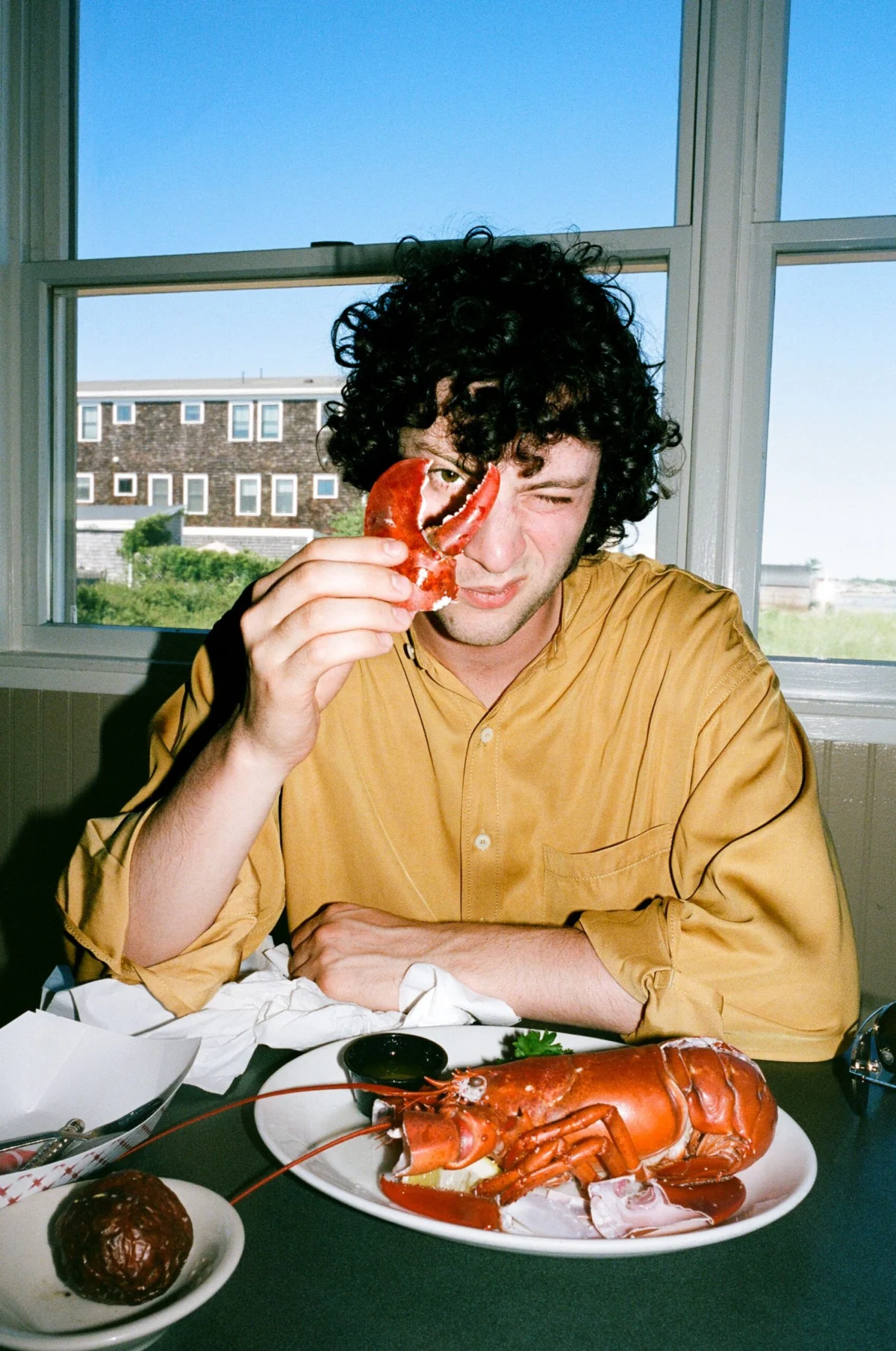
In the new film Tony, Dominic Sessa undertakes the challenging role of portraying a teenage Anthony Bourdain, deliberately crafted to appear out of his depth. The narrative introduces Sessa’s young Tony as a Vassar College freshman, exhibiting a pronounced swagger, a penchant for dramatic pronouncements about his professors’ perceived intellectual shortcomings, and a sword somewhat incongruously tucked into his jeans. His academic journey quickly falters, leading to his eventual failure in those very classes he so arrogantly dismissed. The scene shifts dramatically to the humbling environment of a Provincetown seafood restaurant’s dish station, where Tony’s series of blunders and humiliating mistakes starkly reveal his profound inexperience in any domain sharper than his own sharp wit. This deliberate portrayal of initial ineptitude stands in stark contrast to the actor embodying the role, Dominic Sessa, who possesses a surprising depth of real-world culinary experience that significantly informs his performance.
Dominic Sessa’s Culinary Foundations: A Precocious Start in the Kitchen
Long before stepping onto a film set, Sessa was intimately familiar with the demanding rhythm of a professional kitchen. His culinary education began at the tender age of 13, working summers at Cathy’s 14th Street Bakery in Ocean City, New Jersey. This early immersion provided him with practical skills that most actors portraying chefs would require extensive training to acquire. "I started out at 13, washing dishes," Sessa recounts, detailing his progression under the mentorship of bakery owner Cathy Greene. "Cathy taught me how to mix the doughnut dough, how to cut the doughnuts, fry them and ice them, and eventually how to make croissants." Greene herself corroborates Sessa’s dedication and aptitude, describing him as "a very quick learner and hard worker." Her trust in his capabilities was such that she would entrust him with the responsibility of opening the bakery alone at 4:30 a.m. to prepare for the relentless morning rush, a testament to his reliability and burgeoning skill set.
This foundational experience was not without its trials, offering Sessa a firsthand lesson in accountability—a theme strikingly resonant with the character he now portrays. He vividly recalls a particular incident involving a batch of dough: "One time I put the wrong dough mix in the bowl," Sessa admits with a self-conscious laugh. "There was too much yeast in it. I turned around and it had become this massive dough monster, spilling out of the machine." In a desperate attempt to conceal his error before Greene’s arrival, he hastily transferred the expanding mass into outdoor trash cans. The deception was short-lived; the hyperactive dough, expanding fivefold, erupted from the cans, forcing Sessa to confess. Greene’s response was a pivotal lesson: "She said, ‘I would have been much less disappointed if you’d just told me, and we could have fixed the problem. Now my trash cans are destroyed.’ Cathy taught me that it was okay to make mistakes, as long as I didn’t lie about it." This anecdote provides a poignant parallel to the film’s central theme, illustrating the value of honesty and integrity—lessons young Tony Bourdain himself grapples with.
"Tony": A Biopic of Self-Discovery and the Price of Deception
The film Tony, described as a biopic nested within a sweet summer coming-of-age narrative, prominently features young Bourdain’s complex relationship with honesty. It is no narrative spoiler to reveal that this struggle forms the foundational "through line" of the movie. Anthony Bourdain, in his seminal memoir-in-essays Kitchen Confidential, famously described his younger self as "a spoiled, miserable, narcissistic, self-destructive, and thoughtless young lout, badly in need of a good ass-kicking." This candid self-assessment provides the emotional blueprint for the film’s portrayal, where his character’s inability to confront the truth leads to both literal and figurative setbacks. He fabricates stories to his family, his employer, and his burgeoning love interest, obfuscating his true skills and motivations. Through a series of cinematic misfortunes and realizations, the narrative arc guides him towards the understanding that only radical honesty can pave the way for him to become the person he is destined to be.
Kitchen Confidential: Adventures in the Culinary Underbelly, published in 2000, catapulted Bourdain from a respected but largely anonymous New York chef into a global literary and television icon. The book, initially conceived as an exposé for The New Yorker, offered an unvarnished, often gritty, and darkly humorous look into the high-pressure world of professional kitchens. Its candid portrayal of culinary life, replete with vivid characters, backstage antics, and a profound respect for the craft, resonated deeply with both industry insiders and the general public, selling millions of copies and fundamentally altering perceptions of chefs and restaurants. This literary success led directly to Bourdain’s storied television career, beginning with A Cook’s Tour, followed by the Emmy-winning No Reservations, and culminating in the critically acclaimed Parts Unknown, solidifying his status as a beloved literary and travel television personality.
Parallels in Unconventional Paths: Sessa and Bourdain’s Circuitous Journeys
Beyond their undeniable physical resemblance, Dominic Sessa and Anthony Bourdain share striking similarities in their circuitous paths to prominence. Bourdain’s journey began with an unceremonious exit from college, which ultimately led him to the Culinary Institute of America (CIA) after his transformative summer in Provincetown. The CIA, established in 1946, is widely regarded as one of the world’s premier culinary schools, and Bourdain’s enrollment there marked a pivotal turn from youthful rebellion to professional dedication. His later literary success with Kitchen Confidential was initially expected to entertain only a small circle of chef friends, yet it unexpectedly launched him into a global career that profoundly influenced food culture and travel journalism.
Similarly, Dominic Sessa’s early aspirations were far removed from acting. As a teenager, he envisioned a future as a hockey player, earning a scholarship to the prestigious Deerfield Academy, a highly selective co-educational boarding school in Massachusetts known for its rigorous academics and strong athletic programs. His athletic dreams were abruptly curtailed by a severe preseason skateboarding accident, resulting in a snapped femur. This unforeseen setback forced a pivot, leading him to the school’s theater department. There, he reluctantly took on the demanding lead role of the power-mad King Creon in a production of Sophocles’ ancient Greek tragedy, Antigone.
"I almost didn’t do it, because I didn’t want a big role," Sessa recalls, expressing his initial apprehension. "I was so nervous. I distinctly remember I was not the best hockey player. I was always jealous of the kids who scored goals every game. It makes you really fucking cool." The transformative power of performance, however, offered a different kind of validation. "When I did Antigone, people came up to me after, telling me I was doing something that they wanted to do but didn’t have the courage. That was power. It changed my life." This unexpected turn, from athletic ambition to the spotlight of the stage, mirrors Bourdain’s own unforeseen shift from academic disinterest to culinary mastery, both journeys defined by unforeseen detours that ultimately led to their true callings.
From Deerfield to Hollywood: Sessa’s Breakout Role in The Holdovers

Sessa’s nascent acting career swiftly gained momentum. Just a few years after his Antigone breakthrough, a casting agent introduced him to acclaimed director Alexander Payne. Payne, known for his character-driven dramas like Sideways and Nebraska, ultimately selected Sessa for the pivotal lead role opposite veteran actor Paul Giamatti in the 2023 critically acclaimed film The Holdovers. The film, a poignant dramedy set in a New England boarding school during the Christmas holidays of 1970, garnered widespread critical praise, earning five Academy Award nominations, including Best Picture, Best Actor for Giamatti, and a win for Best Original Screenplay. Sessa’s portrayal of Angus Tully, a troubled but intelligent student left behind during the holidays, was lauded by critics as a remarkable debut performance, showcasing a natural talent and emotional depth that belied his inexperience. His sudden emergence into the cinematic spotlight, much like Bourdain’s literary explosion, was an unexpected and rapid ascent.
Director Matt Johnson, whose previous works include the satirical comedy Nirvanna the Band the Show the Movie (2025) and the biographical drama BlackBerry (2023), recognized the potent parallels between Sessa’s life and the young Bourdain’s narrative while collaborating with screenwriters Todd Bartels and Lou Howe to develop Tony. Johnson explains, "Dom being from New Jersey, his relationship to education, his relationship to a kind of newfound fame that had just discovered him—it ambushed him." This intrinsic resonance made Sessa an ideal choice to embody the iconic figure. "The persona that I’m interested in showing is a young man trying desperately to seem like an adult," Johnson elaborates. "Dom is the reason I made the movie."
Immersion in the Culinary World: Preparing for the Role
To authentically portray Bourdain’s early culinary misadventures and subsequent growth, Sessa undertook extensive preparation for the role, which involved shooting on Cape Cod in the summer of 2025. Despite his early bakery experience, the pace and demands of a restaurant kitchen are distinct. While Sessa, like many young New Yorkers with busy schedules, admits to rarely cooking for himself—even discovering his apartment oven was functional only when a friend baked cookies in it—he is an avid explorer of downtown Manhattan’s diverse culinary landscape, frequenting establishments such as 7th Street Burger, Cafe Mogador (known for its Moroccan cuisine), Miss Lily’s 7A (offering Jamaican fare), and Ayat (specializing in Palestinian dishes).
For Tony, Sessa deepened his practical understanding of restaurant operations by spending time in the kitchen of Gertrude’s, a bistro in Prospect Park, Brooklyn. Under the tutelage of chef-partner Eli Sussman, Sessa learned essential skills like oyster shucking and, critically, absorbed the rapid, efficient movements required of a cook during a bustling service. "At a bakery, you make everything and then you put them out. The pace is a lot different in a restaurant," Sessa observes, highlighting the distinction. "Eli introduced me to restaurant owners in New York. I hung out with them so I could understand that world. You really have to love it and have a passion for it." This hands-on immersion allowed Sessa to not just replicate actions, but to understand the underlying ethos and physical demands that shaped Bourdain’s early professional identity.
Provincetown’s Enduring Charm: A Setting of Transformation
The setting of Provincetown, Massachusetts, holds particular significance in the Bourdain legend, serving as the crucible where his culinary journey truly began. The film captures this formative summer, and Sessa himself developed a deep affection for the historic Cape Cod town during production. "When I’m in my 80s, I want to have an old beach house there," he muses, reflecting on its unique atmosphere. "It’s really magical and so well-preserved, it’s kind of insane the place still exists. You can imagine that it’s still 1975 when you’re there." Provincetown, a vibrant artists’ colony and popular LGBTQ+ destination, has long been a haven for unconventional spirits and a place where individuals can redefine themselves, making it an apt backdrop for young Bourdain’s awakening.
Deconstructing Bourdain: The Dichotomy of Chaos and Control
Although Tony concludes as Bourdain is on the cusp of embarking on his formal culinary education at the CIA, Sessa’s extensive preparation and deep dive into the realities of the restaurant business profoundly informed his understanding of the complex figure he portrays. He emphasizes a crucial aspect of Bourdain’s character that is often overshadowed by his later persona: his formidable professionalism. "I think what a lot of people forget, or lose sight of, is the fact that Tony was a calculated professional," Sessa asserts. "You want to see him as this rebellious, drinking, smoking, globe-trotting kind of guy, but at the end of the day, he ran restaurant kitchens very effectively, which is a really difficult thing to do."
This insight highlights the fundamental dichotomy that defined Bourdain’s life and career: the tension between his outwardly rebellious, adventurous spirit and the rigorous discipline required to excel as a chef and manage high-pressure kitchens. "There are two sides: he’s this cool guy, but he’s also a very professional, capable person," Sessa explains. "That’s the dichotomy of his life. It’s both chaos and control." This nuanced understanding is critical to avoiding a one-dimensional portrayal of Bourdain, ensuring that Tony delves into the formative experiences that forged both the iconoclastic personality and the meticulous professional.
Legacy and Anticipation: The Enduring Allure of Anthony Bourdain
The release of Tony is highly anticipated, offering audiences a fresh perspective on the early life of a cultural titan whose influence continues to resonate years after his passing in 2018. Anthony Bourdain transcended the role of a chef; he was a storyteller, a traveler, a truth-teller, and a relentless advocate for the culinary arts and global understanding. His legacy is complex, marked by both profound insight and personal struggles, making any portrayal of his life a significant undertaking.
Dominic Sessa, with his blend of real-world kitchen experience, a meteoric rise in acting, and a thoughtful approach to character, appears uniquely positioned to bring this formative chapter of Bourdain’s life to the screen. The film promises to explore not just the culinary awakening but the deeper human struggles of honesty, self-discovery, and the search for identity that underpinned Bourdain’s eventual transformation from a "young lout" to a beloved and influential figure. By focusing on these early, foundational experiences, Tony aims to illuminate the roots of the icon, offering audiences a poignant and insightful look into the making of an extraordinary individual whose impact on food, travel, and culture remains indelible.
