

In the landscape of contemporary bar culture, the Purl is recognized primarily as a straightforward combination of ale and a measure of gin, a drink often categorized alongside historical curiosities like the Dog’s Nose or the Boilermaker. Modern enthusiasts typically define the beverage as a pint of British Bitter, served at cellar temperature, fortified with a shot of Old Tom gin. However, a comprehensive examination of historical archives, ranging from 17th-century medical manuals to 20th-century cocktail digests, reveals that the Purl was once a significantly more complex and varied preparation. The transformation of the Purl from a bitter medicinal tonic into a sophisticated "flip" style cocktail, and finally into its current minimalist form, reflects broader shifts in British social history, public health, and distillation trends.
The 17th Century: Purl as a Medicinal Necessity
The earliest recorded iterations of the Purl bear little resemblance to the gin-based beverage found in modern cocktail guides. During the mid-17th century, the term "Purl" referred to a mixture of ale or wine infused with wormwood (Artemisia absinthium). This preparation was primarily valued for its purported health benefits rather than its recreational potential. Wormwood, known for its extreme bitterness, was a staple of the early modern pharmacopeia, utilized to stimulate digestion, expel parasites, and fortify the constitution against infectious diseases.
A pivotal reference to this medicinal use appears in the 1665 publication, Directions for the Prevention and Cure of the Plague Fitted for the Poorer Sort. Released during the height of the Great Plague of London, the manual provided dietary and lifestyle advice for those unable to afford expensive physicians. On its opening pages, the text recommends a "draught or two of Purle," specifically suggesting its consumption in the morning. The inclusion of the Purl in a guide for the "poorer sort" indicates that the drink was both inexpensive and widely accessible. At this stage, the beverage was essentially a form of herbal beer, where the bitterness of the wormwood acted as a preservative and a tonic.
The versatility of the Purl during this era extended beyond ale. In 1684, the publication Aphorisms upon the New Way of Improving Cyder argued that the cider industry could benefit from similar infusions, asserting that a "purl with cider" was as effective and palatable as the traditional ale-based version. By 1690, An English Herbal further solidified the drink’s status in botanical medicine, detailing the specific benefits of wormwood when consumed in a Purl to treat various ailments of the stomach and liver.
The 18th Century: Social Stigma and the Rise of the Purl-Shop
As the 18th century progressed, the Purl transitioned from the domestic medicine cabinet to the public sphere of the London "Purl-shop." This period coincided with the infamous "Gin Craze," a time of significant social upheaval characterized by the mass consumption of cheap, often hazardous spirits. During this era, the Purl began to evolve into a recreational beverage, and it was here that the addition of spirits—initially as a fortifying agent—became common.

The shift in consumption patterns brought about a corresponding change in public perception. No longer viewed strictly as a plague preventative, the Purl began to be associated with vice and morning inebriation. A 1733 entry in The Grub Street Journal illustrates this cultural shift, presenting a character attack on individuals who frequented Purl-shops. The journal linked the consumption of "Pots of Purle" with excessive smoking and gin drinking, suggesting that the habit of taking a "morning constitutional" of bitter ale had devolved into a form of functional alcoholism among the urban working class.
Despite the social stigma, the Purl remained a staple of London life. The bitterness of the wormwood remained a defining characteristic, but the base liquid was increasingly supplemented with whatever spirits were available, laying the groundwork for the gin-centric recipes that would follow in the subsequent century.

The 19th Century: The Golden Age of the Purl Flip
By the Victorian era, the Purl had reached its peak of complexity. It was during this time that the drink was adopted into the burgeoning world of professional mixology. No longer a simple infusion, the 19th-century Purl was often prepared as a "flip"—a category of drinks involving spirits, sugar, spices, and frequently, eggs, all integrated into a base of warmed ale.
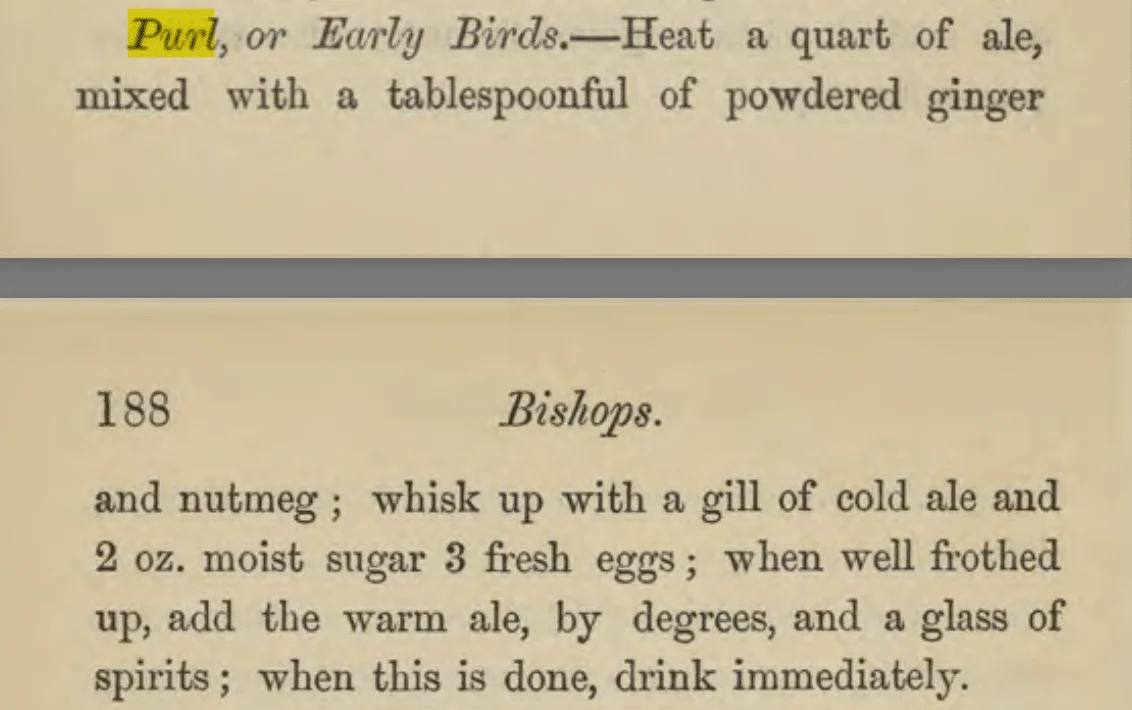
William Terrington’s 1869 volume, Cooling Cups and Dainty Drinks, widely regarded as the first British cocktail book, provides a detailed look at this evolution. Terrington’s recipes for the Purl describe a drink that was served hot. These preparations involved heating the ale and whisking in multiple eggs and sugar to create a rich, frothy texture. Interestingly, Terrington did not mandate the use of gin; while a "glass of spirits" was required, it could just as easily have been brandy or whisky, depending on the preference of the patron or the stock of the bar.

However, Terrington also documented the "Ale Cup," a dedicated gin and ale preparation that more closely aligns with the modern definition of the Purl. This suggests that while the complex, egg-laden versions were popular, a simpler spirit-and-beer combination was also beginning to crystallize as a distinct category. The use of "Old Tom" gin—a sweeter, more botanical style of gin prevalent in the 1800s—was essential to balance the heavy, malty notes of the British Bitters used at the time.
The 20th Century: Simplification and Standardization
The 20th century saw a dramatic streamlining of the Purl. Several factors contributed to this simplification, including the decline of the "flip" style of service, which was labor-intensive and required specialized equipment to heat the ale without curdling the eggs. Additionally, the medical use of wormwood had largely fallen out of favor, leading to its removal from standard bar recipes.

In the 1925 publication Summer Drinks and Winter Cordials, the Purl is still presented as a warmed beverage, but the eggs have largely disappeared. The focus shifted to the interplay between the botanicals in the gin and the bitterness of the ale. By the mid-1930s, as seen in The Art of Mixing Drinks (1935), the Purl had converged on the definition we recognize today: gin, ale, and the occasional addition of bitters to mimic the missing wormwood.
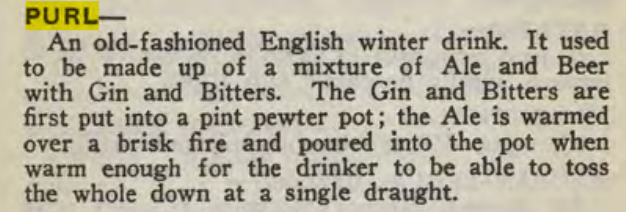
The final stage of the Purl’s evolution is captured in the 1966 edition of The Barman’s Bible (part of the Cocktail and Wine Digest). Here, the Purl is stripped of its medicinal and culinary flourishes, presented as a standard utilitarian drink. The historical requirement for the beverage to be served warm also began to fade, with many bars opting to serve the gin and ale at cellar temperature, reflecting the modern preference for colder beverages.

Technical Analysis: Ingredients and Flavor Profiles
To understand the Purl’s longevity, one must examine the chemical and sensory relationship between its primary components. The traditional choice of a British Bitter provides a backbone of toasted malt and earthy hops. Bitters are typically low in carbonation and served at temperatures between 10°C and 13°C (50°F to 55°F), which allows the complex flavors of the ale to remain prominent when mixed.
The role of gin in the Purl is twofold: it increases the alcohol by volume (ABV) and introduces a bouquet of botanicals. Old Tom gin, the historical standard, contains a higher concentration of licorice and sugar than modern London Dry gins, making it an ideal bridge between the herbal bitterness of the original wormwood infusions and the malty sweetness of the ale. When bitters are added to a modern Purl, they serve as a structural replacement for the absinthin compounds originally provided by the wormwood, restoring the "bite" that characterized the 17th-century versions.

Chronology of the Purl’s Evolution
- 1660s: Purl emerges as a medicinal infusion of wormwood and ale/wine, used as a plague preventative.
- 1680s-1690s: The drink is commercialized; variations using cider appear, and it is documented in herbals for digestive health.
- 1730s: "Purl-shops" become common in London; the drink becomes a recreational morning staple and gains a reputation for being a lower-class vice.
- 1860s: The Purl enters the first British cocktail manuals as a complex, heated "flip" containing ale, spirits (not exclusively gin), eggs, and sugar.
- 1920s-1930s: Recipes are simplified; eggs are removed, and gin becomes the canonical spirit paired with ale.
- 1960s-Present: The Purl is established as a simple two-ingredient drink (ale + gin), occasionally supplemented with bitters, served either warm or at cellar temperature.
Broader Impact and Modern Legacy
The history of the Purl serves as a microcosm of the evolution of British drinking habits. It represents the transition from "physical" drinking—where beverages were consumed for their perceived health benefits—to "social" drinking, where flavor and effect take precedence. The survival of the name "Purl" in the modern bartender’s lexicon is a testament to the drink’s deep roots in London’s urban fabric.
While the modern Purl is a shadow of its Victorian or Caroline-era ancestors, it remains a significant link to the past. The contemporary revival of interest in historical spirits, such as Old Tom gin and artisanal bitters, has led some craft cocktail bars to experiment with the 19th-century "flip" versions of the Purl, reintroducing eggs and heat to the preparation. This suggests that the Purl is not merely a static relic of the 18th century, but a living recipe that continues to adapt to the tastes and technologies of the era. Whether served as a bitter morning tonic for a plague-stricken Londoner or a fortifying pint for a modern enthusiast, the Purl remains one of the most enduring and historically significant combinations in the history of British temperance and intemperance alike.
