

The seventh episode of Food Network’s competitive culinary series Pitmasters saw the field of contestants narrowed to the final three teams, as the competition moved into its most demanding phase yet. In a high-stakes semifinal round that combined long-form traditional barbecue with rapid-fire "Flash Burn" challenges, the remaining pitmasters were tasked with preparing a whole hog, a feat widely considered the ultimate test of skill in the barbecue circuit. The episode concluded with the selection of the final two teams who will compete for the championship title, marking the end of a rigorous journey for some of the nation’s most prominent pitmasters.
The Technical Parameters of the Semifinal Round
The primary challenge, referred to in the competition as the "Big Burn," required the teams to cook a whole hog within a strict nine-hour window. Unlike previous rounds that focused on specific cuts such as brisket or ribs, the whole hog challenge demanded a comprehensive understanding of porcine anatomy. Judges Andrew Zimmern, Ernest Servantes, Big Moe Cason, and Jess Pryles informed the contestants that the evaluation would be based on five distinct sections of the animal: the belly, ham, loin, ribs, and shoulder.
This requirement introduced a significant level of difficulty, as each of these cuts possesses different fat contents and muscle densities, thereby requiring different thermal treatments to reach peak tenderness and flavor. The prize for the most successful hog was an $8,000 cash award and an automatic berth in the season finale.

The competing teams consisted of John and Connie, Esaul and Grecia, and the partnership of Christie Vanover (of Girls Can Grill) and Susie Bulloch (of Hey Grill Hey). Each team approached the challenge with a distinct philosophy, ranging from traditional regional styles to internationally inspired flavor profiles.
Strategic Variations in Whole Hog Preparation
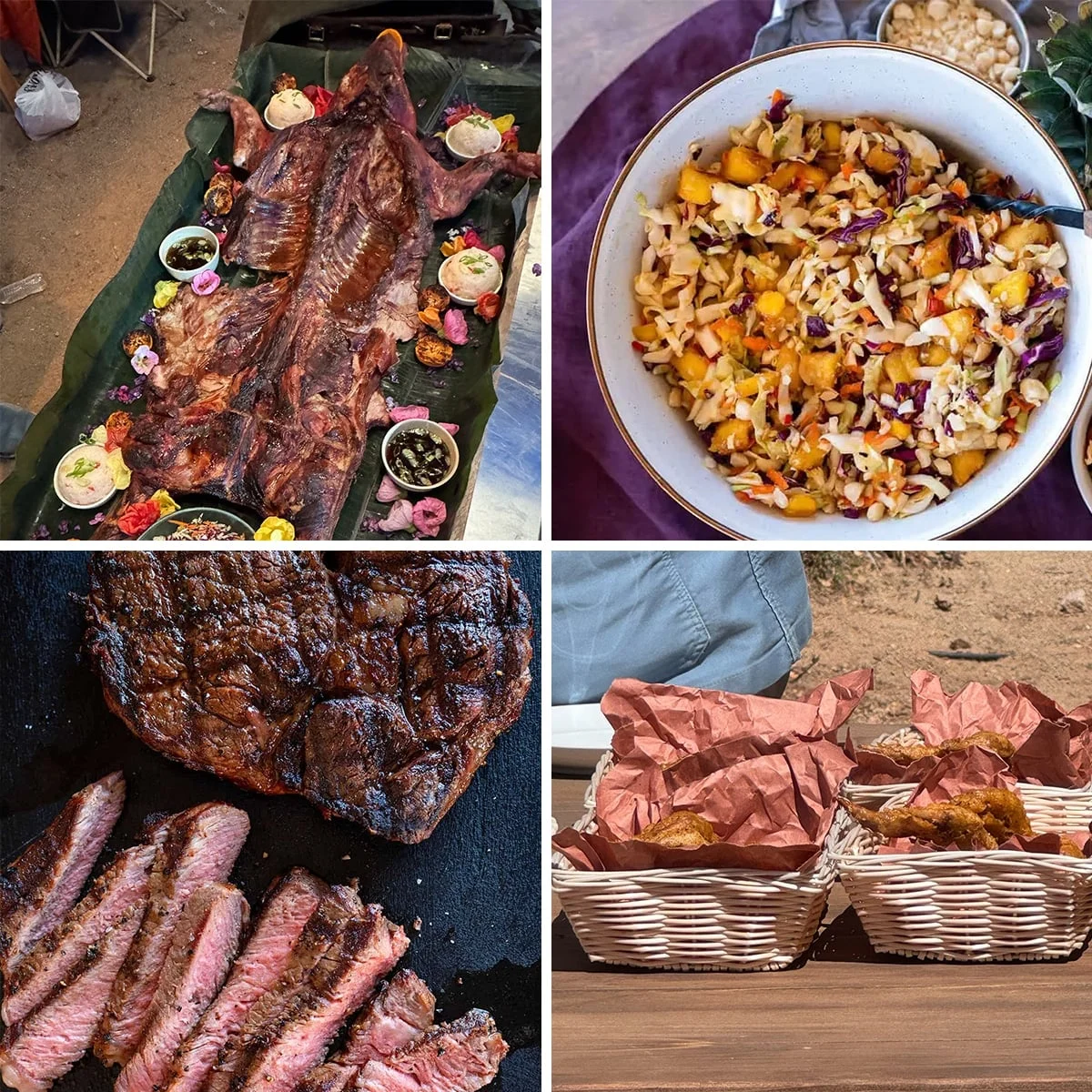
Vanover and Bulloch opted for a departure from traditional American barbecue flavor profiles, selecting a Filipino-inspired adobo preparation. This method utilizes a marinade composed of soy sauce, vinegar, salt, and sugar, providing a tangy and savory counterpoint to the rich, fatty nature of the pork. To complement the hog, the team prepared garlic rice, a soy-vinegar dipping sauce, and a grilled pineapple coleslaw.
A critical technical decision made by the Vanover-Bulloch team was the use of an asado cross for the cook. The asado cross is an Argentinian method involving an upright iron frame where the animal is butterflied and exposed to the direct heat of an open fire. Unlike a traditional offset smoker or a cinderblock pit, the asado cross offers no enclosure to trap heat or moisture. This method relies entirely on the pitmaster’s ability to manage coal placement and distance.
Judges expressed immediate concern regarding this choice, noting that the lack of insulation made the meat vulnerable to external environmental factors. As the nine-hour cook progressed, shifting weather conditions and dropping ambient temperatures began to affect the thermal consistency of the open-air setup. To mitigate heat loss in the final hours, the team was forced to transition the hog from the vertical cross to a horizontal position over a cinderblock base to ensure the thicker hams and shoulders reached the necessary internal temperatures.

The Flash Burn Interruption: Culinary Agility Under Pressure
Two hours into the nine-hour whole hog cook, the competition was interrupted by a surprise "Flash Burn" challenge, designed to test the contestants’ ability to multitask and execute short-order requests. The judges placed specific lunch orders that had to be completed within 90 minutes for a $2,000 prize.
The orders were distributed as follows:
- Ernest Servantes: Requested grilled chicken wings.
- Andrew Zimmern: Requested a meatball sub.
- Big Moe Cason: Requested a barbecue pork burger incorporating onion and garlic.
Through a selection process, John and Connie secured the meatball sub, while Esaul and Grecia took the pork burger. Vanover and Bulloch were left with the chicken wings. The latter team prepared full wings with a chipotle dry rub, smoking them over the live fire before finishing them in a deep fry of beef tallow to achieve a "shattering" crust.
The complexity increased when judge Jess Pryles introduced a second "Flash Burn" with 30 minutes remaining. Pryles requested a perfectly cooked ribeye steak, placing an additional $2,000 on the line. Vanover utilized a "Just Keep Flipping" (JKF) method over hickory chips and embers to develop a crust while maintaining a precise internal temperature of 125 degrees Fahrenheit.

Judging Analysis and Results of the Mid-Day Challenges
The judging of the "Flash Burn" segments highlighted the thin margins for error at this stage of the competition. In the steak challenge, Pryles noted that while the internal cook was accurate, the use of resting butter had slightly compromised the sear she expected from a high-heat charcoal cook.
In the lunch challenge, the chicken wings prepared by Vanover and Bulloch received mixed reviews. While Ernest Servantes praised the flavor and juiciness of the meat, he critiqued the decision to fry the wings, noting that his original request had specified a grilled preparation. Ultimately, Esaul and Grecia were awarded the $2,000 for the lunch challenge, while John and Connie claimed the $2,000 for the steak challenge.
The Final Evaluation of the Whole Hog
As the nine-hour window for the "Big Burn" closed, the teams presented their whole hogs to the panel. The judging focused on the textural consistency across the different cuts and the quality of the skin, which is often considered the "calling card" of a master whole-hog cook.
John and Connie’s presentation was deemed the most consistent, earning them the $8,000 prize and the first guaranteed spot in the finale. The remaining spot came down to a comparison between Esaul and Grecia’s entry and the adobo-style hog from Vanover and Bulloch.

The judges lauded the presentation of the adobo hog, noting that the cohesive nature of the sides—the garlic rice and pineapple slaw—created a complete culinary experience. The skin was singled out as a highlight of the round, with judge Ernest Servantes specifically admiring its texture and clarity. However, the technical risks of the asado cross became apparent in the final tasting; the judges found the shoulder to be slightly tough and the ham "tight," indicating that the meat had not fully broken down due to the temperature fluctuations experienced during the open-air cook.
Demographic Shifts and Cultural Impact in Competitive Barbecue
A significant takeaway from Episode 7 was the demographic makeup of the semifinalists. For the first time in the series’ history, the majority of the remaining competitors were women. This shift reflects a broader trend in the barbecue industry, which has historically been dominated by male figures.
The participation of Christie Vanover and Susie Bulloch, both of whom have built significant platforms focused on "approachable, backyard-style" barbecue, underscored the evolving nature of the sport. Their advancement to the final three demonstrated that techniques honed in domestic settings can compete effectively against professional circuit veterans. While they were ultimately eliminated in this round, their performance throughout the season has been cited by industry analysts as a milestone for female representation in live-fire cooking.
Conclusion and Outlook for the Finale
With the elimination of Vanover and Bulloch, the finale of Pitmasters is set to feature John and Connie against Esaul and Grecia. The departure of the "Girls Can Grill" and "Hey Grill Hey" partnership marks the end of a seven-episode run characterized by technical experimentation and a commitment to family-inspired menus.

The competition now moves toward its conclusion, with the final teams vying for a grand prize and the official title of Pitmaster. The season has highlighted the increasing complexity of barbecue as a televised sport, where success is determined not only by the quality of the smoke but by logistical management, culinary versatility, and the ability to adapt to unpredictable environmental variables.
The finale is scheduled to air next Monday at 9/8c on Food Network, with streaming availability on HBO Max and Discovery+. The conclusion of the season will serve as a definitive look at the current state of American barbecue excellence, pitting traditional methods against modern competitive strategies.
