

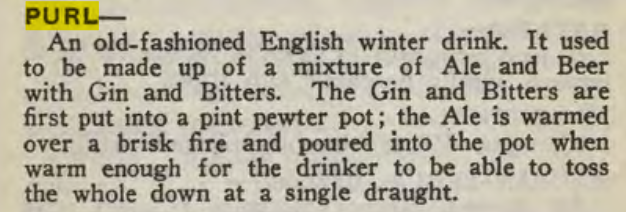
The modern landscape of British bar culture often categorizes the Purl as a straightforward, utilitarian combination: a pint of ale fortified with a single shot of gin. Historically linked to the 18th and 19th centuries, this contemporary iteration typically utilizes an Old Tom style gin—a sweeter, more botanical precursor to the London Dry—and a traditional British Bitter, often served at cellar temperature to maintain its structural integrity. However, a deep archival analysis of cocktail manuals and medical texts reveals that the Purl was once a significantly more complex beverage, undergoing a multi-century transformation from a bitter plague preventative to a decadent, spiced morning restorative, before finally settling into its simplified modern form.
The Medicinal Genesis: Wormwood and the Great Plague
The origins of the Purl are rooted not in recreation, but in the desperate search for survival during the volatile health crises of 17th-century London. In its earliest documented form, a "Purl" was not a gin-based drink, but rather a preparation of ale or wine infused with wormwood (Artemisia absinthium). During this era, wormwood was prized for its supposed antiseptic and digestive properties.
Historical records, such as the 1665 publication Directions for the Prevention and Cure of the Plague Fitted for the Poorer Sort, explicitly recommend the consumption of Purl as a primary health defense. The text advised the "poorer sort"—those who could not afford expensive apothecaries—to take "a draught or two of Purle… especially in the morning." This suggests that the drink was an accessible, low-cost prophylactic intended to bolster the immune system against the miasmas believed to carry the bubonic plague. At this stage, the "purl" referred specifically to the infusion of bitter herbs, creating a flavor profile that would be jarring to the modern palate, characterized by intense bitterness and the malty sweetness of unrefined ales.
By the late 1600s, the concept of the Purl began to expand. In 1684’s Aphorisms upon the New Way of Improving Cyder, the burgeoning cider industry attempted to claim a share of the medicinal market, asserting that "purl wide cider" was as effective as the ale-based variety. This indicates that the term "Purl" was initially a category of herbal infusion rather than a recipe tied to a specific base alcohol.
The 18th Century: From Pharmacy to Public House
As the threat of the plague receded, the Purl transitioned from a medicinal necessity to a recreational staple, albeit one that retained its reputation as a "morning constitutional." By the early 1700s, London saw the rise of dedicated "Purl-shops." It was during this period that spirits began to be introduced to the mixture, coinciding with the "Gin Craze" that gripped the British working class.

The transition was not without social friction. In a September 1733 edition of The Grub Street Journal, the consumption of Purl was cited in character attacks against the lower classes, where it was grouped with smoking and excessive gin drinking as a sign of moral decay. The drink had become a tool of the "early bird"—those who began their intoxication shortly after sunrise.
Botanical texts from the era, such as the 1690 volume An English Herbal, continued to praise the benefits of wormwood in Purl for its ability to "strengthen the stomach" and "create an appetite." This duality of the drink—part health tonic, part intoxicating vice—allowed it to persist in the British diet for decades. The bitterness of the wormwood helped mask the harshness of poorly distilled spirits, making it an ideal vehicle for the rudimentary gins and brandies of the time.

The Victorian Era and the Rise of the "Flip" Style
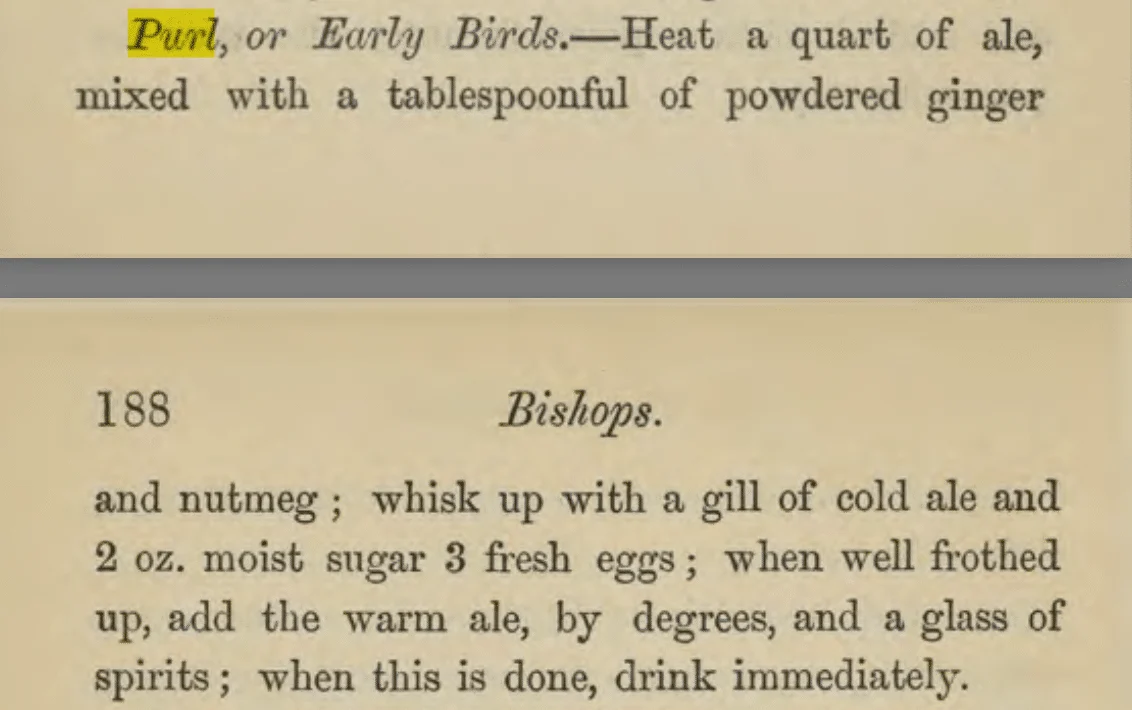
By the mid-19th century, the Purl reached its peak of complexity. It was no longer a simple infusion but had evolved into a sophisticated "flip"—a category of drink characterized by the addition of eggs, sugar, and spices, often served warm.
William Terrington’s 1869 manual, Cooling Cups and Dainty Drinks, widely regarded as the first definitive British cocktail book, provides a window into this elaborate preparation. Terrington’s recipes for Purl often called for warmed beer, multiple eggs, and a variety of spices like nutmeg and ginger. Crucially, gin was not yet the mandatory spirit. Depending on the patron’s preference or the barkeeper’s stock, the spirit component could just as easily be brandy or whisky.

Another recipe in Terrington’s manual, the Ale Cup, specifically calls for gin and ale, signaling the beginning of the convergence between the two ingredients. This period represented the Purl at its most culinary, requiring skill to "roll" the drink between vessels to create a frothy, emulsified head without curdling the eggs—a technique that added a creamy texture and significant caloric density, further cementing its role as a breakfast substitute for laborers.
The 20th Century: Simplification and the Standardization of Gin
The 20th century brought about a radical simplification of the Purl, driven by changes in labor laws, the industrialization of brewing, and evolving tastes. The labor-intensive "flip" elements—the eggs and the hand-spicing—began to disappear from standard bar manuals. Simultaneously, the use of wormwood vanished, likely due to the rising regulation of thujone-containing plants and the preference for cleaner, more consistent bitters.

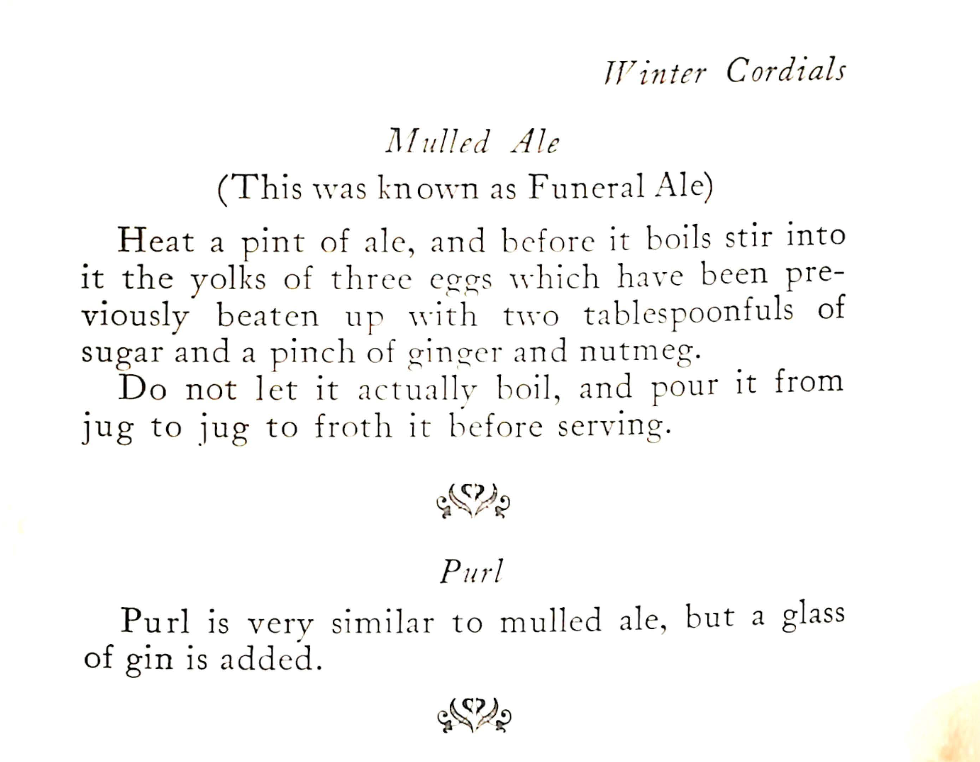
By 1925, as seen in Summer Drinks and Winter Cordials, the Purl had begun to stabilize into a mixture of ale, gin, and sugar, though the tradition of warming the ale persisted. The 1935 volume The Art of Mixing Drinks and the 1966 Barman’s Bible show the final stages of this evolution. The recipe was eventually reduced to its core components:
- The Spirit: Gin became the canonical choice, specifically the sweeter Old Tom style which complemented the malt of the beer.
- The Base: A strong British Ale or Bitter.
- The Modifier: A dash of bitters replaced the complex herbal infusions of the 17th century.
This streamlined version was easier to prepare in a high-volume commercial environment and aligned with the mid-century trend toward "shorter" and less caloric drinks. The medicinal origins were forgotten, replaced by a reputation for being a potent, "no-nonsense" fortification for the beer drinker.

Chronology of the Purl’s Evolution
- 1665: Documented as a plague remedy (Ale + Wormwood) for the "poorer sort."
- 1680s-1690s: Expansion into cider bases; recognized as a digestive tonic in herbal manuals.
- 1730s: Rise of Purl-shops in London; associated with early morning drinking and social vice.
- 1860s: Transformation into a "flip" style drink with eggs, spices, and variable spirits (Brandy/Gin/Whisky).
- 1920s: Removal of eggs and wormwood; gin becomes the primary spirit; warming of the ale remains common.
- 1960s-Present: Standardization as a simple "gin in a pint" combination, typically served at cellar temperature.
Technical Analysis of Ingredients
The shift from medicinal wormwood to gin is scientifically significant. Wormwood contains thujone, a compound that, in high doses, was believed to have psychoactive effects, though modern science suggests its impact in traditional infusions was minimal. The transition to gin—essentially a botanical spirit—allowed the drink to retain a "herbal" character while providing a more controlled and palatable alcohol content.
The choice of British Bitter as the modern base is also functional. The hop profile of a traditional bitter provides the necessary counterpoint to the botanicals in gin (juniper, coriander, angelica root). When served at cellar temperature (approximately 12-14°C), the ale’s carbonation is soft, allowing the gin’s aromatics to integrate rather than being overwhelmed by the sharp "fizz" found in modern lagers.

Broader Impact and Modern Legacy
The story of the Purl is a microcosm of the history of British social classes. It began as a desperate measure for the poor, ascended to a complex indulgence for the Victorian middle class, and eventually returned to a utilitarian staple of the modern pub.
In the contemporary "craft cocktail" revival, some bartenders are attempting to bridge these eras by reintroducing wormwood bitters or creating house-made "Purl syrups" that mimic the spiced, egg-thickened texture of the 1860s. However, for the majority of the drinking public, the Purl remains a hidden gem of the "Boilermaker" family—a testament to the enduring British tradition of fortifying one’s ale.
The drink’s survival over four centuries highlights a fundamental aspect of mixology: recipes are not static. They adapt to the economic, medical, and cultural realities of their time. Whether served as a bitter defense against the Great Plague or a modern winter warmer, the Purl remains one of the most resilient and historically significant preparations in the canon of British beverages.
