

The fourth episode of Food Network’s high-stakes culinary competition, Pitmasters, introduced a fundamental shift in the tournament’s structure, transitioning from a general field competition to a rigorous head-to-head format. This mid-season pivot intensified the pressure on the remaining six teams, as the results of this round directly influenced the cumulative scoring system that determines tournament longevity. Following their victory in the "Big Burn" of the previous episode, contestants Susie Bulloch, founder of Hey Grill Hey, and Christie Vanover, creator of Girls Can Grill, were granted a significant strategic advantage: the authority to dictate the competitive matchups and assign specific proteins to each bracket.
The strategic deployment of this advantage was central to the episode’s narrative. Bulloch and Vanover utilized their knowledge of the other teams’ strengths and weaknesses to curate a field they believed would maximize their chances of advancement. The teams were divided into three distinct brackets, each assigned a different animal to be prepared "nose-to-tail." The selections resulted in a goat-centric bracket, a lamb-centric bracket, and a pig-centric bracket. Bulloch and Vanover strategically placed themselves in the pig bracket, facing off against fellow competitors Matt and Max, a decision based on their extensive experience with pork-based recipes and traditional smoking techniques.

The Big Burn Challenge: Nose-to-Tail Requirements
The primary challenge of the episode, titled the "Big Burn," required teams to process a whole animal and produce two main dishes and two side dishes within a strict 10-hour window. A critical component of this challenge was the "nose-to-tail" philosophy, a culinary approach championed by lead judge Andrew Zimmern. This philosophy emphasizes the ethical and culinary importance of utilizing every part of the animal, from offal and fatty trimmings to lean muscles and connective tissue. While the teams were not strictly required to use every individual organ, the judging panel—comprised of Zimmern, legendary pitmaster Big Moe Cason, and champion barbecuer Ernest Servantes—evaluated teams based on the diversity of cuts used and the logic behind their inclusion.
Bulloch and Vanover opted for a cohesive, German-inspired menu, a choice that allowed them to demonstrate technical versatility while honoring familial culinary traditions. The decision to lean into German heritage was multifaceted; it provided a structured framework for the whole-animal challenge and allowed the team to utilize high-fat cuts, lean loins, and even bones for stock production.
Technical Execution of the German-Inspired Menu
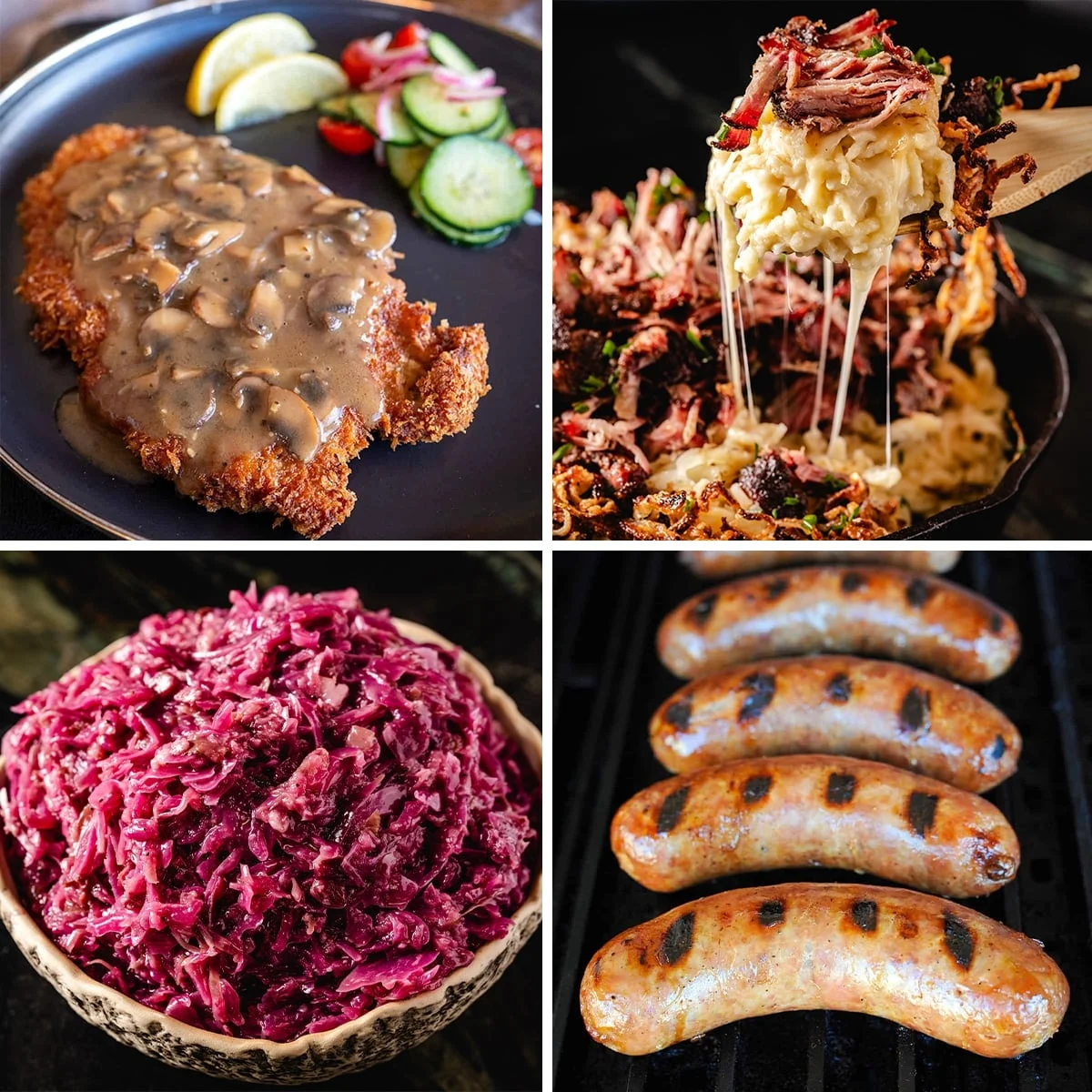
The centerpiece of the team’s presentation was a Smoked Sauerbraten. Traditionally a pot roast that requires days of marinating in a vinegar-based brine to tenderize tough cuts of beef, Bulloch and Vanover adapted the recipe for the 10-hour competition window using pork shoulder and shanks. The meat was seasoned with a specialized beef rub to add depth and then braised over an open fire. This braising stage served two purposes: it broke down the heavy connective tissue in the shanks and shoulder while simultaneously producing a rich, tangy aromatic profile that drew positive commentary from judge Ernest Servantes during the mid-cook inspection.

Complementing the Sauerbraten was a Pork Loin Jägerschnitzel, prepared by Vanover. This dish required precise temperature control to ensure the lean loin remained succulent while the breaded exterior achieved a golden-brown, crisp texture. In a move that highlighted the nose-to-tail requirement, Vanover constructed a mushroom gravy using a base of pork stock brewed on-site from the pig’s rib bones. This level of vertical integration—using the skeletal remains of the animal to enhance the flavor of a primary cut—aligned closely with the judges’ expectations for the challenge.
The side dishes were equally integrated into the whole-animal theme. The team prepared Rotkohl, a traditional German braised red cabbage. To satisfy the requirement that every dish feature the animal, Bulloch incorporated smoked and finely chopped pork belly into the cabbage, providing a fatty, smoky counterpoint to the acidity of the vinegar and the sweetness of the vegetable. The final component was Käsespätzle, a hand-made German egg noodle. Preparing pasta from scratch over a live fire is considered a high-risk maneuver in a competition setting due to the volatility of water temperatures and the physical labor involved. The Spätzle was topped with smoked pig cheeks, a prized "nose-to-tail" cut known for its high collagen content and intense flavor.
The Flash Burn: High-Speed Charcuterie
Interacting with the timeline of the Big Burn was the "Flash Burn," a secondary, high-velocity challenge designed to test technical precision under extreme time constraints. The teams were given exactly one hour to produce a perfectly cased and cooked sausage link using remaining portions of their assigned animal. Big Moe Cason, serving as the primary adjudicator for this segment, emphasized that shortcuts, such as forming patties or "naked" sausages, would result in immediate disqualification or significant point deductions.

Bulloch and Vanover produced a beer-braised pork bratwurst. The technical difficulty of this challenge lies in the grind and the emulsification of the fat; if the meat is ground too coarsely or the fat content is too low, the sausage becomes dry and crumbly. Conversely, if the fat is not properly integrated, the casing can burst during the cooking process. Their bratwurst featured caramelized onions and cabbage, topped with pickled mustard seeds—a garnish inspired by the culinary style of Michael Symon. The mustard seeds provided a "pop" of acidity, essential for cutting through the dense richness of a fresh pork sausage. The winner of this segment was awarded a $2,000 cash prize, adding a financial incentive to the already high-stakes round.
Judging Criteria and Cumulative Scoring Impact
The judging for Episode 4 was particularly rigorous due to the head-to-head format. Unlike previous rounds where teams were ranked in a general pool, the winners of each individual animal bracket were granted immediate safety, ensuring their progression to the next episode. For the teams that lost their head-to-head matchups, their survival in the competition was tied to the show’s cumulative scoring system.
Pitmasters utilizes a season-long leaderboard where points are accrued based on the technical execution, flavor profile, and creativity of every dish served. At the conclusion of Episode 4, the team with the lowest overall cumulative score across all four episodes was eliminated, regardless of whether they won or lost their specific head-to-head battle in this round. This system prevents a single "bad day" from necessarily ending a front-runner’s journey while ensuring that consistent mediocrity is eventually penalized.

During the deliberation, the judges focused on the "animal-forward" nature of the dishes. Andrew Zimmern specifically looked for evidence that the teams understood the anatomy of the pig, goat, or lamb they were assigned. The feedback provided to Bulloch and Vanover centered on the cohesion of their menu and the successful elevation of "humble" cuts like the cheeks and shanks.
Broader Implications for the Barbecue Industry
The performance of Susie Bulloch and Christie Vanover in this episode highlights a continuing trend in the professional barbecue circuit: the rise of female pitmasters in a traditionally male-dominated field. By leveraging digital platforms—Bulloch through Hey Grill Hey and Vanover through Girls Can Grill—both contestants have built significant influence prior to their appearance on Food Network. Their success on Pitmasters serves as a validation of "backyard" expertise being translated to a professional, competitive stage.
Furthermore, the emphasis on nose-to-tail cooking in a barbecue competition reflects a broader shift in the American culinary landscape toward sustainability and culinary adventurousness. Traditional American BBQ has long focused on a narrow set of cuts: the brisket, the ribs, and the butt. By forcing world-class pitmasters to contend with whole goats and pigs, the show is expanding the definition of "barbecue" to include braising, curing, and whole-animal roasting, techniques that are historically rooted in global fire-cooking traditions but are only recently gaining mainstream traction in the U.S. competition circuit.

Conclusion and Future Outlook
As the competition moves into its fifth episode, the remaining teams face a narrowing path to the championship. The results of the head-to-head matchups in Episode 4 have significantly altered the leaderboard, placing several teams in precarious positions. For Bulloch and Vanover, the episode was a demonstration of both strategic acumen in the bracket selection and technical proficiency in the execution of a complex, multi-course German menu.
The cumulative nature of the scoring means that every subsequent "Big Burn" and "Flash Burn" will carry more weight, as the margin for error disappears. Viewers can continue to follow the progress of these pitmasters as they navigate the remaining challenges, with the series continuing to air on Food Network and streaming on HBO Max and Discovery+. The next episode is expected to further test the limits of live-fire cooking, with rumors of even more challenging proteins and unconventional cooking environments on the horizon.
