

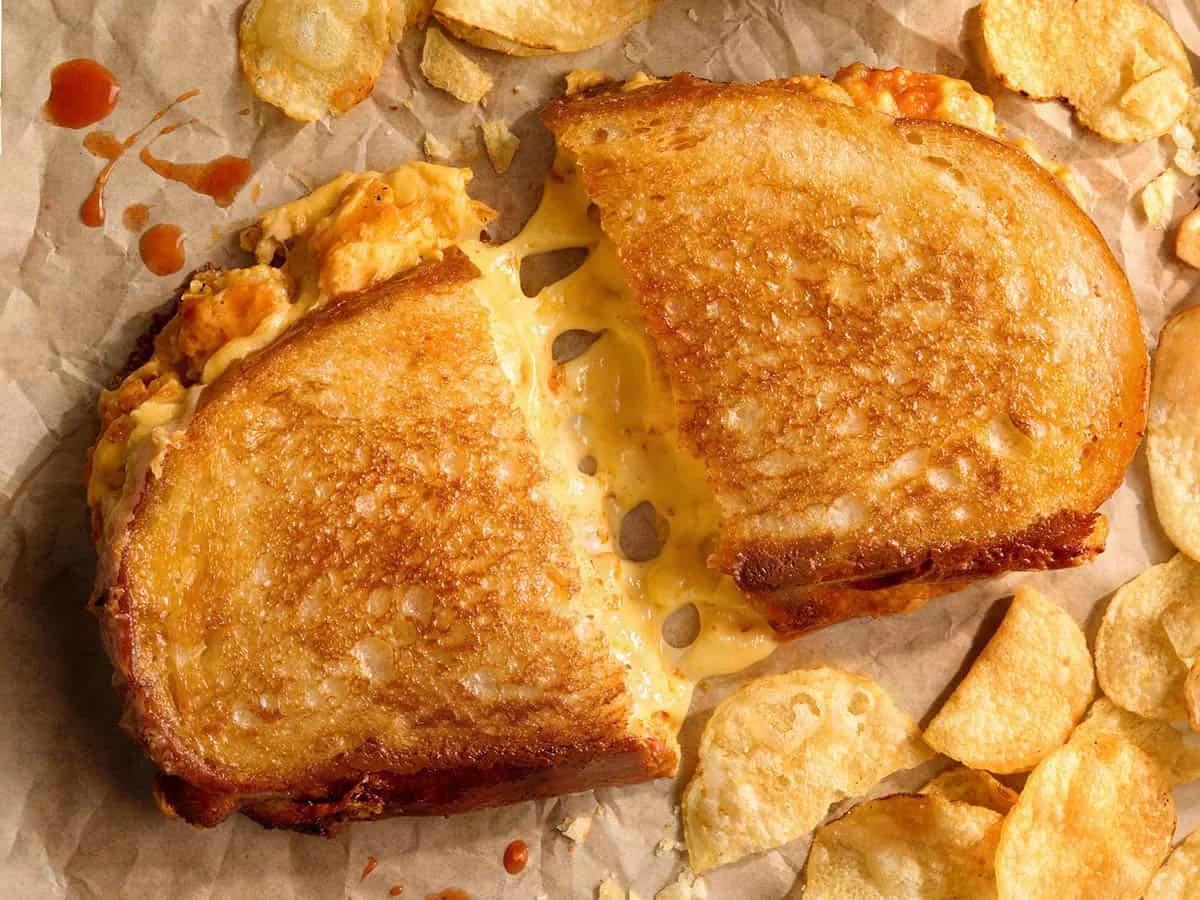
The Buffalo Chicken Grilled Cheese has emerged as a prominent example of modern American fusion cuisine, blending the spicy, vinegar-forward profile of traditional Buffalo wings with the structural comfort of a classic toasted sandwich. This culinary hybrid, meticulously refined within the Nashville Test Kitchen, represents a strategic response to rising food costs, prioritizing the utilization of leftover proteins and pantry staples to create a high-value meal for approximately $3.17 per serving. By elevating the standard grilled cheese through the inclusion of pulled rotisserie chicken and a customized cayenne-based sauce, culinary researchers have identified a formula that satisfies consumer demand for "Game Day" flavors without the associated costs of stadium or restaurant dining.

Structural Composition and Ingredient Selection
The integrity of a Buffalo Chicken Grilled Cheese relies heavily on the selection of its foundational components. According to technical specifications provided by the Nashville Test Kitchen, sourdough bread is the preferred medium due to its dense crumb and robust crust. The fermentation process of sourdough creates a structural lattice capable of containing high-moisture fillings, such as buffalo sauce and melted cheese, without succumbing to structural failure or "sogginess." For consumers seeking alternatives, Texas toast or other hearty, thick-cut loaves are recommended to maintain this necessary barrier.

The protein element typically consists of one cup (approximately 5.5 ounces) of cooked chicken. Data indicates that utilizing leftover rotisserie chicken is the most cost-effective and time-efficient method, although grilled or shredded crockpot chicken remains a viable substitute. The choice of American cheese—four slices per sandwich—is a deliberate economic and functional decision. While artisanal cheeses offer complex flavor profiles, American cheese possesses a superior melt rate and emulsification properties that align with the two-minute-per-side toasting window, ensuring a homogenous texture within the sandwich.

A critical divergence from traditional grilled cheese methodology is the application of mayonnaise on both the interior and exterior surfaces of the bread. From a chemical perspective, mayonnaise—an emulsion of oil, egg yolk, and acid—facilitates a more even Maillard reaction than butter. The high smoke point of the oil in mayonnaise allows for a deeper golden-brown finish, while the thin interior layer acts as a moisture barrier, protecting the sourdough from the acidity and hydration of the Buffalo sauce.

The Science of Buffalo Sauce Emulsification
The flavor profile of the sandwich is defined by a specific iteration of Buffalo sauce, a culinary staple originating from the Anchor Bar in Buffalo, New York, in 1964. The Nashville Test Kitchen’s formulation requires two tablespoons of melted salted butter, one-quarter cup of Frank’s RedHot Original sauce, one-half teaspoon of Worcestershire sauce, and one-quarter teaspoon of garlic powder.

The use of Frank’s RedHot is emphasized due to its high vinegar content and cayenne pepper base, which provides the characteristic "tang" essential to the dish. When whisked with melted butter, the fats encapsulate the capsaicin molecules, tempering the heat and creating a smooth, orange emulsion. The addition of Worcestershire sauce introduces umami depth, while garlic powder provides a savory baseline. This sauce is applied directly to warmed chicken to ensure the protein is thoroughly saturated before assembly, a technique designed to prevent "dry pockets" within the finished sandwich.

Chronology and Culinary Development
The development of the Buffalo Chicken Grilled Cheese follows a clear timeline of American comfort food evolution:

- 1920s-1930s: The rise of the "soda fountain" and the Great Depression popularized the open-faced toasted cheese sandwich as an affordable protein source.
- 1964: Teressa Bellissimo of the Anchor Bar creates the first Buffalo wing sauce, establishing the flavor profile of cayenne and butter.
- 1990s-2000s: The "gourmet" grilled cheese movement begins, with restaurants incorporating non-traditional fillings like bacon, avocado, and buffalo chicken.
- 2020-Present: Economic pressures and the "Budget Bytes" philosophy emphasize "fridge foraging"—the art of using leftovers like rotisserie chicken to create high-quality meals at home.
- 2026 (Current Context): The Nashville Test Kitchen formalizes the Buffalo Chicken Grilled Cheese recipe, prioritizing a cost-per-recipe under $5.00 to address ongoing consumer concerns regarding food inflation.
Economic Analysis of the $3.17 Price Point
In a market where the average fast-casual sandwich can exceed $12.00, the $3.17 price point of this recipe represents a significant saving for the average household. This cost-efficiency is achieved through several strategic maneuvers:

- Protein Optimization: Rotisserie chickens are often sold as "loss leaders" in grocery stores. By picking the carcass clean, consumers can extract enough meat for 3-4 sandwiches, reducing the per-serving protein cost to less than $1.00.
- Pantry Synergy: Ingredients like garlic powder, Worcestershire sauce, and mayonnaise are shelf-stable staples. When amortized over the life of the container, their contribution to the per-sandwich cost is negligible.
- Waste Reduction: The recipe is specifically designed to utilize the "last bits" of chicken and bread that might otherwise be discarded, aligning with global initiatives to reduce domestic food waste.
Nutritional Profile and Dietary Implications
A quantitative analysis of the Buffalo Chicken Grilled Cheese reveals a calorie-dense profile suitable for high-energy requirements, though it necessitates moderation within a standard diet. A single sandwich provides:

- Calories: 1027 kcal (51% of the recommended daily intake based on a 2,000-calorie diet).
- Protein: 67g (134% of the daily value), making it an exceptionally high-protein meal.
- Fat: 70g (108% of the daily value).
- Sodium: 4202mg (183% of the daily value).
The high sodium content is primarily attributed to the Buffalo sauce and American cheese. Health experts suggest that while the protein content is beneficial for muscle maintenance and satiety, the sandwich should be viewed as an occasional indulgence or "Game Day" specialty rather than a daily staple. To mitigate the caloric impact, researchers suggest splitting the sandwich between two individuals and supplementing the meal with low-calorie sides such as celery and carrot sticks, which mirror the traditional serving style of Buffalo wings.

Expert Insights and Official Methodology
Jess Rice, a former Chef Professor at Niagara College and a prominent figure in the Nashville culinary scene, spearheaded the testing of this recipe. With a background that spans international culinary theory and raw vegan innovation, Rice’s involvement underscores the technical rigor applied to even the simplest comfort foods.

"The goal is to provide a ‘win’ for both the palate and the wallet," Rice stated regarding the project. The Nashville Test Kitchen’s methodology involves "rigorous testing" to ensure that recipes remain accessible to home cooks without professional-grade equipment. The instruction to preheat the skillet for two to three minutes over medium heat is a result of these tests, identifying the optimal temperature to achieve cheese melt-synchronicity with bread browning.

Strategic Meal Prep and Storage Logistics
Unlike traditional meal-prep items, the assembled Buffalo Chicken Grilled Cheese does not respond well to prolonged storage or freezing due to the moisture content of the sauce. However, the Nashville Test Kitchen has provided a logistical framework for those wishing to prepare the meal in advance:

- Refrigeration: The Buffalo chicken filling can be prepared and stored in an airtight container for 3-4 days. It must be reheated independently before being added to the sandwich to ensure the internal temperature reaches safety standards without over-toasting the bread.
- Freezing: The chicken filling can be frozen in 1.25-cup portions for up to three months. While the buttery sauce may undergo slight separation upon thawing, mechanical agitation (stirring) restores the emulsion.
- Assembly: Sandwiches must be toasted "to order" to maintain the crispness of the sourdough.
Broader Impact on the American Sports Landscape
The Buffalo Chicken Grilled Cheese is more than a meal; it is a cultural artifact of the American sports experience. As "Game Day" gatherings continue to be a primary driver of domestic food spending, the shift toward home-prepared, budget-friendly alternatives reflects a broader trend of "at-home entertainment."

By providing a restaurant-quality experience for a fraction of the cost, this recipe empowers consumers to maintain cultural traditions during periods of economic volatility. The suggestion to serve the sandwich alongside "cowboy caviar," jalapeño poppers, or oven-baked steak fries further emphasizes the sandwich’s role as a centerpiece in a larger social ecosystem. As the Nashville Test Kitchen continues to release data-backed recipes, the Buffalo Chicken Grilled Cheese stands as a testament to the fact that culinary excellence and economic pragmatism are not mutually exclusive.
