

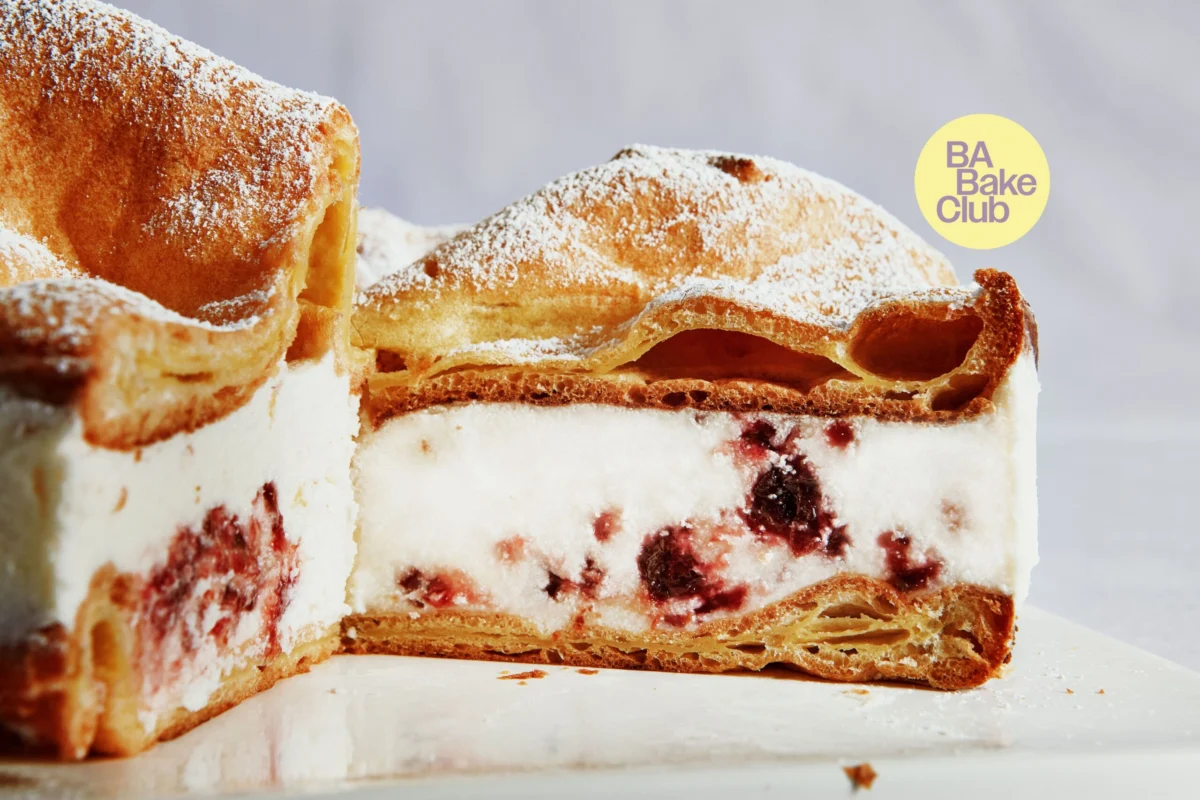
For six years, Bon Appétit senior Test Kitchen editor Jesse Szewczyk harbored a singular culinary ambition: to publish a recipe for Karpatka. Despite never having crafted the intricate Polish dessert in its entirety, Szewczyk’s vision for what he affectionately terms "the drag queen of Polish desserts" found its perfect stage in BA Bake Club, a dynamic online community dedicated to fostering confident and curious bakers. This month, his long-awaited Plum Karpatka recipe, a harmonious blend of traditional Polish flavors and an inventive American twist, has captivated the club’s members and sparked a lively discussion on technique, tradition, and innovation in baking.
The Genesis of a "Drag Queen" Dessert
Szewczyk’s dedication to the Karpatka project underscores a broader philosophy at BA Bake Club: breaking down complex baking into foundational "building blocks." As he explained to co-host Shilpa Uskokovic during a recent podcast episode, "I’ve made every component before; I just haven’t arranged the puzzle pieces in this fashion." This sentiment resonates deeply with the club’s mission, as Uskokovic added, "We hope that that’s what people in Bake Club take away… that by having these building blocks, you can make all these things, even if they’re the first time you’re making them."
The Karpatka, named for Poland’s Carpathian Mountains, is traditionally a showstopping choux pastry cake filled with a rich pastry cream or créme mousseline. Szewczyk’s rendition pays homage to his Polish heritage through a vibrant plum compote, while injecting an American sensibility with a no-bake cheesecake filling. This ingenious fusion creates a dessert that is both familiar and exciting, retaining the dramatic visual appeal of a classic Karpatka while offering a distinct textural experience. The resulting "sky-high desserts," as noted by enthusiastic listeners, have become a testament to the club’s empowering approach to baking.
Demystifying Karpatka: A Step-by-Step Culinary Journey
The Karpatka recipe, though appearing elaborate, is meticulously designed to guide bakers through each stage, building confidence with every component. The process begins with the plum compote, moves to the foundational pâte à choux, and concludes with the innovative cheesecake filling before assembly.
The Plum Compote: A Nod to Polish Roots
Szewczyk’s choice of plum compote is a deliberate nod to Polish culinary traditions. Plums hold a significant place in Polish culture and baking, often featured in late-summer and autumn desserts. Beyond cultural relevance, plums are naturally high in pectin, making them ideal for a thick, jammy compote that provides a vivid counterpoint to the creamy filling.
The compote requires cooking plums with sugar and salt until thick, then finishing with lemon zest, juice, and vanilla. A crucial tip for bakers, emphasized by Szewczyk in response to listener queries, is to reduce the compote sufficiently. As Mark D, one of the diligent Bake Club members, observed, under-reduced jam can be too thin. Szewczyk advises cooking it until a spatula dragged through it leaves a clear streak for a second, indicating adequate moisture reduction. For rapid cooling, spreading the compote in a thin layer on a sheet tray can significantly cut down chilling time, ensuring it’s cool enough not to melt the cheesecake filling during assembly. The versatility of the compote was further highlighted by Meg, another Bake Club participant, who successfully incorporated both peach and plum compotes into her Karpatka, demonstrating the recipe’s adaptability to various seasonal fruits, including berries and other stone fruits.
Mastering Pâte à Choux: The Dramatic Puff
The heart of the Karpatka lies in its dramatic, craggy choux pastry shells. Originating in France in the 16th century, pâte à choux (or choux paste) is a light, hollow pastry dough that relies on steam for leavening. The process involves cooking butter, sugar, salt, and water to a simmer, then incorporating flour to create a thick doughy paste. This pre-cooking step, known as pre-gelatinization, is essential for the flour to absorb moisture and develop structure.
Szewczyk shared a "eureka moment" regarding choux: the importance of aggressive mixing after adding eggs. While traditionally mixed until just combined, he discovered that whipping the dough vigorously in a mixer for five full minutes dramatically aerates the batter, leading to an impressive, almost gnome-hat-like puff during baking. This mechanical aeration, combined with the eggs’ ability to trap air, results in a pastry that expands up to twice its original volume.
For baking, the choux is divided between two cake pans. Szewczyk advises against greasing the sides of the pan, as the choux needs to "climb" to achieve maximum height, similar to a soufflé. A parchment round at the bottom of each pan, secured with small "goo dots" of choux pastry, ensures easy release. He also stresses the importance of baking the choux until it reaches a "medium wood shade," darker than a typical golden brown, to ensure resilience against the moisture from the filling and refrigeration. This extended baking helps prevent a "gummy" texture, a common issue raised by bakers like Rachel L, who found her choux slightly soft towards the center. Re-crisping previously baked choux in a hot oven for a few minutes is a known technique used in professional kitchens, though baking it sufficiently from the start is ideal for a Karpatka.
The American Twist: Stable Cheesecake Filling
Breaking from the traditional Karpatka fillings like créme mousseline or pastry cream lightened with whipped cream, Szewczyk sought a more stable alternative. Initial tests with traditional fillings proved "ephemeral," weeping and losing structure quickly. The solution, proposed by deputy food editor Hannah, was to stabilize it with cream cheese, ultimately leading to the concept of a no-bake cheesecake filling.
To further enhance stability, gelatin was incorporated. This decision transformed the Karpatka from a delicate dessert requiring immediate consumption into one that can be proudly displayed for hours and enjoyed days later. The no-bake cheesecake filling involves blooming powdered gelatin in cold water, dissolving it with heated heavy cream, then combining it with cream cheese, powdered sugar, vanilla, and salt, before whipping in additional heavy cream for a light texture.
Working with gelatin requires careful attention: blooming it in cold water is crucial to prevent lumps, and ensuring it’s fully dissolved in the warm cream is key to avoiding "rubbery specks" in the final product. While some bakers, like Rachel L, experimented with agar as a gelatin substitute, Uskokovic and Szewczyk cautioned that agar, a non-thermoreversible hydrocolloid, behaves differently, yielding a brittle set and not easily mimicking gelatin’s pliable texture. This highlights the precise nature of ingredient substitutions in baking and the importance of understanding their chemical properties.
Assembling the Showstopper
Assembling the Karpatka is where all the components unite in a grand display. One choux disc remains in its cake pan, lined with a parchment collar extending above the pan’s rim, creating a mold. The cheesecake filling is then layered with dollops of the plum compote, which are gently swirled together. Szewczyk advises a light hand with swirling to prevent an "overswirled" appearance when cut, suggesting a painterly approach rather than aggressive mixing. He also offered a clever trick: bending a spoon at a 90-degree angle to easily spread the filling against the parchment collar.
The second choux disc is placed on top, like a crown, and gently pressed down. The assembled Karpatka then requires a minimum of eight hours of refrigeration, ideally overnight, for the gelatin to fully set. The moment of demolding can be daunting, but Szewczyk assures bakers of the Karpatka’s sturdiness. After removing the parchment collar, the cake is confidently flipped onto a serving plate. A final, artistic touch involves taking an offset spatula or bench scraper and gently swiping it around the sides of the cake. This subtle action not only smooths the edges but also artfully bleeds the red compote into the white filling, creating a "romantic, painterly quality" that elevates its visual appeal.
BA Bake Club: Fostering Confident and Curious Bakers
BA Bake Club, co-hosted by Szewczyk and Uskokovic, stands as a vibrant testament to modern culinary education and community engagement. Described as "the nerdiest and most wholesome corner of the baking internet," the club annually publishes a recipe on bonappetit.com, focusing on a specific baking concept. Members are encouraged to bake the recipe, submit questions, and share photos of their creations, fostering a dynamic learning environment. These submissions are then discussed on the podcast, providing valuable feedback and deeper insights into the recipes.
The club celebrates its members through traditions like the "Baker of the Month Award." This month, Mark D received the honor for his "wonkiest, craziest" choux, highlighting the club’s appreciation for creative expression and daring attempts, even amidst minor technical challenges. Looking ahead, the September Bake Club recipe promises another exciting challenge: Glazed Apple Pie Fritters, featuring ricotta and Honeycrisp apples, conceived by Uskokovic as a nod to state fair treats and cider donuts.
Global Baking Perspectives: A Conversation with Ruby Bhogal
Further enriching the Karpatka discussion, the BA Bake Club podcast welcomed Ruby Bhogal, a Season 9 finalist from The Great British Baking Show (known as Bake-Off in the UK). Bhogal, author of the new book Around the World in 80 Cakes, offered a global perspective on baking innovation and tradition.
Bhogal’s book, a three-year labor of love, was inspired by a desire to "reignite her baking mojo" after completing her first book. What began as a fun exploration of ten cakes quickly expanded to eighty, driven by the catchy title and a commitment to deep-diving into the history and origins of each dessert. She emphasized the challenge of respecting national traditions—as "people are very patriotic about their cakes"—while still adding her unique twist to avoid "regurgitating" existing material. Szewczyk and Uskokovic praised Bhogal’s approach as "decolonizing baking education," moving beyond the dominant narrative of French technique to showcase the rich diversity of global baking traditions, from European classics to lesser-known gems like a Fijian honey cake.
Bhogal’s own Karpatka journey included traditional versions and playful riffs, such as rhubarb and strawberry compote, and a "brilliant" PB&J variation. This aligns perfectly with the Bake Club’s ethos of giving credit to tradition while embracing creative interpretation. Addressing a listener’s concern about Karpatka in hot weather, Bhogal, drawing from her Bake Off tent experience (where air conditioning is famously absent), suggested making smaller, individual Karpatkas or choux buns. She also advised re-crisping baked choux in a low oven for 5-10 minutes just before serving to counteract any moisture absorption, noting that choux pastry inherently "loves moisture." The idea of "tiny Karpatkas" sparked immediate enthusiasm from the hosts, envisioning adorable individual servings.
Baking Beyond the Tent: Ruby Bhogal’s Journey
Bhogal’s personal baking journey is a testament to embracing new passions and unexpected opportunities. She revealed a rather unconventional path to the Great British Baking Show tent, having only started baking a year before applying. Her application, initially a "very jokey manner" during a period of unemployment, quickly turned serious. She humorously admitted to "cheating" during the rigorous application process by furiously Googling answers to baking questions.
Despite her relative inexperience compared to fellow contestants who had baked since childhood, Bhogal believes her lack of expectation was an asset. "I had no expectation… I was just counting my lucky stars that I made it into the tent," she shared. This mindset allowed her to fully immerse herself in the experience, leading to invaluable learning and lifelong friendships, most notably with fellow baker Antony, who even baked her wedding cake.
In a rapid-fire Q&A, Bhogal offered further insights into her baking philosophy: her go-to bake sale item is a "crowd-pleaser" like her Brooklyn Blackout chocolate cake; her emergency baking contact is Antony (for calming, if not always advice); the best baking smell is "laminated pastry" for its pure butter aroma; her kitchen motto is "What’s the worst that can happen?"; and her most cherished compliment came from Prue Leith, who specifically asked for her recipe for a cake she made on the show. Bhogal’s journey and insights reinforce the idea that passion, curiosity, and a willingness to learn are more important than pre-existing expertise in the world of baking.
Implications and Future of Baking Innovation
The Bon Appétit Bake Club’s Karpatka recipe and its accompanying discussions, amplified by the insights of Ruby Bhogal, highlight a significant trend in contemporary culinary culture. It underscores a growing appreciation for global culinary traditions, moving beyond Eurocentric dominance to embrace diverse flavors and techniques. The emphasis on "building blocks" and "decolonizing baking education" suggests a pedagogical shift towards empowering home bakers with fundamental skills that can be adapted and innovated upon, rather than simply replicating recipes.
The digital platform of BA Bake Club exemplifies how online communities are fostering skill development, cultural exchange, and a supportive environment for culinary enthusiasts. The interaction between editors and listeners, addressing real-world baking challenges, creates a dynamic feedback loop that enriches the entire community. This blend of entertainment, education, and community engagement ensures that baking remains an accessible, exciting, and continuously evolving art form, encouraging home cooks to confidently explore new flavors and techniques, one "drag queen" dessert at a time. The success of Szewczyk’s Karpatka and Bhogal’s global baking explorations signals a future where culinary boundaries are not just crossed, but celebrated and creatively reimagined.
