

The competition for the title of Food Network’s Pitmaster reached a critical juncture in its seventh episode, as the field narrowed to the final three teams. Competitors Susie Bulloch of Hey Grill Hey and Christie Vanover of Girls Can Grill faced off against two other elite pairings—John and Connie, and Esaul and Grecia—in a high-stakes round that determined which teams would advance to the series finale. The episode centered on the "Big Burn," a grueling nine-hour whole hog challenge, and was punctuated by two "Flash Burn" surprise rounds that tested the competitors’ ability to pivot under extreme time pressure. With a total of $12,000 in prize money on the line for the day, the episode highlighted the technical complexities of open-fire cooking and the increasing diversity of flavor profiles in the modern barbecue circuit.
The Technical Stakes of the Big Burn Whole Hog Challenge
The primary objective of the episode, labeled the "Big Burn," required the final three teams to prepare a whole hog from start to finish within a nine-hour window. Judges Andrew Zimmern, Jess Pryles, Big Moe Cason, and Ernest Servantes emphasized that the challenge was not merely about cooking the animal through, but about achieving perfection across five distinct sections: the belly, ham, loin, ribs, and shoulder. Each of these cuts possesses different fat content and connective tissue densities, requiring precise heat management to ensure that the leaner loin does not dry out before the tougher shoulder and ham reach tenderness.

Zimmern described the whole hog as one of the most demanding trials in the barbecue world, a sentiment echoed by the technical requirements of the cook. Bulloch and Vanover opted for a Filipino-inspired adobo flavor profile, a departure from traditional North Carolina or Memphis styles often seen in such competitions. This choice utilized a vinegar-based marinade featuring soy sauce, salt, and sugar, designed to cut through the richness of the pork.
To execute this, the team employed an asado cross, a traditional Argentinian method where the animal is butterflied and suspended vertically over an open fire. Unlike a traditional offset smoker or a cinderblock pit, the asado cross offers no lid or insulation, leaving the meat entirely exposed to the elements. This method relies on radiant heat from hardwood coals and requires constant monitoring of wind speed and ambient temperature, both of which can drastically alter cooking times.
Chronology of the Flash Burn Interruptions
Two hours into the nine-hour whole hog cook, the competition was interrupted by the "Flash Burn," a surprise challenge requiring the teams to prepare a specific lunch order for the judges within 90 minutes. This secondary challenge carried a $2,000 prize. The judges placed specific, individualized orders:

- Ernest Servantes: Grilled chicken wings.
- Andrew Zimmern: A meatball sub.
- Big Moe Cason: A BBQ pork burger incorporating onion and garlic.
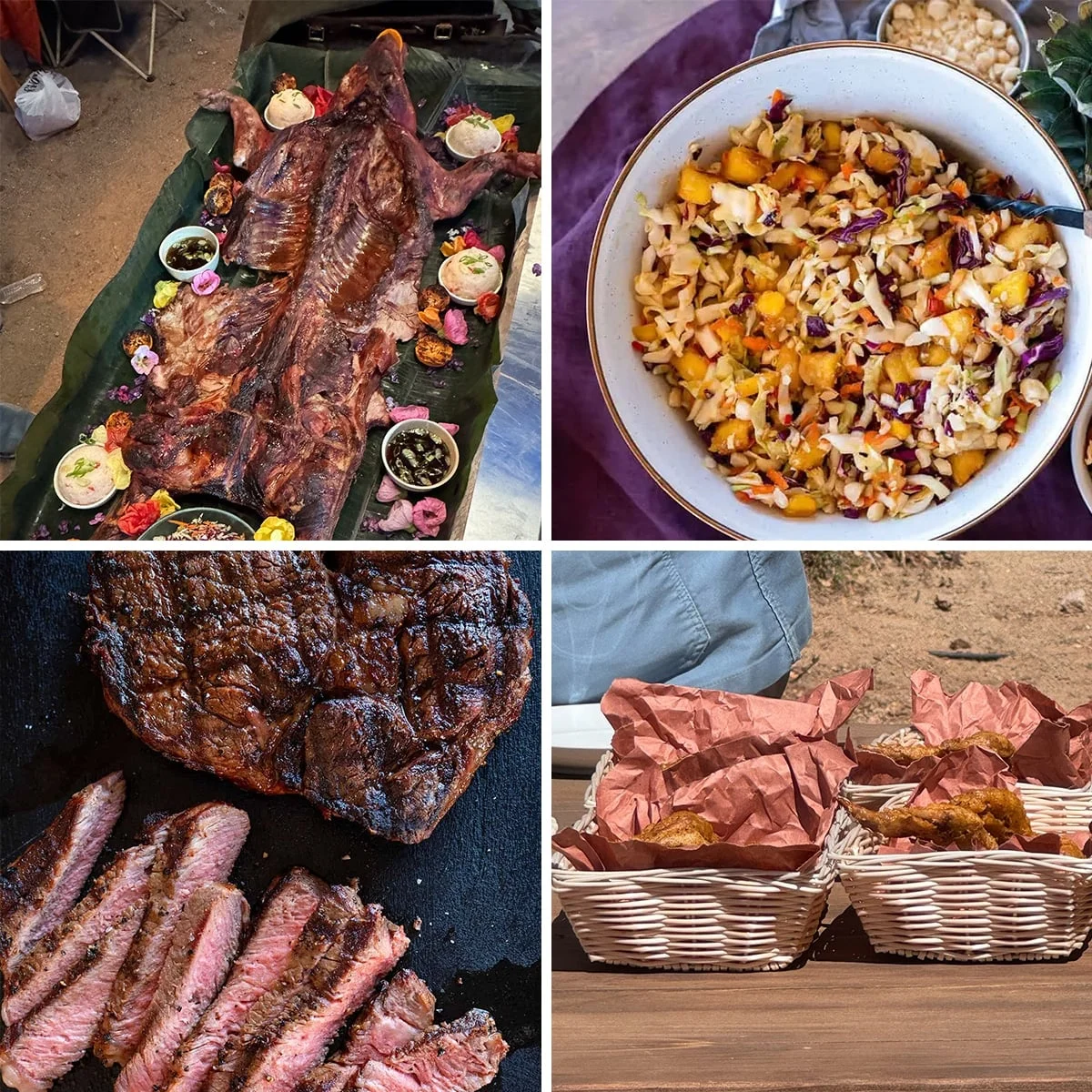
Through a selection process, John and Connie secured the meatball sub, while Esaul and Grecia chose the pork burger. Bulloch and Vanover were tasked with the grilled chicken wings. The Bulloch-Vanover team prepared full wings with a chipotle dry rub, smoking them over live fire before finishing them in a beef tallow fry to achieve a crisp texture.
The complexity of the midday service increased further when judge Jess Pryles announced a second "Flash Burn" with 30 minutes remaining on the clock. Pryles, a respected meat scientist, requested a perfectly cooked ribeye steak to be served alongside the other lunch orders, with an additional $2,000 prize for the winner. Vanover took the lead on the steak, utilizing a "Just Keep Flipping" (JKF) method over hickory chips and embers to develop a crust while maintaining an internal temperature of 125 degrees Fahrenheit.
Comparative Analysis of Culinary Methods and Judging Outcomes
The lunch service provided the first major point of contention among the judges. While the Bulloch-Vanover team produced wings that were described as seasoned and juicy, they faced criticism for the preparation method. Servantes had specifically requested "grilled" wings, and the decision to fry the wings after smoking them was viewed by some judges as a departure from the requested prompt.

In the steak challenge, Pryles noted that while the internal temperature was well-managed, the exterior crust was lighter than preferred. She also expressed a personal preference against the use of resting butter, arguing that it can mask the natural flavor of the beef tallow and soften the sear. Ultimately, Esaul and Grecia won the first Flash Burn prize for their pork burger, while John and Connie secured the $2,000 for the steak challenge, leaving Bulloch and Vanover without a win in the midday rounds.
Environmental Challenges and Final Whole Hog Execution
As the afternoon progressed, the teams returned their focus to the whole hog. For the Bulloch-Vanover team, the asado cross method proved difficult as the weather began to cool. In an open-air environment, a drop in ambient temperature can stall the internal temperature of the meat, particularly in the thickest parts of the hog like the hams and shoulders.
To compensate for the loss of heat, Bulloch and Vanover made the tactical decision to remove the hog from the vertical cross and place the rack directly onto cinderblocks over the fire. This moved the meat closer to the direct heat source, providing the necessary thermal energy to push the hams and shoulders through their final cooking phase. Throughout the process, the team used a mop sauce to maintain surface moisture and layer flavor, a critical step in open-fire cooking where the lack of a lid leads to rapid evaporation.

The presentation of the hogs was a major factor in the final judging. Bulloch and Vanover presented their adobo hog as a "pig pickin’" centerpiece, surrounded by garlic rice, grilled pineapple coleslaw, and a soy-vinegar dipping sauce. This cohesive approach was designed to offer a balanced bite of acidity, sweetness, and savory pork.
Final Judging and Elimination Results
The final evaluation of the three whole hogs was described by the judges as one of the most difficult of the season. The criteria focused on the texture of the various cuts and the quality of the skin, which is often considered the "gold standard" of a whole hog cook.
The judges’ feedback for Bulloch and Vanover was mixed:

- The Skin: Ernest Servantes praised the skin as exceptional, noting its clarity and texture.
- The Loin and Sides: The flavor of the adobo baste and the quality of the side dishes received positive remarks.
- The Ham and Shoulder: The judges found the shoulder to be slightly tough and the ham to be "tight," indicating that those specific sections had not reached the ideal level of fat rendering and collagen breakdown.
John and Connie were declared the winners of the Big Burn, earning the $8,000 prize and the first guaranteed spot in the series finale. The final decision for the second spot came down to the teams of Esaul and Grecia versus Bulloch and Vanover. Based on the technical consistency of the pork cuts, the judges chose Esaul and Grecia to advance.
Broader Implications and Industry Context
The elimination of Susie Bulloch and Christie Vanover marked the end of a significant run for two of the most prominent women in the contemporary barbecue industry. Their progression to the final three of a national Food Network competition reflects a broader shift in the demographics of professional barbecue, a field historically dominated by male competitors.
Furthermore, the inclusion of Filipino-inspired flavors and South American cooking techniques (asado) in a mainstream American competition highlights the globalization of barbecue. While traditional regional styles remain the foundation of the sport, judges and audiences are increasingly rewarding technical proficiency applied to diverse culinary traditions.

The episode also demonstrated the inherent risks of "approachability" in high-level competition. Bulloch and Vanover, known for their "backyard style" and accessible recipes, successfully competed against specialized competition circuit veterans for seven episodes. However, the final margins in elite barbecue often come down to the precise thermal management of secondary cuts—a challenge magnified by the choice of an open-air asado cross over more controlled pit environments.
As the series moves toward its finale, the remaining teams—John and Connie, and Esaul and Grecia—will compete for the ultimate title of Pitmaster. The departure of Bulloch and Vanover leaves a void in the competition’s narrative, but their performance stands as a testament to the viability of creative, non-traditional flavor profiles in the highest tiers of live-fire cooking. The finale is scheduled to air on Food Network, with streaming availability on HBO Max and Discovery+, concluding a season that has emphasized both the rigors of tradition and the evolution of the craft.
