

The Scene Unveiled: A Deep Dive into Nolan’s Portrayal
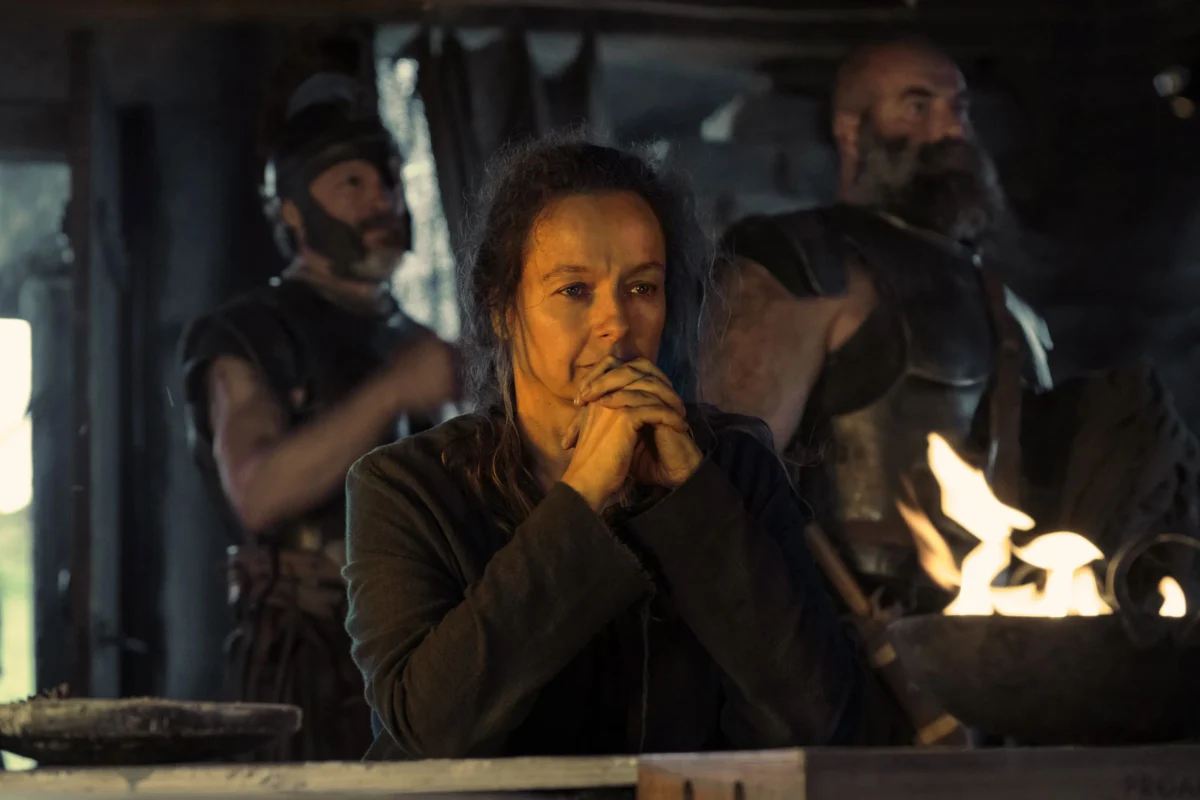
For those who have yet to embark on the nearly three-hour journey of Nolan’s The Odyssey, the context for this infamous scene is crucial. As Odysseus, portrayed with a grizzled gravitas by Matt Damon, navigates the perilous return to Ithaca from the Trojan War, his beleaguered crew makes numerous stops. One such stop is the mythical island of Aeaea, the domain of the sorceress Circe, compellingly brought to life by Samantha Morton. Starving and desperate, Odysseus’s men stumble upon her dwelling. When they request sustenance, Circe obliges, offering them a stew that, in Nolan’s distinct cinematic vision, is anything but appetizing.
The film’s depiction eschews any traditional notion of a welcoming repast. Instead, the men are shown consuming a revolting, stringy concoction with a primal, almost desperate fervor. Close-up shots emphasize the grotesque textures of the stew – possibly strips of intestine or long, unidentifiable cuts of meat – as the men slurp and chew with wide, unblinking eyes, their movements bordering on the frenzied. The sound design accompanying this sequence is particularly impactful, amplifying the repulsive act of consumption, turning a simple meal into an act of visceral horror. As translator Emily Wilson concisely noted in her review, "All the food looks horrible," a sentiment echoed widely by audiences. This unsettling meal is, of course, a prelude to Circe’s notorious magical transformation, turning Odysseus’s men into swine – or, as some interpretations suggest, merely revealing their inherent swinish nature. The scene masterfully employs horror aesthetics to underscore the themes of temptation and degradation.
Public and Critical Reception: A Digital Echo Chamber
The immediate aftermath of The Odyssey‘s release saw an explosion of discussion surrounding Circe’s feast. Online forums, review aggregator sites, and short-form video platforms like TikTok were flooded with reactions. Videos dissecting the scene, often accompanied by expressions of disgust or morbid fascination, quickly went viral. Phrases like "I can’t unsee it" and "truly disturbing" became common refrains. This intense public engagement highlights Nolan’s ability to craft moments that transcend mere narrative progression, becoming cultural talking points in their own right. The consensus among viewers is not merely that the scene is visually challenging, but that it successfully evokes a profound sense of unease, fulfilling its narrative purpose by making the audience feel the same repulsion intended for Odysseus’s doomed crew. This collective digital experience has significantly shaped the early discourse around the film, positioning the Circe encounter as a defining, if unsettling, highlight.
Homer’s Original Vision: The Literary Antecedents of Circe’s Deception
To fully appreciate Nolan’s artistic choices, it is essential to return to the source material. Homer’s Odyssey, an epic poem dating back to the 8th century BCE, introduces Circe as a powerful sorceress and goddess renowned for her transformative magic. In various translations, including Samuel Butler’s, the text describes Circe’s initial offering to Odysseus’s men as a more palatable, if still deceptive, feast: "cheese, honey, meal, and Pramnian wine." This description suggests a seemingly innocuous, even appealing, meal designed to lower the men’s guard before the potent drugs mixed within the offering take effect. The literary emphasis is on the deceptive nature of the food and the men’s greed, rather than the intrinsic repulsiveness of the meal itself.
The core narrative of Circe’s island, Aeaea, serves as a critical juncture in Odysseus’s journey. It tests the resilience and loyalty of his men, and more importantly, Odysseus’s own cunning and self-control. The transformation of the men into pigs is a symbolic representation of their succumbing to base desires and gluttony, losing their humanity in the process. Nolan’s adaptation, by making the food itself intrinsically disgusting, amplifies this symbolic degradation, externalizing the internal corruption that the original text implies. It’s a bold reinterpretation that prioritizes visceral impact over a literal translation of Homer’s culinary descriptions, aiming to convey the moral implications through sensory shock.
Historical Authenticity vs. Artistic License: The Culinary Debate
Nolan’s choice to depict a "fucked-up stew" has also inadvertently ignited a fascinating debate among food historians regarding the culinary practices of ancient Greece. Cathy Kaufman, an assistant professor in The New School’s department of food studies and chair emerita of the Culinary Historians of New York, weighed in on the matter. According to Kaufman, the notion of ancient island-dwelling Greeks regularly consuming "entrail stew" is largely inconsistent with historical evidence. Instead, their diet would have primarily consisted of staples like roasted goat and sheep, an abundance of fresh fish, and dense, barley-based bread. These were the mainstays of their sustenance, reflecting both the agricultural and maritime resources available in the Hellenic world.
However, the discussion is not entirely one-sided. Mariana Kavroulaki, another Greek culinary historian, points out that while characters in The Odyssey are frequently depicted spit-roasting proteins—a poetic flourish emphasizing masculinity and hunting rituals within the epic—the actual culinary practices of the era the poem is set in (the Late Bronze Age/Early Iron Age) did include stewing meats. This nuance suggests that while Nolan’s specific portrayal of the stew’s ingredients might be an artistic exaggeration, the method of stewing itself might not be entirely anachronistic. This subtle distinction adds complexity to the historical accuracy debate, suggesting that the film, despite its dramatic liberties, might possess a fleeting thread of historical grounding in its culinary techniques, even if its visual execution is designed to shock. Ultimately, as many scholars and critics have noted, cinematic adaptations of millennia-old myths are rarely meant to be historically precise documents, but rather interpretations that resonate with contemporary audiences. The "accuracy debate," as some have labeled it, often rages on, reflecting the perennial tension between historical fact and artistic interpretation in adaptations of classical works.
Nolan’s Intent: Subtext and Symbolism in the Feast
The deliberate decision to make Circe’s feast so repulsive speaks volumes about Christopher Nolan’s directorial intent. Known for his meticulous planning and deeply thematic narratives, Nolan rarely includes gratuitous elements. In this context, the repugnance of the stew serves a critical purpose beyond simple shock value. It is a potent visual metaphor designed to reflect the moral state of Odysseus’s men. The greedy, almost animalistic way they consume the slop underscores their inherent avarice and crude sensibilities, portraying them as already possessing the pig-like qualities that Circe’s magic merely brings to the surface.
Nolan’s cinematic language often involves externalizing internal states, and the Circe feast is a prime example. The revolting appearance and sound of the meal are not just unpleasant; they are a direct manifestation of the men’s internal corruption and lack of discipline. The stew is presented as an almost immediate judgment on their character. This artistic choice elevates the scene beyond a mere magical transformation; it transforms it into a profound commentary on human nature, temptation, and the consequences of unchecked desire. By making the food itself a symbol of degradation, Nolan ensures that the audience understands, on a visceral level, that these men are not simply victims of a sorceress, but willing participants in their own downfall, drawn to the repulsive meal by their own base instincts. It’s a powerful thematic statement, consistent with Nolan’s reputation for crafting complex narratives that challenge viewers to look beyond the surface.
The Narrative Resolution: Odysseus’s Cleverness and Circe’s Relent
The scene’s impact is further highlighted by its resolution, which pivots on Odysseus’s unique qualities. Unlike his men, Odysseus (Matt Damon) approaches Circe with a combination of caution and cunning. Forewarned by Hermes, he smartly refuses her stew, armed with an antidote and a strategic threat. In Nolan’s version, this defiance extends to threatening Circe’s transformed sister, a bird-like creature, forcing the sorceress to relent. This display of intelligence, self-control, and strategic thinking stands in stark contrast to the impulsive gluttony of his crew.
Odysseus’s ability to resist Circe’s trickery and negotiate the return of his men underscores the epic’s central theme of resilience and leadership. It reinforces the idea that true heroism lies not just in physical prowess, but in wit and moral fortitude. The film’s portrayal effectively emphasizes that Circe’s initial assessment of Odysseus and his men, though perhaps harsh, was fundamentally accurate regarding the latter’s character flaws. Odysseus’s triumph over Circe is not just a victory against magic, but a victory of intellect and virtue over base instincts, a critical turning point that allows the journey towards Ithaca to continue.
Broader Implications: Cinematic Adaptation and Mythological Resonance
Christopher Nolan’s The Odyssey and its controversial Circe feast scene exemplify the challenges and opportunities inherent in adapting ancient epics for a modern cinematic landscape. By taking significant artistic liberties with the source material’s specific details while remaining true to its thematic core, Nolan demonstrates the power of visual storytelling to reinterpret timeless narratives for contemporary audiences. The film’s ability to generate such intense discussion around a single scene speaks to its success in engaging viewers on multiple levels—viscerally, intellectually, and emotionally.
This adaptation contributes to the ongoing cultural conversation about heroism, temptation, and the enduring complexities of human nature, themes that remain as relevant today as they were in Homer’s time. Within Nolan’s filmography, The Odyssey fits comfortably, showcasing his signature style of high-concept, visually immersive narratives that often challenge conventional interpretations. The lasting impact of Circe’s feast scene, despite or perhaps because of its unsettling nature, ensures that Nolan’s The Odyssey will be remembered not just as another adaptation, but as a bold, distinctive, and ultimately unforgettable cinematic experience that leaves a profound mark on its viewers.
