

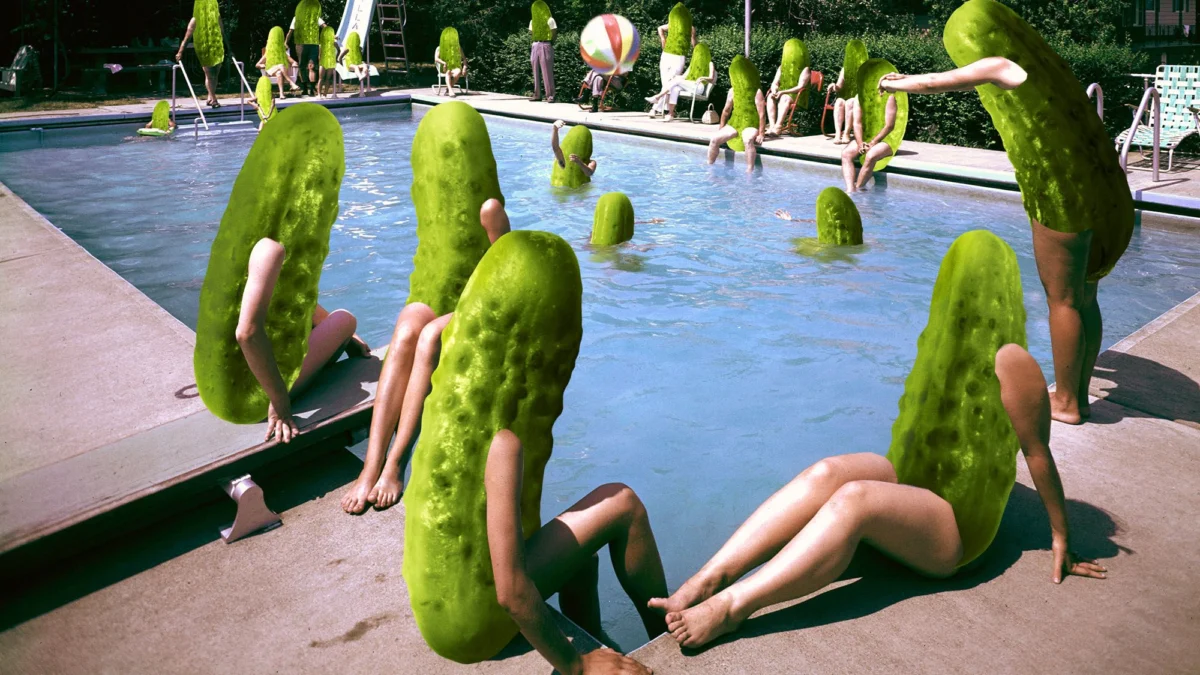
In a vivid demonstration of a burgeoning culinary and cultural phenomenon, influencer Serena Neel recently captivated a vast online audience by transforming her backyard swimming pool into a colossal vat of pickles. Adorned in an "I ❤️ Pickles" shirt and a distinctive headband featuring an oversized pickle, Neel embarked on a mission to swim amidst 50,000 Josh’s Pickles. A dedicated team, humorously dubbed "pickle enablers," assisted her in ceremoniously emptying wheelbarrow after wheelbarrow of the briny cucumbers into the pool. The spectacle culminated in a verdant, bobbing sea of pickles completely obscuring the chlorinated water beneath. After the painstaking task, Neel, donning goggles and a swimsuit, executed a dramatic cannonball into the pickle-laden expanse, solidifying her place in the annals of internet eccentricity and underscoring the current zenith of pickle popularity. This audacious stunt, while seemingly whimsical, serves as a potent symbol of what many in the food industry are calling "Peak Pickle"—an era where the humble pickled cucumber transcends its traditional role to permeate nearly every facet of consumer culture.
The Unmistakable Rise of the Pickle Phenomenon
While Neel’s pickle pool dive represents an extreme manifestation, the broader "pickle craze" has been steadily fermenting for years. Pickles, in their various forms, boast an ancient and diverse history, predating written language and spanning cultures from Mesopotamia to India, China, and Europe. Historically valued for preservation, flavor, and medicinal properties, pickles have long held a staple position in global cuisines—from Eastern European dill pickles and German gherkins to Korean kimchi and Japanese tsukemono. In American culture, they are synonymous with deli sandwiches, backyard barbecues, and classic comfort food. However, the current wave of pickle obsession extends far beyond these traditional applications, transforming the briny flavor profile into a ubiquitous trend.
The modern resurgence can be attributed to several converging factors. The craft food movement, with its emphasis on artisanal production, fermentation, and unique flavor experiences, laid significant groundwork. Consumers became more interested in the origins and processes of their food, leading to a renewed appreciation for fermented goods like pickles. Simultaneously, the rise of health and wellness trends highlighted the probiotic benefits of fermented foods, further boosting pickles’ appeal as a gut-friendly snack. Yet, perhaps the most significant catalyst has been the advent of social media. Platforms like Instagram and TikTok, with their visual-first approach, are perfectly suited to amplify novel and shareable food trends. As Karen Solomon, author of Pickles, Illustrated, succinctly puts it, "Thank you, Instagram." These platforms create a viral loop where unique food concepts gain rapid traction, inspiring both consumers and manufacturers to explore new pickle-infused frontiers.
A Timeline of Pickle’s Pervasiveness
The sheer breadth of pickle-flavored products available today is staggering, indicating a market eager to embrace this distinct taste. What began with traditional pickle spears and chips has exploded into an eclectic array of consumables and non-food items, demonstrating the pervasive influence of the trend.
- Early 2010s: Gourmet pickle brands and artisanal delis began gaining traction, emphasizing natural ingredients and unique brining techniques. Pickle-flavored potato chips started appearing more widely, moving beyond niche markets.
- Mid-2010s: Picklebacks (a shot of whiskey followed by a shot of pickle brine) gained popularity in bars, introducing pickle juice as a standalone beverage component.
- Late 2010s: The innovation accelerated. Pickle beer, such as the collaboration between Pabst Blue Ribbon and Grillo’s Pickles, hit the market, merging the tangy flavor with craft brewing. Fast-food chains began experimenting, with some offering pickle-brined fried chicken sandwiches or pickle-flavored condiments.
- Early 2020s: The trend moved into unexpected territories. Pickle marshmallows emerged, ostensibly for adventurous s’mores. Dill pickle-flavored spreadable cheeses, like those from The Laughing Cow, offered a tangy twist to snack time. Beyond food, the flavor profile began influencing lifestyle products. Pickle-inspired personal lubricants, lip glosses, and even perfumes appeared, showcasing the trend’s almost satirical reach. Fashion and accessories also joined the fray, with pickle-themed purses, t-shirts, and even a bespoke $2,000 pickle ring underscoring the depth of consumer engagement.
- Present Day: The phenomenon continues to expand, with pickle juice becoming a popular sports drink alternative for electrolytes and innovative cocktail menus featuring pickle brine prominently.
This chronological expansion highlights not just a passing fad but a sustained and deepening interest that has spurred creativity across various industries.
Economic Momentum and Industry Affirmation
The "Peak Pickle" era is not merely anecdotal; it is firmly supported by robust market data and confirmed by industry leaders. Last November, FoodNavigator, a respected food and beverage trade publication, reported a remarkable surge in pickle-flavored product sales. The market saw an astonishing increase of nearly 34% from the previous year, translating to approximately $490 million in sales. This significant growth underscores a powerful consumer demand that manufacturers are eager to meet.
Mark Luker, the chief commercial officer at Grillo’s Pickles, a prominent player in the market, encapsulates the industry’s surprise and sustained enthusiasm. "We keep saying, okay, this is the last year of the craze, and every year it seems to get bigger," Luker noted. This sentiment reflects a broader industry trend where initial skepticism about the longevity of the pickle craze has given way to strategic investment and product development. Companies are recognizing that the pickle’s versatile flavor profile appeals to a wide demographic seeking bold, distinctive tastes.
Karen Solomon further elaborates on the "bandwagon effect" driving this expansion. She draws parallels to past food trends, recalling periods when "all chips were blue" or when "everything started to be super ultrahot, fiery, and spicy" following the rise of brands like Takis. This cyclical nature of flavor trends suggests that food manufacturers are highly attuned to consumer preferences, quickly adapting their product lines to capitalize on popular profiles. The pickle, with its inherent tang, umami, and refreshing crunch, offers a unique and adaptable foundation for innovation, making it an attractive "flavor du jour" for product developers.
The sustained growth and industry investment signal that the pickle phenomenon is more than a fleeting novelty. It reflects a deeper consumer desire for adventurous flavor experiences, a celebration of comfort food with a modern twist, and the undeniable power of social media to catapult niche interests into mainstream obsessions.
Culinary Innovation: Pickles Beyond the Plate
Beyond snacks and merchandise, the pickle boom is fundamentally transforming culinary landscapes, particularly in the realm of mixology. Bartenders and chefs are increasingly recognizing pickle juice as a sophisticated ingredient that offers complex layers of flavor and acidity.
Ly Costales, the assistant director of food and beverage at the prestigious Hotel del Coronado in San Diego, eloquently explains the appeal of pickle juice in cocktails. "Pickle juice already has the salinity, vinegar-forward acidity, and garlic character built in, so it cuts sweetness and adds a savory depth," Costales states. This inherent complexity makes pickle brine a natural fit for balancing drinks, much like olive brine elevates a dirty martini. The Hotel del Coronado has successfully capitalized on this trend, with its pickle margarita becoming one of the bar’s top sellers since its launch over a year ago. The drink, a testament to innovative mixology, demonstrates how a seemingly unconventional ingredient can achieve widespread appeal when expertly integrated.
Similarly, Trick Dog, a renowned bar in San Francisco, has embraced pickle juice in its sophisticated cocktail offerings. They recently debuted a dirty Manhattan, a refined concoction that combines robust rye whiskey with the distinct brine from house-made bread-and-butter pickles, rounded out by a tamarind-infused vermouth. This creative application highlights how varying pickle brines—from dill to bread-and-butter—can impart different nuances to a drink. According to a representative from Trick Dog, the introduction of "vinegar and vinegar-based ingredients" at the bar "unlocked a whole new section of ingredients," showcasing a paradigm shift in how mixologists approach flavor profiles. This embrace of acidic and fermented components is pushing the boundaries of traditional cocktail making, resulting in unique and memorable drinking experiences.
The versatility of pickle juice extends beyond cocktails, inspiring chefs to incorporate it into various dishes. Pickle brine has found its way into marinades for meats, adding tenderness and a tangy depth. It’s used in salad dressings, as a flavor enhancer for roasted vegetables, and even as a secret ingredient in some baked goods to impart a subtle tang. This culinary adaptability ensures that the pickle’s presence is not limited to novelty items but is becoming a legitimate tool in the modern kitchen, further cementing its role in contemporary gastronomy.
The Perils of the "Bandwagon Effect" and Viral Missteps
While the pickle’s ascent to culinary stardom is largely celebrated, the sheer momentum of the trend, particularly amplified by social media, also highlights the potential for indiscriminate application. The "bandwagon effect," as described by Karen Solomon, can lead to enthusiastic but ultimately ill-advised culinary experiments, driven more by virality than by genuine flavor compatibility.
A prime example of this phenomenon is the recent flurry of viral reels suggesting the addition of frozen pickles to Sauvignon Blanc. These social media posts, often featuring a cheerful chef’s kiss at the end, offer no explanation of how such a combination tastes, nor any context or tasting notes. The implicit message is simply "try this ASAP" because pickles are popular, and an unusual pairing is more likely to garner views and engagement. This approach prioritizes spectacle over substance, capitalizing on the current "hotness" of pickles without critical evaluation.
This contrasts sharply with another recent social media-driven wine trend where influencers, including notably Sarah Jessica Parker, encouraged followers to add jalapeño slices to Sauvignon Blanc or rosé. While initially met with skepticism, many, including this writer, found the jalapeño infusion to be "low-key good," adding a subtle spice and complexity that genuinely enhanced the wine’s profile. This demonstrates that some unconventional pairings can indeed yield pleasant results, provided there’s an underlying logic or harmonious interaction of flavors.
However, the same cannot be said for the pickle-in-Sauvignon Blanc experiment. Upon attempting this viral suggestion, the experience proved largely unpleasant. The immediate aroma upon lifting the glass—a strong scent of dill and vinegar—did little to entice. The inherent tart acidity of the dill pickle, when combined with Sauvignon Blanc’s signature mouth-puckering acidity, resulted in an overwhelming and dissonant sourness. Furthermore, the pickle brine significantly impeded the wine’s crisp finish, leaving a flat-feeling, dense-tasting glass that lacked the refreshing qualities typically sought in a Sauvignon Blanc. While this particular experiment utilized dill pickle juice, one might speculate if a bread-and-butter or spicy pickle could yield different, perhaps less jarring, results. Nonetheless, the initial attempt strongly suggested that not all flavor combinations, even those involving popular ingredients, are destined for success. The pursuit of viral content can sometimes overshadow sound culinary judgment.
Navigating the Golden Age of Pickles
Ultimately, the pickle phenomenon underscores a broader truth about food trends: they are dynamic, influenced by history, culture, technology, and sheer human creativity. While the current "Peak Pickle" era has brought forth innovations that genuinely enhance our culinary experiences—especially in the realm of cocktails and adventurous snacks—it also reminds us that discernment is key. Not every ingredient belongs everywhere, regardless of its popularity.
As we continue to live through this golden age of pickles, the invitation remains to explore and enjoy. Experiment at home with pickle juice in creative ways, perhaps crafting unique pickle lemonades, refining pickle martinis, or perfecting the tangy pickle margarita. And when a pickle cocktail appears on a restaurant or bar menu, do yourself the favor of giving it a try; chances are, it’s been thoughtfully crafted to showcase the pickle’s best attributes. The enduring appeal of the pickle, from its ancient origins to its modern-day viral stardom, is a testament to its multifaceted nature and its remarkable ability to surprise and delight the palate, even if some of its contemporary applications push the boundaries of taste. The question isn’t if the pickle craze will eventually wane, like mason jar salads or cronuts, but rather what enduring legacy this flavorful fermentation will leave on our plates and in our glasses.
