

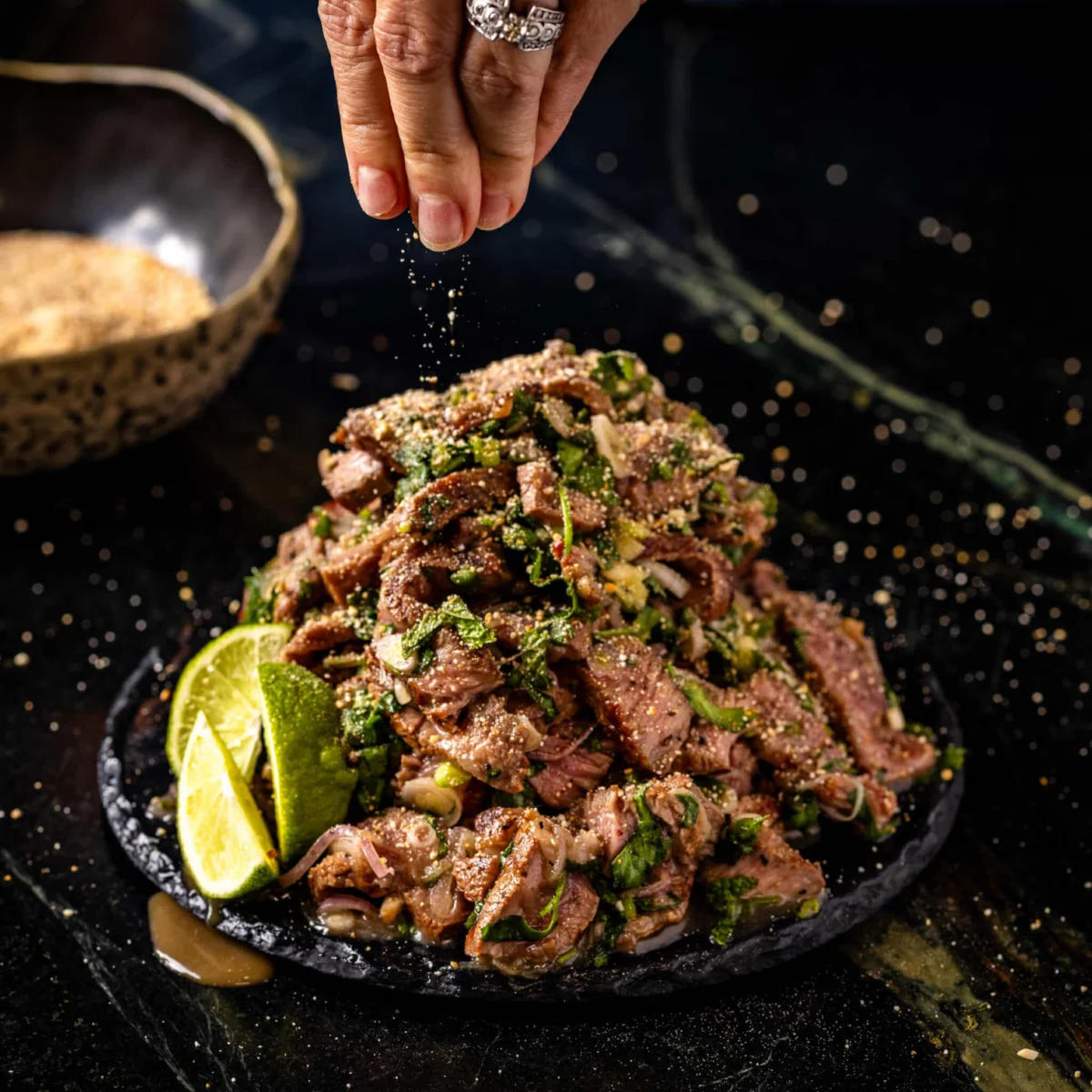
The intersection of high-stakes competitive barbecue and traditional Southeast Asian flavors has produced one of the most distinctive entries in the modern grilling canon: the Thai Beef Waterfall Salad. Known natively as Nam Tok Neua, this dish represents a sophisticated balance of heat, acidity, and umami, recently popularized on a national scale through its appearance on the Food Network’s Pitmasters. The dish, characterized by its smoky, rare-grilled beef and vibrant herbal dressing, serves as a bridge between the rustic traditions of the Isan region of Thailand and the technical precision of American backyard grilling.
The Evolution of Nam Tok Neua in Competitive Barbecue
The emergence of Thai Beef Waterfall Salad in the American mainstream can be traced through the evolution of culinary competitions. In a notable Season 3 episode of Food Network’s Pitmasters, the dish was utilized as a strategic "turf" component in a surf-and-turf challenge. Susie Bulloch, founder of the barbecue platform Hey Grill Hey, developed a streamlined version of the recipe to compete against Christie Vanover of Girls Can Grill. While Vanover presented a coconut-lime halibut, Bulloch opted for the bold, aggressive flavors of the Nam Tok Neua to demonstrate the versatility of the grill beyond traditional low-and-slow smoking techniques.

The term "Nam Tok" translates literally to "waterfall" or "falling water." In the context of Thai culinary history, this refers to the juices dripping from the meat as it is grilled over an open flame—a visual and auditory hallmark of Isan street food. By adapting this for a Western audience, culinary experts have focused on making the ingredients approachable while maintaining the structural integrity of the flavor profile.
Chronology of Preparation and Technical Methodology
The production of a high-quality Thai Beef Waterfall Salad follows a rigorous chronological sequence that ensures both the textural contrast of the beef and the aromatic potency of the herbs.
The Marination Phase
The process begins with the selection of the protein. Historically, Nam Tok Neua was made with various cuts of beef available in rural Thailand, but the modern culinary standard often dictates the use of hanger steak. Known as the "butcher’s steak" because it was often reserved by meat cutters for their own consumption, the hanger steak is prized for its loose grain and deep, beefy flavor. The steak is marinated for approximately one hour in a mixture of soy sauce and coarse black pepper. This brief duration is intentional; it allows the salt to penetrate the outer layers of the muscle fibers without denaturing the proteins to the point of toughness.

The Development of Khao Khua
Simultaneously, the preparation of toasted rice powder, or Khao Khua, takes place. This is a critical component that provides a nutty aroma and a necessary crunch. Raw glutinous rice (sticky rice) is toasted in a dry skillet over medium-high heat until it reaches a deep golden brown. Once cooled, it is pulverized into a coarse powder. This ingredient acts as a thickening agent for the dressing while providing a textural counterpoint to the tender beef.
Thermal Processing
The grilling phase requires a high-heat environment, typically between 400 and 450 degrees Fahrenheit. The objective is to achieve a significant Maillard reaction—the chemical reaction between amino acids and reducing sugars that gives browned food its distinctive flavor—on the exterior while maintaining a rare internal temperature. Using a constant-flip method, the steak is generally pulled at an internal temperature of 115 degrees Fahrenheit, allowing carryover cooking to bring the final temperature to a resting state of 120 to 125 degrees Fahrenheit.
Assembly and Dressing
The final stage involves slicing the rested steak against the grain to ensure tenderness. The meat is then tossed with a dressing composed of fish sauce (or a soy-based alternative), lime juice, shallots, cilantro, mint, and green onions. The toasted rice powder is added at the final moment to preserve its crispness.

Culinary Science and Nutritional Data Analysis
The Thai Beef Waterfall Salad is not only a flavor-dense dish but also a study in balanced nutrition and chemical synergy. Unlike many Western barbecue dishes that rely on sugar-heavy sauces and fats, Nam Tok Neua derives its impact from fresh aromatics and fermentation.
According to nutritional analysis, a standard serving of this salad contains approximately 143 calories. The macronutrient breakdown is as follows:
- Carbohydrates: 30g (primarily from the toasted rice powder and aromatics)
- Protein: 6g (per serving, though this varies based on steak portioning)
- Sodium: 1983mg (largely attributed to the soy sauce and fish sauce components)
- Vitamin A: 585 IU
- Vitamin C: 9 mg
From a chemical perspective, the high acidity of the lime juice serves two purposes: it balances the richness of the beef fat and acts as a flavor enhancer for the fresh mint and cilantro. The inclusion of shallots and green onions provides a sharp, sulfuric bite that cuts through the umami of the soy-marinated steak.

Market Trends and Ingredient Accessibility
The rise of this dish coincides with a broader shift in the American meat market. Hanger steak, once an obscure cut, has seen a surge in demand at specialty butcher shops and high-end grocery chains. Market analysts suggest that the popularity of international recipes like Nam Tok Neua has contributed to the "premiumization" of secondary beef cuts.
For consumers unable to source hanger steak, culinary experts recommend flank steak, skirt steak, or tri-tip as viable alternatives. These cuts share the loose-grain structure necessary to absorb the dressing effectively. This adaptability has made the Thai Beef Waterfall Salad a staple in the "Backyard BBQ Hero" movement, where home cooks seek to replicate restaurant-quality international cuisine using standard grilling equipment.
Regional Variations and Official Responses
While the recipe popularized on Pitmasters is tailored for the American palate, the dish remains a point of cultural pride in Thailand’s Isan region. Authentic versions often incorporate higher levels of dried chili flakes (prik bon) and may use different varieties of local herbs.

Culinary historians and Thai food experts, such as those at Hot Thai Kitchen, note that the dish is traditionally served with "khao niao" (sticky rice), which is used to sop up the "waterfall" of juices and dressing. The reception of the fusion version in the United States has been overwhelmingly positive, with judges in the barbecue circuit praising the dish for its ability to provide a "palate cleanser" effect amidst a menu of heavy, smoked meats.
Broader Impact on the Barbecue Industry
The inclusion of Thai Beef Waterfall Salad in a premier competition like Pitmasters signifies a shift in the definition of "barbecue." Historically confined to the "low and slow" traditions of the American South—incorporating ribs, brisket, and pulled pork—the industry is expanding to include high-heat, international techniques.
This globalization of the grill has several implications:

- Technological Innovation: Grill manufacturers are increasingly designing products that can handle both low-temperature smoking and high-temperature searing to accommodate diverse recipes.
- Educational Growth: Platforms like Hey Grill Hey and Girls Can Grill have transitioned from simple recipe blogs to educational hubs that teach the science of meat temperatures and the history of global flavors.
- Consumer Behavior: There is a growing trend of "freshness" in barbecue. The Thai Beef Waterfall Salad represents a move toward incorporating raw vegetables and fresh herbs into a meal traditionally dominated by heavy sides like coleslaw and baked beans.
Conclusion
The Thai Beef Waterfall Salad stands as a testament to the power of culinary cross-pollination. By taking a traditional Isan staple and subjecting it to the rigors of American competitive grilling, chefs have created a dish that is both a technical challenge and a sensory triumph. Its reliance on simple, high-quality ingredients—beef, soy, lime, and herbs—ensures its longevity in the repertoire of both professional pitmasters and backyard enthusiasts. As the barbecue landscape continues to evolve, the Nam Tok Neua serves as a reminder that the most profound flavors often occur where different cultures meet at the flame.
