

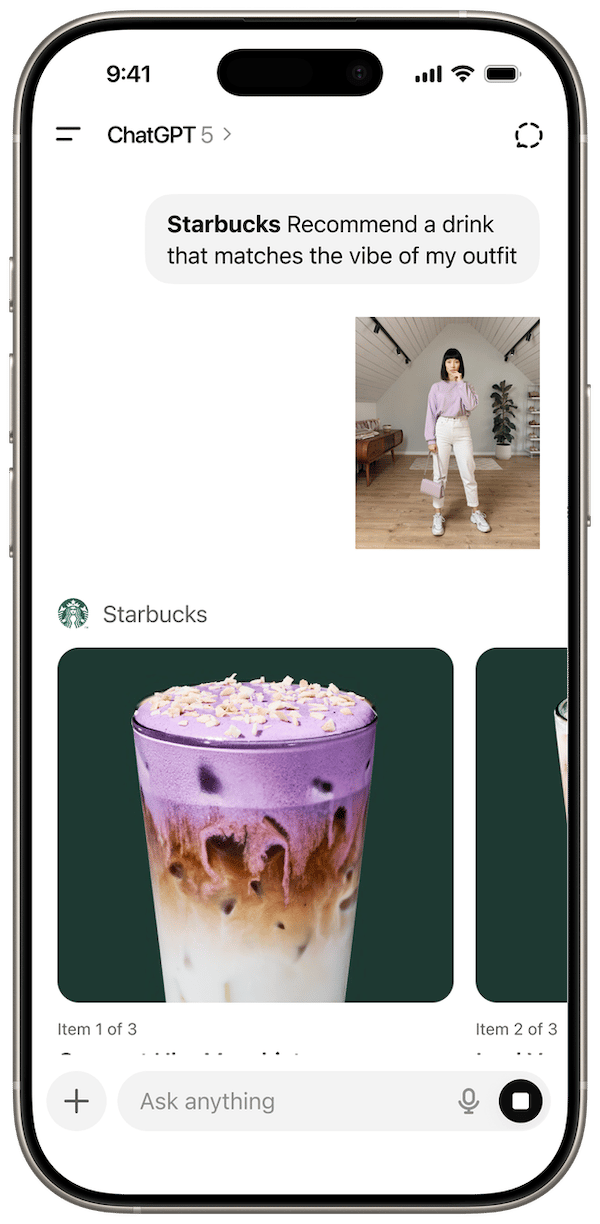
In a significant move to enhance customer personalization and streamline the ordering process, Starbucks has initiated a pilot program integrating its ordering capabilities with ChatGPT, the widely recognized artificial intelligence chatbot. This innovative initiative, which began on Tuesday, allows customers to discover and customize their ideal Starbucks beverage by engaging in natural language conversations with an AI-powered Starbucks app within the ChatGPT ecosystem. The move positions Starbucks as a pioneer among major restaurant chains in leveraging conversational AI for direct customer engagement and order initiation, signaling a new frontier in the intersection of artificial intelligence and the food service industry.
The Genesis of "Mood-Based" Ordering
The core of this new offering lies in its ability to move beyond traditional menu browsing. As highlighted by Paul Riedel, Senior Vice President of Digital and Loyalty at Starbucks, customers increasingly begin their beverage selection journey not with a fixed menu, but with a feeling or a specific craving. "Over the past year, one thing has become clear: customers aren’t always starting with a menu. They’re starting with a feeling," Riedel stated. "We wanted to meet customers right at that moment of inspiration and make it easier than ever to find a drink that fits." This philosophy underpins the development of the ChatGPT app, designed to interpret nuanced customer inputs such as mood, current cravings, the prevailing weather conditions, or even the user’s attire.
The user experience is designed to be intuitive. Customers access the Starbucks app by navigating through the ChatGPT app directory, searching for "@starbucks," and then enabling the integration. Once active, they can engage in a dialogue with the AI. For instance, a customer seeking a less sweet beverage can simply express this preference, and the AI will generate suitable recommendations from Starbucks’ extensive menu. The system also allows for a more visual approach, enabling users to upload a photo that captures their current context – be it a sunny day or a particular outfit – from which the AI can infer a suitable drink suggestion.
A Seamless Digital Journey from Inspiration to Order
Following the AI’s recommendation, customers retain full control over their order. They can further customize their chosen beverage within the ChatGPT interface, select their preferred Starbucks location, and then seamlessly transition to the official Starbucks app or website to complete the checkout process. This phased approach ensures that while the initial discovery and personalization occur within the AI environment, the secure and familiar payment and order finalization take place on Starbucks’ dedicated platforms.
This integration represents a strategic leap for Starbucks in fortifying its position within the highly competitive beverage market. The company faces mounting pressure from both established quick-service giants expanding their beverage offerings, such as McDonald’s and Taco Bell, and specialized drive-thru competitors like Dutch Bros and 7 Brew, which have rapidly gained traction. By embracing cutting-edge technology, Starbucks aims to not only differentiate itself but also reinforce its image as a forward-thinking, tech-savvy brand.
AI as a Catalyst for Discovery and Customer Delight
The implications of this technological adoption extend beyond mere order placement. Starbucks views this AI integration as a powerful tool for sparking creativity and encouraging beverage discovery among its customer base. "This is the kind of technology that sparks creativity and helps customers discover something new," Riedel explained. He further elaborated on the positive impact on in-store staff: "For our baristas, it means customers arrive feeling more ready, more inspired and more excited about the drink they’re about to enjoy." This suggests a potential for improved operational efficiency and enhanced customer satisfaction, as baristas can focus on crafting drinks for customers who have a clearer idea of their preferences.
The company acknowledges that this initiative is currently in a testing phase. "This is a test, and that the company would learn from the test as more customers use it," Riedel confirmed. This iterative approach underscores Starbucks’ commitment to refining its technological integrations based on real-world user feedback and data. "Riedel called it ‘an opportunity for us to listen, learn and refine as we go. You’ll see us continue exploring new ways technology can delight our customers while supporting our baristas.’" The sentiment is one of continuous evolution, with the company hinting at further exploration of AI’s potential to enhance the customer experience. "This is only the beginning," he concluded, signaling a long-term vision for technology integration.
Broader Industry Context and Future Outlook
Starbucks’ foray into conversational AI for order initiation is not an isolated event but rather a reflection of a broader trend across various industries. The rapid advancements in Large Language Models (LLMs) like ChatGPT have opened up new avenues for businesses to interact with consumers in more personalized and dynamic ways. For the quick-service restaurant sector, this translates to enhanced customer engagement, improved order accuracy, and potentially increased sales through more tailored recommendations.
The ability of AI to process and interpret natural language allows for a level of interaction that surpasses traditional graphical user interfaces. Instead of navigating through multiple menus and sub-options, customers can articulate their desires in plain language, making the ordering process more accessible and less time-consuming. This is particularly beneficial for complex menus with numerous customization options, such as Starbucks’.
Chronology of AI Integration in Food Service (Illustrative)
While Starbucks’ direct conversational AI order initiation is a recent development, the broader integration of technology in the food service industry has been ongoing:
- Early 2010s: Rise of mobile ordering apps, allowing customers to pre-order and pay for food and beverages.
- Mid-2010s: Increased adoption of self-service kiosks in fast-food chains, reducing reliance on human cashiers for order taking.
- Late 2010s: Expansion of delivery services and partnerships with third-party platforms, integrating digital ordering with logistics.
- Early 2020s: Emergence of AI-powered chatbots for customer service inquiries and basic order taking on brand websites and apps.
- 2023-2024: Pilot programs and wider adoption of advanced AI, including LLMs, for personalized recommendations, order customization, and conversational commerce, as exemplified by Starbucks’ ChatGPT integration.
Analysis of Implications
For Customers:
- Enhanced Personalization: The ability to describe moods, cravings, or even upload visual cues for drink recommendations offers a highly personalized experience.
- Convenience and Efficiency: Natural language interaction can simplify the decision-making process, especially for those unfamiliar with the full menu or seeking something specific.
- Discovery: AI can introduce customers to new drinks or customizations they might not have discovered through traditional browsing.
For Starbucks:
- Competitive Advantage: Being an early adopter of this advanced AI application can enhance brand perception and attract tech-savvy consumers.
- Data Insights: Interactions with the AI can provide valuable data on customer preferences, trends, and popular customization patterns, informing future menu development and marketing strategies.
- Operational Efficiency: If successful, this could lead to more informed customers arriving at stores, potentially reducing order times and improving barista workflow.
- Brand Modernization: The integration with a leading AI platform like ChatGPT positions Starbucks as a modern, innovative company.
Challenges and Future Considerations:
While promising, this integration is not without its potential challenges. Ensuring the AI accurately interprets all customer inputs, maintaining data privacy and security, and managing customer expectations regarding AI capabilities are crucial. The cost of developing and maintaining such sophisticated AI integrations also needs to be considered. Furthermore, the human element of customer service, often a hallmark of brands like Starbucks, will need to be carefully balanced with technological advancements.
As Starbucks continues to test and refine this AI-powered ordering system, its success will likely pave the way for further adoption of similar technologies across the quick-service industry. The company’s willingness to experiment with cutting-edge AI signifies a commitment to innovation, aiming to redefine the customer journey from initial inspiration to final sip. The journey of finding the perfect cup of coffee has indeed become a dialogue, mediated by the intelligence of machines.
