

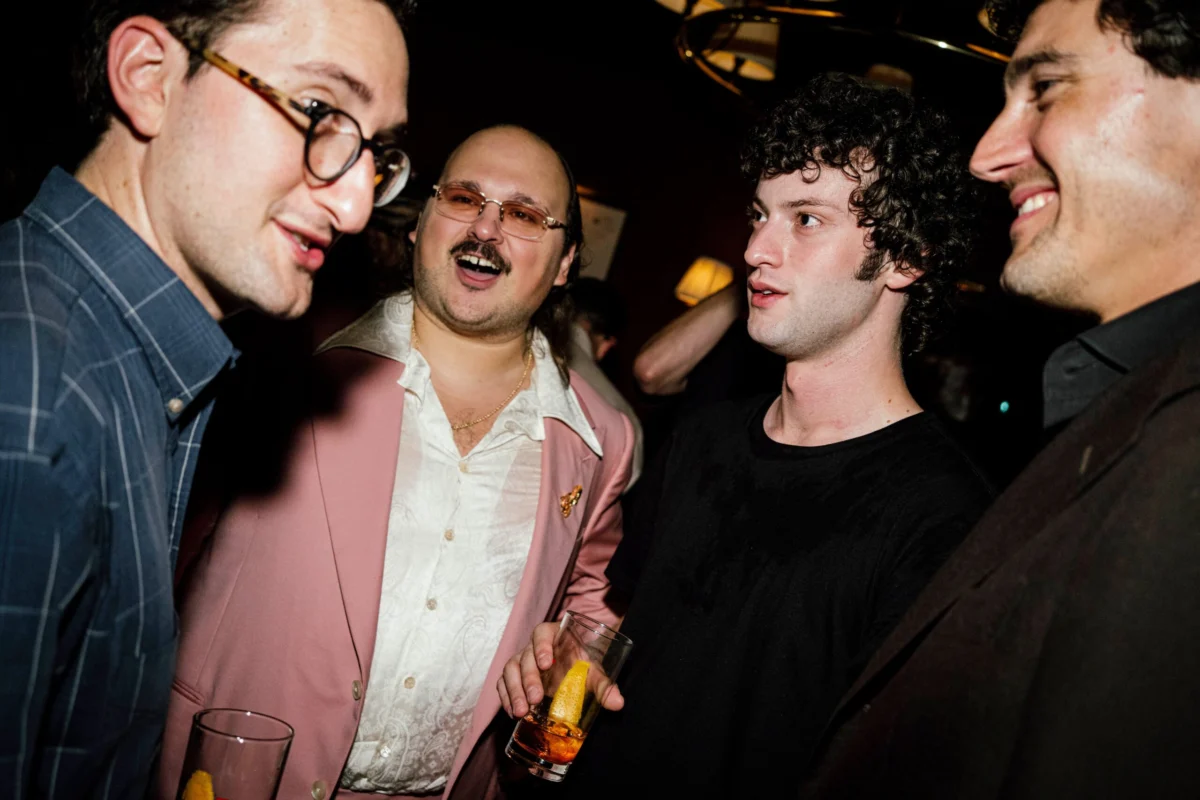
The Golden Steer, a bastion of old-school Manhattan opulence with its deep-button tufted leather banquettes, mirrored columns, and dark wood paneling, recently played host to the premiere party for Tony, A24’s much-anticipated biopic on the late Anthony Bourdain. This glittering Greenwich Village steakhouse, known for its lavish atmosphere and a menu featuring steaks that can reach a formidable $240, presented a paradox. It was an undeniably glitzy setting, one that Bourdain, with his well-documented preference for the unpretentious, salt-of-the-earth establishments like New York’s venerable Keen’s Steakhouse, might have ostensibly scoffed at. Yet, the choice of venue held a profound, almost poetic resonance: the very building at One Fifth Avenue once housed Vince and Linda’s in the 1990s, a crucial chapter in the Bourdain-iverse where he honed his craft as a chef, long before he became a global culinary icon.
The evening, a Tuesday, was thick with the palpable spirit of Bourdain, yet it also served as a stark reminder of the seismic shifts that have reshaped the food world since his passing eight years prior. The sophisticated buzz of the Golden Steer underscored the dramatic evolution of culinary culture, which has accelerated into hyperdrive, largely driven by viral trends and the pervasive influence of social media. The era of "Bourdain-ing" a fantastic, hidden gem of a restaurant – elevating it through genuine discovery and authentic storytelling – has seemingly been supplanted by an influencer-heavy landscape, often yielding mixed and sometimes inauthentic results. This juxtaposition left many attendees yearning for a simpler time in food, an era preceding mimosa towers and when the nuanced flavor of brown butter was still a culinary revelation rather than a ubiquitous ingredient.
The Iconic Venue and Its Echoes of Bourdain
The Golden Steer, an establishment that has quickly cemented its place in New York City’s competitive dining scene, embodies a certain classic American steakhouse grandeur. Its interior design, characterized by the plush, tufted leather, reflective surfaces, and rich wood, speaks to an era of refined dining, an experience often associated with exclusivity and indulgence. This aesthetic stands in sharp contrast to the culinary philosophy Bourdain famously championed throughout his career: a reverence for authentic, often gritty, street food, dive bars, and local eateries that prioritized flavor and cultural immersion over ostentation. His admiration for places like Keen’s, a New York institution since 1885, was rooted in its historical gravitas, its straightforward menu, and its unwavering commitment to tradition without excessive fanfare. The $240 steak at the Golden Steer, a price point indicative of luxury dining, would likely have been met with Bourdain’s signature sardonic wit, as he frequently critiqued the pretentiousness and exorbitant pricing often found in high-end gastronomy.
However, the historical significance of the One Fifth Avenue address transcends the present-day aesthetic. For fans of Bourdain, this location is hallowed ground. In the early 1990s, before the meteoric rise ignited by Kitchen Confidential, Anthony Bourdain served as the chef at Vince and Linda’s, a restaurant that occupied the very same space. This period was formative for Bourdain, a time when he was navigating the demanding, often brutal, realities of professional kitchens in New York City. It was a crucible where his culinary skills were sharpened, his understanding of the industry deepened, and perhaps, where the seeds of his distinctive narrative voice began to germinate. Hosting the premiere party here offered a poignant full-circle moment, connecting the celebration of his legacy to the very foundations of his career, a subtle acknowledgment of his journey from a working chef to a global cultural phenomenon.

"Tony" – A Cinematic Homage to a Culinary Icon
The centerpiece of the evening, of course, was the A24 biopic Tony. A24, a production company renowned for its critically acclaimed and often boundary-pushing films (such as Everything Everywhere All at Once and Moonlight), brings a significant gravitas to the Bourdain story. The decision to greenlight a biopic underscores Bourdain’s enduring cultural impact, transcending the culinary world to become a figure of broader artistic and philosophical significance. The film aims to explore the complex layers of Bourdain’s life, from his struggles and triumphs in the kitchen to his transformative career as a writer and television host, ultimately grappling with the enigmatic figure he remained until his untimely death in 2018.
Dominic Sessa, who portrays Bourdain in the film, was a focal point of the party. Sporting Bourdain-esque curls – a deliberate choice that, while missing Bourdain’s iconic mutton chops, clearly evoked his image – Sessa was observed swirling a glass of red wine, tucked into one of the massive banquettes. His casting has been met with considerable anticipation, as capturing Bourdain’s unique blend of cynicism, charisma, and intellectual curiosity is a formidable task. Early reactions from those who attended the premiere screening were largely positive. Christina Chaey, a respected food writer and former Bon Appétit editor, confided that the film surprised her, moving her to tears on several occasions. Ludwig Hurtado, author of the forthcoming book Bad Foodies, resonated with a specific narrative thread, remarking, "Who among us hasn’t gone to Provincetown, said we’re writing a book, and hasn’t written anything?" These initial sentiments suggest the film successfully delves into the more human, relatable aspects of Bourdain’s journey, connecting with audiences on an emotional level beyond his public persona.
A Guest List Reflecting Bourdain’s Enduring Influence
The premiere party’s guest list was a vibrant tapestry of individuals from the culinary, media, and entertainment worlds, all drawn by Bourdain’s indelible influence. Beyond Dominic Sessa, his co-star, podcaster Stavros Halkias, cut a distinctive figure, maneuvering through the crowded room in a salmon pink leisure suit, adding a touch of unexpected sartorial flair to the formal setting. Celebrity guests included Subway Takes creator Kareem Rahma, who was seen in a corner with actor Cole Sprouse, both poring over an A24-produced Bourdain coffee table book titled Happier, Stupider Times that was prominently displayed. This particular detail highlighted A24’s comprehensive approach to celebrating Bourdain’s legacy, extending beyond the film to curated merchandise that speaks to his literary and philosophical contributions.
The room was, naturally, teeming with prominent figures from the food media landscape. Among them were food writers and former Bon Appétit editors Christina Chaey and Aliza Abarbanel, Ludwig Hurtado, and podcaster and writer Peyton Dix. Their presence underscored Bourdain’s profound impact on food journalism and criticism, as he redefined the genre by infusing it with personal narrative, cultural commentary, and an uncompromising search for authenticity. Chefs Anthony Ha and Eric Ripert, a close friend and frequent collaborator of Bourdain’s, were noted to have attended the film’s premiere but reportedly departed before the after-party, perhaps preferring a more private moment of reflection. Top Chef‘s Gail Simmons was observed floating through the crowd, encountering Jonah Reider, famously known for the clandestine supper club he operated out of his Columbia University dorm room – a testament to the diverse and often unconventional talent that Bourdain’s career inspired and celebrated.
The catering for the event was a curated experience in itself, reflecting Bourdain’s eclectic tastes and his appreciation for both high-low culinary experiences. Guests enjoyed frosty martinis, a classic cocktail often associated with Bourdain’s sophisticated yet straightforward preferences. Passed trays featured delicate lobster thermidor tartlets, an elevated appetizer that fit the luxurious ambiance of the Golden Steer. More notably, the party’s culinary offerings included smoked salmon and cream cheese bagels from the iconic New York institution Barney Greengrass, a nod to classic deli culture, alongside bowls of Mapo Tofu from acclaimed chef Danny Bowien. This blend of traditional New York deli fare and innovative, globally inspired dishes mirrored Bourdain’s own culinary journey, which celebrated both local traditions and international flavors with equal enthusiasm.

The Shifting Tides of Food Culture – A Post-Bourdain World
The atmosphere, while celebratory, also carried an undercurrent of reflection on how much the culinary landscape has transformed in the eight years since Bourdain’s death. His passing in 2018 coincided with the accelerating ascendancy of social media as a dominant force in food culture. What was once a niche interest has now gone into "hyperdrive," evolving into a global phenomenon where trends ignite and spread instantaneously. The "business of Bourdain-ing a fantastic hole-in-the-wall restaurant" – a process of authentic discovery and storytelling that introduced countless hidden gems to a wider audience – has, in many ways, been co-opted and commodified. Influencers, often driven by algorithms and brand partnerships, now frequently dictate public perception, sometimes prioritizing aesthetic over substance, leading to "mixed results" and a sense of inauthenticity that Bourdain himself often railed against.
This new paradigm is characterized by elements like "mimosa towers," elaborate and often gimmicky presentations designed for viral social media content, and the transformation of once-novel ingredients like "brown butter" into culinary clichés. The author’s yearning for a "simpler time in food" is a sentiment echoed by many long-time observers of the industry, who perceive a loss of genuine discovery and a saturation of manufactured experiences.
Bourdain, known for his acerbic commentary and his disdain for pretension, would undoubtedly have had strong opinions on the current state of the restaurant industry. One conversation at the party delved into this hypothetical, imagining Bourdain grumbling about the "reservation-obsessed" culture, where securing a table at a popular eatery can feel like a competitive sport. He would likely have critiqued the "influencer-heavy" scene, where a restaurant’s success can hinge more on its Instagrammability than the quality of its food or service. Furthermore, the harsh economic realities facing restaurants, particularly in New York City, would have resonated deeply with him. The soaring commercial rents have led to the tragic closure of many "legacy stalwarts" – beloved establishments headed by celebrated chefs, like Tom Colicchio’s Craft, which could no longer sustain operations. These closures represent a significant loss to the cultural fabric of a city, a lamentable outcome for an industry Bourdain passionately advocated for.
A particularly poignant anecdote from the party involved a guest’s fruitless "quest" to find a cigarette – "an apt quest at any Bourdain-adjacent function." In an era where smoking is increasingly marginalized, even at a high-profile, somewhat rebellious event, the inability to bum a single cigarette symbolized a broader shift. Bourdain, with his rock-and-roll sensibility and his embrace of life’s rougher edges, was often pictured with a cigarette, a visual shorthand for his counter-cultural persona. The difficulty of finding one at his own biopic after-party subtly underscored how much the world, even the world that celebrates him, has changed from the one he inhabited.
Examining Bourdain’s Legacy in a New Era
The consensus among attendees that the film was "good" and emotionally impactful highlights Bourdain’s enduring appeal. He wasn’t just a chef or a TV host; he was a storyteller, a provocateur, and a philosopher who articulated the profound connections between food, culture, and humanity. The biopic, backed by A24, serves as a crucial artifact in preserving this legacy, ensuring his stories and perspectives continue to reach new generations.

However, the question of "Would Bourdain have liked it?" remains complex. One guest, who had met him multiple times, speculated, "Maybe later in his life when he’d matured." This suggests that while the younger, more rebellious Bourdain might have disdained the glitz, a more seasoned Bourdain might have appreciated the sentiment and the artistic merit of the tribute, even if he maintained his characteristic skepticism about the trappings of fame.
Bourdain consistently reminded his audience that "restaurants, food culture—hell, culture, more broadly—is ephemeral." He understood that trends fade, establishments close, and even the most iconic figures eventually recede into history. This philosophical underpinning of his work makes the current moment, where his legacy is being celebrated in a dramatically altered landscape, all the more resonant. He wasn’t naive enough to believe that the "challenging, impossible, dazzling food world of 2026" would be one he would wholeheartedly embrace. Yet, as the article concludes, he also wasn’t "cynical enough to think he’d surrender to it." Instead, he would likely have continued to challenge, question, and seek out the authentic amidst the artificial, the enduring amidst the ephemeral.
His legacy, therefore, is not merely about preserving the past but about providing a framework for engaging with the present. The premiere party for Tony at the Golden Steer, with its blend of historical significance, contemporary glamour, and underlying reflections on a rapidly changing world, encapsulated the very essence of Bourdain’s complex and enduring impact. It was a celebration not just of a man, but of the ongoing conversation he ignited about food, culture, and what it truly means to live an examined life. In an ever-evolving world, Bourdain’s voice, channeled through cinema and collective memory, continues to resonate, challenging us to look beyond the surface and to appreciate the profound stories simmering beneath.
