

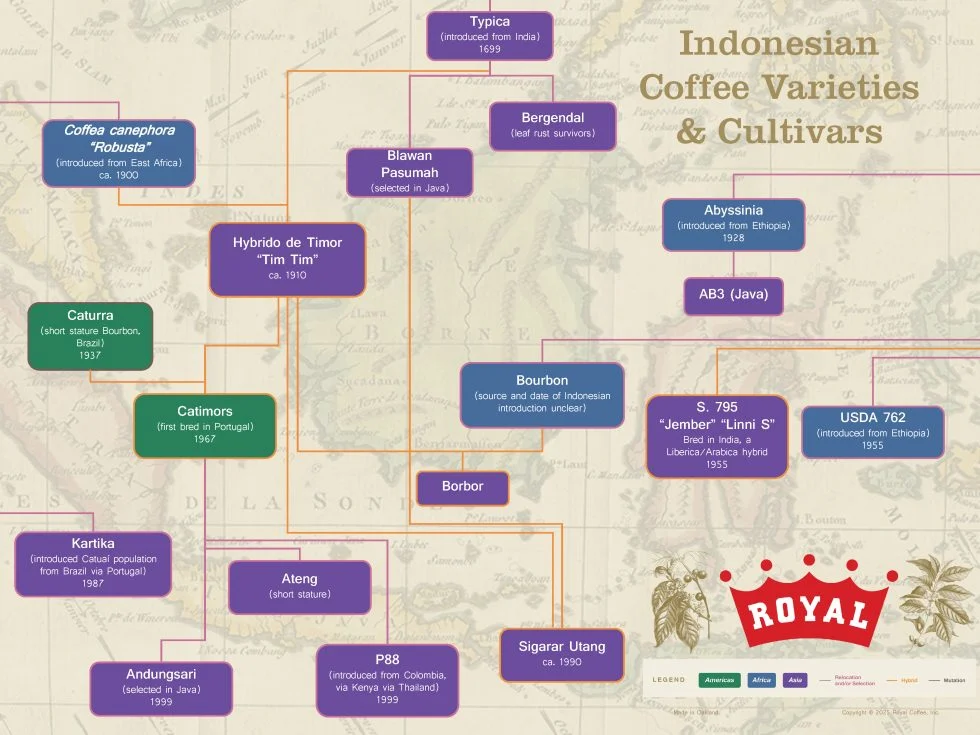
Indonesia’s profound connection to coffee cultivation stretches back over three centuries, beginning in 1699 with the introduction of plants by Dutch colonial traders. This archipelago nation, the world’s largest and the fourth most populous globally, has not only nurtured coffee but has also played a pivotal role in its botanical and commercial evolution. The very origins of the Typica variety of Arabica coffee can be traced to the Indonesian island of Java, from where it was transported to the botanical gardens of the Netherlands and subsequently disseminated across the globe. This foundational contribution underscores Indonesia’s indelible mark on the history of coffee.
The late 19th century presented a significant challenge to Indonesian coffee production when a devastating outbreak of coffee leaf rust swept through the islands. This crisis served as a critical inflection point, transforming Indonesia into a vital testing ground for alternative coffee species more resilient to the fungal disease. Prominently, Coffea canephora, commonly known as Robusta, was introduced and cultivated extensively. Efforts to enhance the resilience and genetic diversity of the nation’s coffee output also led to the introduction of Liberica and Excelsa varieties. These introductions, driven by necessity and a forward-looking approach to agricultural challenges, laid the groundwork for the robust and diverse coffee industry that exists today.
In the contemporary global coffee market, Indonesia consistently ranks among the top five coffee-producing nations by volume. In 2024, the country is estimated to have produced approximately 11 million 60-kilogram bags of coffee. A significant aspect of this production is local consumption, with over a third of the coffee grown on the islands being enjoyed domestically rather than being destined for export markets. This substantial domestic demand not only supports local economies but also reflects a deeply ingrained coffee culture within Indonesian society.
Indonesia’s sustained relevance in modern coffee production is a testament to its enduring agricultural heritage and strategic positioning. The nation benefits from a robust genetic stock of coffee plants, a deeply entrenched history of cultivation and processing expertise, and its proximity to rapidly expanding coffee consumer markets across Asia. Islands such as Java, Sumatra, Sulawesi, Bali, and Flores, despite facing environmental challenges like rising temperatures, unpredictable weather patterns, typhoons, and seismic activity, appear well-positioned to maintain and potentially increase their coffee production into the foreseeable future. This resilience is built upon a combination of favorable climate conditions in certain regions, ongoing research and development, and a skilled agricultural workforce.
The intricate relationship between the Indonesian archipelago, its coffee production, and its consumption patterns has naturally given rise to a unique lexicon and a diverse array of coffee cultivars and varieties. This report aims to provide a comprehensive overview of these Indonesian coffee cultivars and varieties, drawing from historical records, research institutes, and local knowledge.
The Pantheon of Indonesian Coffee Cultivars
The following is a detailed exploration of notable coffee cultivars and varieties found and developed within Indonesia, highlighting their origins, characteristics, and significance.
Abyssinia: Often referred to as "Abyssinian Arabica," this cultivar’s introduction to Indonesia is credited to P.J.S. Cramer, a former director of coffee research in Java. In 1928, Cramer reportedly brought seeds directly from estates in Abyssinia (present-day Ethiopia) to Indonesia. Eleven selections were made, with seven (AB1-AB7) being released. These selections, known locally as "Abyssinia" or cognates like "Adsenia" or "Abissinie," have a remarkable global reach. Notably, selection AB3, originating from Java, was later transferred to Cameroon and subsequently to Costa Rica, from where its genetics spread throughout the Americas. Morphologically similar to Typica, AB3 was often mistaken for a relative. However, genetic fingerprinting by World Coffee Research has validated its direct Ethiopian provenance. The cultivar AB3 is globally recognized as "Java."
Andungsari: This is a dwarf Catimor variety that thrives in full sun and demands high agricultural inputs. It exhibits susceptibility to leaf rust. Andungsari 1 was specifically selected in 1982 by the Indonesian Coffee and Cocoa Research Institute (ICCRI) in East Java. The selection process involved extensive agronomic trials, evaluating yield, quality, and other crucial factors over approximately 17 years. It was officially recognized as a commercial variety by the Ministry of Agriculture in 1999.
Ateng: The name "Ateng" is an abbreviation for "Aceh Tengah," a region in Sumatra. It is also coincidentally the name of a well-known Indonesian comedian. This Catimor variety was selected for its short stature, making the coffee shrubs easier to harvest. Generally cultivated at lower altitudes due to its inherent disease resistance, Ateng is not typically considered a high-quality cultivar but is widely planted across the country. It is sometimes referred to as "Ateng Jeluk" or "Ateng Super."
Bergendal: This cultivar is an apocryphal designation for old Typica-type trees that demonstrated remarkable resilience and survived the initial Coffee Leaf Rust outbreak in the late 19th century. Its survival is often attributed to natural resistance or adaptation.
Blawan Pasumah: A Typica selection originating from East Java, this variety is likely named after the Blawan Estate, a significant coffee plantation in the region. Its history is closely tied to the development of Typica in Indonesia.
Borbor: This variety is a hybrid resulting from a cross between Hybrido de Timor and Bourbon. Its genetic makeup combines traits from two distinct and important coffee lineages.
Gayo Dua: A cross between Tim Tim (a Hybrido de Timor) and Bourbon, Gayo Dua is subject to genetic variance due to interbreeding and propagation from seed. There are also rumors suggesting it might be a cross with S. 795 rather than Bourbon. This variety shares lineage with Borbor.
Gayo Satu: Initially a selection of Hybrido de Timor, Gayo Satu has evolved into a cross involving Tim Tim and other locally grown varieties. It is primarily found in the Gayo region of Sumatra and reflects the dynamic nature of cultivar development in response to local conditions.
Hybrido de Timor (HdT): This is the original Arabica-Canephora hybrid, which arose spontaneously and was later reproduced commercially. Today, HdT is not commonly found as a pure variety but exists within the genetic makeup of many more popular cultivars. Locally, it is known as "Tim Tim."
Java: This entry refers to the cultivar known as Abyssinia. The historical significance of "Java" as a variety name is deeply intertwined with its origin and early dissemination from Indonesia.
Jember: This is a local name commonly used for the S. 795 variety in Indonesia, reflecting its introduction and widespread cultivation through the Jember research station.
Kartika: The name "Kartika" is derived from "Kopi Arabica Tipe Katuai," indicating it is an Arabica coffee of the Catuai variety. It was introduced to Indonesia in 1987 as part of a multi-location variety trial sponsored by Portugal. While capable of producing high-quality coffee, Kartika is highly susceptible to leaf rust and requires significant agricultural inputs.
Komasti: A portmanteau of "Komponen Andungsari Tiga" (Andungsari Component Three), Komasti is a development of the ICCRI (Indonesia Coffee and Cocoa Research Institute), also known as Puslitkoka. This variety is composed of six genotypes, which raises concerns about genetic stability when propagated from seed. Growers favor Komasti for its rapid fruiting, large cherry size, and importantly, its resistance to coffee leaf rust, a trait absent in the original Andungsari variety.
Kopyol: This variety is a cross between Tim Tim (Hybrido de Timor) and other local species, predominantly found in Bali. Its unique genetic blend contributes to the diverse coffee profiles emerging from the island.
Lini S: This is another local designation for the S. 795 variety, emphasizing its status as a selected lineage.
Onan Ganjang: A selected variety from the Humbang Hasundatan Regency in North Sumatra, southwest of Dolok Sanggul. While some sources classify it as pure Arabica, others suggest it is a cross involving Bourbon and S. 795 genetics. This variety was specifically chosen for its larger bean size, a desirable trait for many coffee consumers and roasters.
P88: This cultivar is a Colombian selection, likely a Catimor, initially introduced to Kenya and then to Thailand. It was brought to the Gayo region of Indonesia from Thailand in 1989. Its journey highlights the international exchange of coffee germplasm.
Rambung: This name is sometimes used synonymously with Abyssinia AB7. Alternatively, it can denote a cross between AB7 and Hybrido de Timor, indicating a hybrid lineage with potential for enhanced resilience.
Rasuna/Lasuna: Reportedly a cross between Typica and Catimor, this variety combines the historical significance of Typica with the disease resistance often associated with Catimor hybrids.
S. 795: Released in 1946 by India’s Central Coffee Research Institute (CCRI) as "Selection 3," S. 795 remains widely cultivated in both India and Indonesia. In Indonesia, it is known locally as Lini S or frequently Jember, named after the research station in East Java through which it was introduced to the region starting in 1955. This variety is a product of crossing Kent with an interspecific hybrid of Liberica and Arabica known as S. 228 (CCRI’s "Selection 1"). The development of S. 228 dates back to the mid-1930s and is believed to have originated from a spontaneous hybridization. S. 795 is recognized for its robust yield and good cup quality, making it a cornerstone of Indonesian coffee production.
Sigarar Utang: Sometimes spelled "Sigararutang," this variety is a hybrid cross of Arabica and Hybrido de Timor selection 831. It is steeped in local lore, with its name translating to "the payer of debts," a nod to its rapid maturation and high productivity. While sometimes confused with Ateng (a Catimor), it is generally considered distinct, though some sources suggest Sigarar Utang is a selection of Ateng. Rumors surrounding its selection point to Opung Sopan Boru Siregar in Desa Batu Gajah, Paranginan, Lintong, Humbang Hasundatan on Sumatra, reportedly in the late 1980s. It was purportedly introduced by ICCRI in the 1990s and officially endorsed by the Ministry of Agriculture in 2005. Genetic testing indicates that while it clusters closely with Ateng, it is likely a Typica (Blawan Pasumah) crossed with Hybrido de Timor, offering a complex genetic profile.
Tim Tim: Short for "Timor Timur" (East Timor), this is the original Hybrido de Timor, a spontaneous cross between Canephora and Arabica. Similar to HdT, it is no longer commonly found as a distinct variety but forms part of the genetic heritage of many cultivated lines.
USDA: Officially designated USDA 762, this selection was sourced from Ethiopian stock originating in Mizan Tafari, in the western Kaffa region. It was collected by Jean B. H. Lejeune and brought to Indonesia by the Food and Agriculture Organization (FAO) in 1955. The pronunciation is often rendered as "oos-dah." This variety represents a significant contribution from Ethiopian germplasm to Indonesian coffee diversity.
Other Cultivars with Unclear Taxonomy/Provenance: Beyond these well-documented varieties, other cultivars such as Gayu Tigre and Kobra are known to exist within Indonesia, though their exact taxonomic classifications and precise origins remain subjects of ongoing research and local knowledge.
A Legacy of Resilience and Innovation
Indonesia’s journey with coffee is a narrative of adaptation, resilience, and continuous innovation. From the introduction of Typica to the widespread cultivation of disease-resistant hybrids, the nation has consistently demonstrated its capacity to evolve within the demanding global coffee landscape. The historical challenges posed by coffee leaf rust spurred crucial advancements in plant breeding and selection, leading to the development and adoption of varieties like Robusta and various hybrids.
The ongoing efforts by institutions like the Indonesian Coffee and Cocoa Research Institute (ICCRI) are vital in maintaining and enhancing the genetic diversity and quality of Indonesian coffee. Through rigorous research, selection, and dissemination of improved coffee varieties, these bodies contribute to the sustainability of the sector and the livelihoods of countless farmers.
The significant domestic consumption of coffee within Indonesia further strengthens its position in the global market. It creates a stable demand base and fosters a rich coffee culture, influencing consumer preferences and driving innovation in processing and brewing methods.
Broader Implications and Future Outlook
Indonesia’s role as a major coffee producer is intrinsically linked to global coffee prices, supply chain stability, and the availability of diverse coffee offerings. The nation’s ability to produce substantial volumes of coffee, coupled with its growing domestic market, provides a unique dynamic in international trade.
As climate change continues to pose challenges to agricultural production worldwide, Indonesia’s focus on developing and cultivating resilient coffee varieties will be increasingly important. The ongoing research into genetics, disease resistance, and adaptation to changing environmental conditions will be critical for ensuring the long-term viability of coffee farming in the archipelago.
Furthermore, the rich tapestry of Indonesian coffee cultivars represents a significant contribution to the global coffee gene pool. The unique characteristics of these varieties, from the aromatic complexities of Abyssinia to the robust yields of S. 795 and the resilience of modern hybrids, offer a diverse palette for coffee enthusiasts and industry professionals alike. The continued exploration and understanding of these cultivars will undoubtedly enrich the global coffee experience and solidify Indonesia’s legacy as a vital player in the world of coffee.
This comprehensive overview, supported by contributions from researchers and industry experts, underscores the depth and complexity of Indonesia’s coffee heritage, highlighting its enduring significance from historical introduction to its current standing as a global coffee powerhouse.
