

In the landscape of contemporary mixology, the Purl is frequently categorized as a straightforward combination of British ale and a measure of gin. To the modern palate, this beverage is understood as a historical relic of 18th and 19th-century British bar culture, typically prepared with Old Tom gin—a slightly sweeter, more botanical precursor to the London Dry style—and a traditional British Bitter served at cellar temperatures. However, a deeper investigation into the historical record reveals that the Purl’s identity has undergone a series of radical transformations over the past four centuries. What began as a bitter medicinal tonic intended to ward off the bubonic plague eventually evolved into a complex, egg-laden "flip" before finally settling into its current, simplified form. This trajectory reflects broader shifts in European medicine, social class structures, and the industrialization of the spirits trade.
The Medicinal Origins of the 17th Century
The earliest iterations of the Purl were not designed for recreational consumption but were instead rooted in the pharmacopeia of the 1600s. During this era, "Purl" referred to a mixture of ale or wine infused with wormwood (Artemisia absinthium). This botanical, known for its extreme bitterness, was prized for its purported antiseptic and digestive properties. In 1665, the publication "Directions for the Prevention and Cure of the Plague Fitted for the Poorer Sort" explicitly recommended the consumption of Purl as a prophylactic measure. The manual advised readers to partake in "a draught or two of Purle… especially in the morning," suggesting that the drink served as a foundational element of public health for those who could not afford more expensive apothecaries.
The accessibility of the Purl during the 17th century underscores its status as a beverage of the working class. Because wormwood was a common herb and ale was a staple of the English diet, the mixture provided a low-cost means of self-medication. By 1684, the drink’s popularity was such that other beverage industries attempted to capitalize on its reputation. In "Aphorisms upon the New Way of Improving Cyder," proponents of the cider industry argued that a "purl with cider" was just as efficacious as the traditional ale-based version. This indicates that by the late 17th century, the term "Purl" had begun to describe a category of bittered, fortified ferments rather than a single, rigid recipe.
The 18th Century Transition from Medicine to Social Vice
As the threat of the plague receded, the Purl transitioned from a medicinal necessity to a recreational habit, often consumed as a "morning constitutional." This shift brought with it a change in social perception. By the early 1700s, the "Purl-shops" of London had become synonymous with the burgeoning "Gin Craze," a period of extreme alcohol consumption among the urban poor.
Historical records from "The Grub Street Journal" in September 1733 illustrate a growing societal disdain for the drink. In one character attack published in the journal, the consumption of Purl was listed alongside smoking and heavy gin drinking as a sign of moral and physical decay. The addition of distilled spirits to the traditional wormwood-ale mixture likely began during this period, as the availability of cheap, domestically produced grain spirits increased. The Purl was no longer just a bitter tonic; it had become a potent intoxicant used to facilitate "all-day drinking" habits. Despite the criticism from the upper classes, the Purl remained a fixture of London life, providing a cheap and warming stimulant for laborers, dockworkers, and the "poorer sorts" mentioned in earlier medicinal texts.

The 19th Century and the Rise of the Complex Flip
By the Victorian era, the Purl had moved away from its austere, bitter roots and entered a phase of culinary complexity. The 19th century saw the Purl reimagined as a "flip"—a category of drinks involving heat, sugar, and often eggs. This version of the drink was far removed from the simple wormwood infusions of the 1660s.
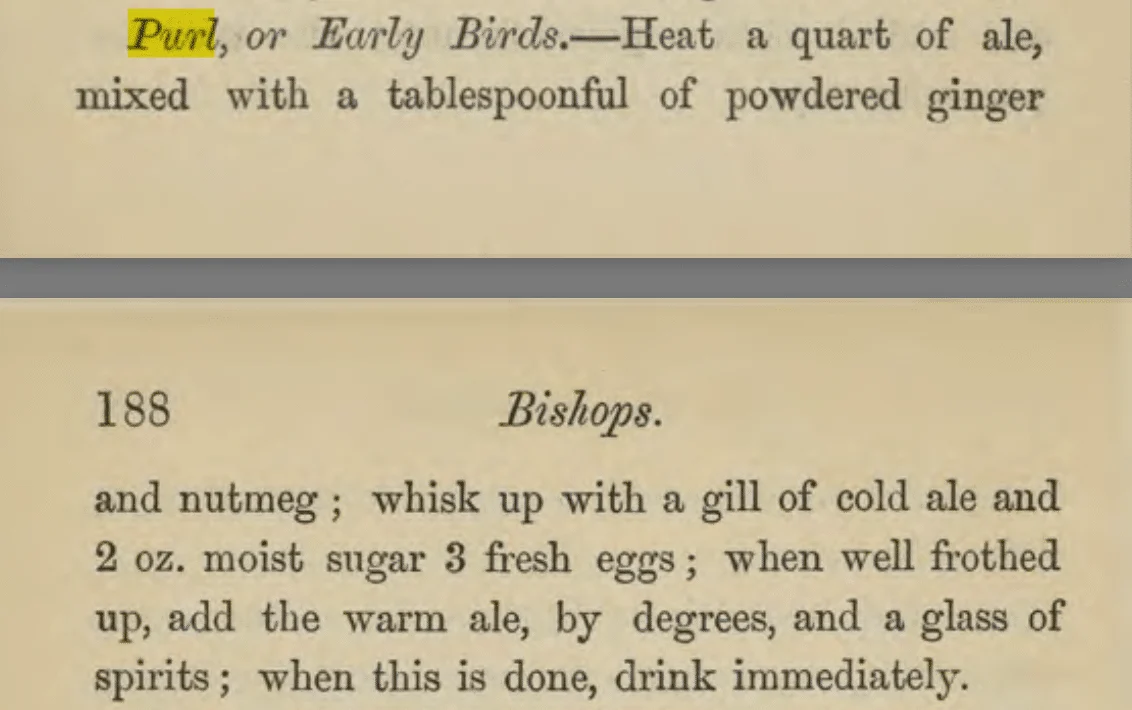
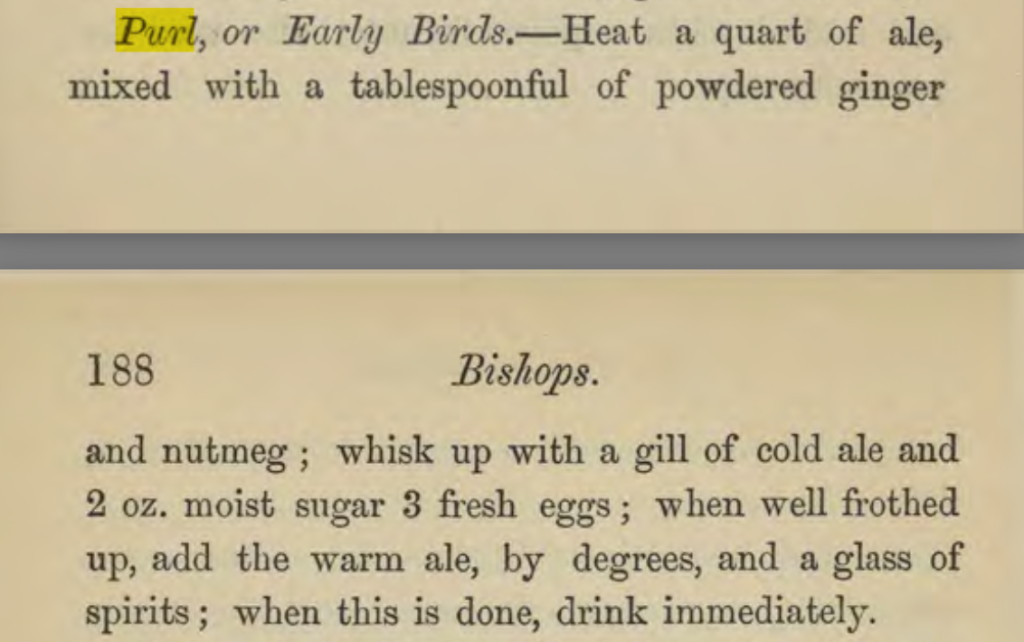
William Terrington’s 1869 volume, "Cooling Cups and Dainty Drinks," which is widely regarded as the first British cocktail book, provides a window into this evolution. Terrington’s recipes for the Purl frequently called for warmed beer and multiple eggs, creating a rich, frothy texture. Crucially, the spirit added to these 19th-century Purls was not exclusively gin. Depending on the patron’s preference or the bar’s inventory, the spirit could just as easily have been brandy, whisky, or rum.

Another recipe in Terrington’s manual, titled the "Ale Cup," specifically designated gin as the primary spirit, suggesting that while the Purl was becoming more complex, a sub-genre of gin-and-ale drinks was beginning to crystallize. This period represented the height of the Purl’s sophistication, where it was served as a restorative, warming beverage in the prestigious coaching inns and public houses of the British Isles.
The 20th Century Simplification and the Standardization of Gin
The 20th century marked a period of consolidation for the Purl. As modern medicine rendered wormwood tonics obsolete and the fast-paced nature of modern bars made the preparation of labor-intensive "flips" less practical, the Purl began to simplify. The use of eggs and elaborate heating processes largely disappeared from standard bar manuals.

By the mid-20th century, gin had emerged as the canonical spirit for the Purl. This shift is documented in several influential cocktail guides:
- 1925: "Summer Drinks and Winter Cordials" by Mrs. Leyel maintained the tradition of warming the ale but removed the complexity of the Victorian flip.
- 1935: "The Art of Mixing Drinks" further codified the gin-and-ale pairing, though it often still suggested the addition of bitters to mimic the lost flavor profile of the original wormwood.
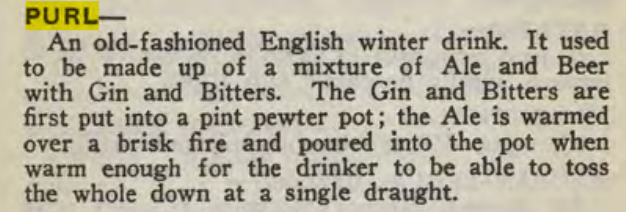
- 1966: "The Barman’s Bible" (Cocktail and Wine Digest) presented the Purl in its most modern form—a simple mixture of gin, ale, and occasionally a dash of bitters or a slice of lemon.
This evolution from a complex, multi-ingredient restorative to a two-ingredient "boilermaker" variant reflects the broader trend of cocktail simplification that occurred following the World Wars. The bitterness once provided by wormwood was replaced by the botanical complexity of gin and the natural hops of the ale.

Technical Analysis of Ingredients and Preparation
To understand the Purl’s longevity, one must analyze the chemical and sensory interplay of its primary components. Historically, the ale used was a "British Bitter," characterized by a malt-forward profile and moderate hopping. When served at cellar temperature (approximately 12-14°C), the ale provides a rich, textured base that carries the higher alcohol content of the spirit without overwhelming the palate.
The choice of Old Tom gin in historical reconstructions is significant. Unlike London Dry gin, which is characterized by a sharp, juniper-forward profile, Old Tom gin is typically pot-distilled and lightly sweetened. This sweetness acts as a bridge between the bitter hops of the ale and the botanical notes of the spirit. In versions of the Purl that include bitters, the addition of Angostura or orange bitters serves as a functional replacement for the wormwood (Artemisia absinthium) used in the 17th century. Wormwood contains thujone and various bitter glucosides which, while no longer used for their perceived medicinal "anti-plague" properties, provided a unique drying sensation that balanced the sweetness of the malt.

Social and Economic Implications
The history of the Purl is inextricably linked to the economic history of London. The drink’s early recommendation for the "poorer sort" highlights the role of alcohol as a substitute for clean water and professional medical care. In the 17th and 18th centuries, fermented beverages were often safer to consume than urban water supplies, and the infusion of herbs like wormwood provided a rudimentary form of health maintenance for the laboring classes.
Furthermore, the Purl’s transition into a gin-based drink mirrors the rise of the British distilling industry. As gin production became a major economic driver in the 18th century, it naturally integrated into existing beverage traditions. The "Purl-house" became a specific type of establishment that catered to a demographic looking for maximum potency at a minimum price, eventually evolving into the modern pub where "a pint and a chaser" remains a common order.

Modern Resurgence and Legacy
In the current era of the "craft cocktail renaissance," the Purl has seen a modest revival among bartenders interested in historical drinks. Modern interpretations often seek to honor the drink’s complex 19th-century roots rather than its simplified 20th-century form. Some high-end bars have experimented with "hot pokers"—an 18th-century technique where a red-hot iron is plunged into the ale, gin, and sugar mixture to caramelize the sugars and create a frothy head.
Despite these artisanal revivals, the Purl remains primarily a footnote in cocktail history, overshadowed by more famous gin drinks like the Martini or the Gin and Tonic. However, its story is a vital record of how taste is shaped by necessity, economy, and time. From a desperate shield against the plague to a Victorian breakfast luxury and finally to a simplified modern ale-fortifier, the Purl stands as a testament to the enduring human desire to refine and reinvent the ritual of the communal drink. The modern definition of "ale + gin" may be simple, but it carries with it the echoes of four centuries of London’s social and medical history.
