

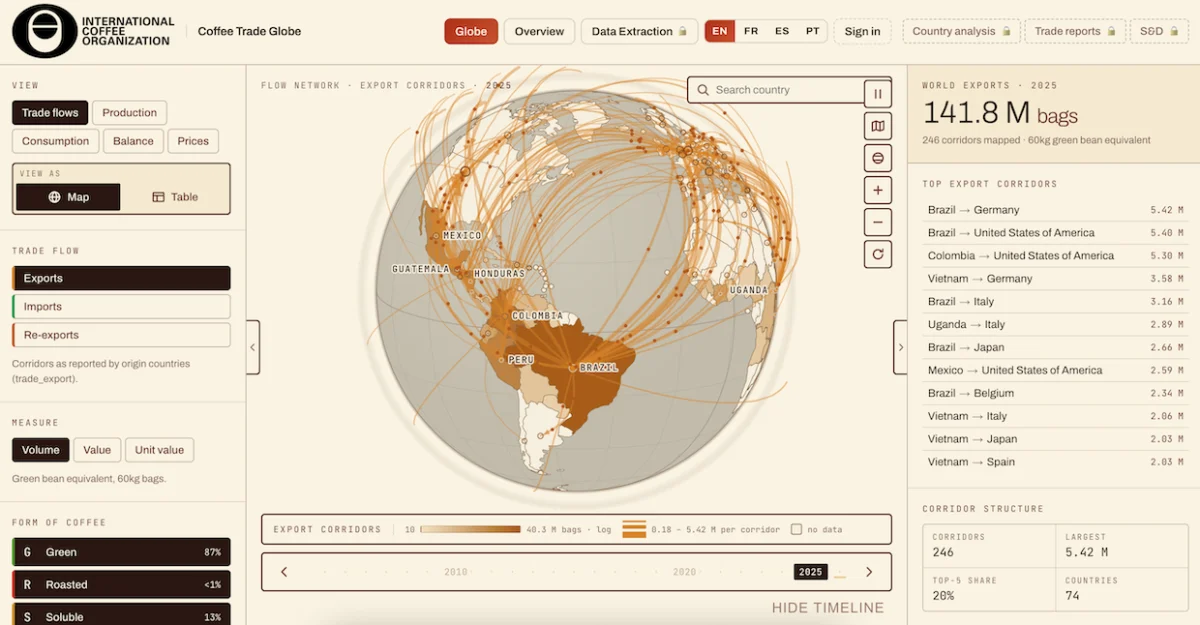
Geneva, Switzerland – In a significant move to democratize access to crucial market data, the International Coffee Organization (ICO) has unveiled its comprehensive Coffee Market Intelligence Platform. This new interactive digital tool, launched this week during the 142nd Session of the International Coffee Council in Geneva, offers free, public access to a vast repository of global coffee market information, encompassing prices, trade flows, production volumes, consumption trends, and certified stock levels. The platform aims to empower stakeholders across the coffee value chain with timely and credible data, fostering more informed decision-making and potentially mitigating market volatility.
For decades, the ICO, an intergovernmental body established in 1963 under the auspices of the United Nations, has been a primary source for many widely cited global statistics related to coffee production, trade, and pricing. However, accessing this wealth of information was often a fragmented process, with data dispersed across various public and private ICO publications, reports, and databases. The new Coffee Market Intelligence Platform consolidates these disparate sources into a single, user-friendly interface, featuring dynamic dashboards, detailed tables, and an innovative interactive 3D globe that visualizes global trade patterns.
Expanding Accessibility: A Paradigm Shift in Data Dissemination
The launch of this platform marks a pivotal expansion of public access to the ICO’s extensive data archives. Previously, much of the granular detail and historical data required subscription or membership to the organization. By making a substantial portion of this information freely available, the ICO is not only enhancing transparency but also leveling the playing field for a wider array of market participants, including smallholder farmers, independent roasters, researchers, and consumers who may not have previously had the resources to access such critical market intelligence.
Vanúsia Nogueira, Executive Director of the ICO, emphasized the strategic importance of this initiative during the announcement. "Good data cannot eliminate volatility, but it can reduce uncertainty," Nogueira stated. "When stakeholders work from a shared and credible evidence base, they can make better decisions about production, investment, trade, risk management, and sustainability." This statement underscores the ICO’s vision of fostering a more resilient and equitable global coffee industry through improved data accessibility.
The introduction of the platform arrives at a time when the digital landscape is awash with new data dissemination websites, many of which leverage artificial intelligence (AI) with ambitious claims of providing market insights. However, a significant number of these emerging platforms often fall short of delivering meaningful value, hampered by a lack of foundational data, an incomplete understanding of the coffee industry’s complexities, or an overreliance on speculative algorithms rather than concrete statistical evidence. The ICO’s platform, by contrast, is grounded in decades of rigorous data collection and analysis, drawing primarily from the organization’s extensive private statistical records, including member-reported trade data and its own meticulously compiled production and consumption estimates. While the ICO has not explicitly detailed whether AI is a core component of the platform’s architecture, its strength lies in the authoritative and verifiable nature of its underlying data.
Unveiling the Depths of Global Coffee Market Data
The public-facing Coffee Market Intelligence Platform offers a comprehensive suite of data points designed to provide a holistic view of the global coffee market. Key features include:
- ICO Composite Indicator Price (I-CIP): This crucial benchmark aggregates price movements across different coffee types and origins, offering a general indicator of global coffee price trends.
- Futures Prices: Users can track the benchmark futures prices for Arabica coffee in New York and Robusta coffee in London, vital for understanding market sentiment and price discovery.
- Trade Flows: Detailed information on export and import volumes between countries, allowing for an analysis of global trade dynamics and the identification of key trading partners.
- Production and Consumption Figures: Comprehensive data on global coffee output and demand, enabling an assessment of supply-and-demand balances.
- Exchange-Certified Stocks: Insights into the levels of coffee held in certified warehouses for futures trading, offering a proxy for available supply.
The platform’s Market Overview dashboard synthesizes several of these major indicators onto a single screen, providing an immediate snapshot of critical market conditions, including the global balance between production and consumption and overall supply-and-demand dynamics. This centralized view allows for rapid assessment of the market’s health and potential future trajectories.
A particularly innovative feature is the Interactive Globe. This dynamic visualization tool allows users to explore global coffee trade in a visually engaging manner. By interacting with the globe, users can filter and analyze trade data based on origin country, destination country, the form of coffee traded (e.g., green beans, roasted, instant), coffee species (Arabica, Robusta), and processing methods. This granular level of detail empowers users to uncover intricate patterns and relationships within the global coffee supply chain.
Beyond the interactive globe, other specialized dashboards offer in-depth analyses at the country level, providing insights into individual nation’s production capabilities, consumption patterns, and trade contributions. These drill-down capabilities are invaluable for researchers, policymakers, and businesses seeking to understand regional market specificities and opportunities.
Data Access Tiers and Membership
The ICO has implemented a tiered access model for its new platform. The most recent full year of data is made available free of charge to the general public. However, access to historical data archives and advanced data extraction functionalities is currently reserved for ICO member countries and registered subscribers. This approach aims to balance the ICO’s mandate for broad data dissemination with the need to incentivize membership and support the organization’s operational costs.
The International Coffee Organization currently boasts a membership of 49 members, collectively representing 75 countries. On the production side, 42 exporting nations are members, including major global producers such as Brazil, Vietnam, Colombia, Indonesia, and Ethiopia. Notably, some significant coffee-producing countries, such as Uganda and Guatemala, are not current members of the ICO. This absence from the ICO membership can mean that their detailed trade and production data, while potentially tracked by the ICO through other means, may not be as seamlessly integrated or as readily available through the platform as that of member states.
On the consuming side, the ICO has seven importing members. These include the European Union, which represents its 27 member states as a single bloc, along with Japan, Norway, Russia, Switzerland, Tunisia, and the United Kingdom. The most prominent absence from the consuming member list is the United States, which formally withdrew from the International Coffee Agreement in 2018. Other major coffee-consuming nations that are not currently ICO importing members include Canada, China, South Korea, and Australia. The non-membership of these key consuming markets means that the platform’s insights into their consumption patterns and import demands might be less detailed or rely more on broader global estimates.
Background and Historical Context of the ICO
The International Coffee Organization was established on January 1, 1963, in London, following the first International Coffee Agreement (ICA) in 1959. Its primary objective was to address the significant price volatility that characterized the global coffee market during the mid-20th century, which often led to economic instability for coffee-producing countries. The ICO, operating under successive International Coffee Agreements, has served as a forum for dialogue between exporting and importing countries, aiming to promote international cooperation, ensure adequate supplies, and maintain stable prices.
The organization’s work has historically involved collecting, analyzing, and disseminating statistical data on coffee production, consumption, trade, and prices. This data has been instrumental in shaping market understanding, informing policy decisions, and guiding investment in the sector. The ICO also facilitates discussions on a range of issues affecting the coffee industry, including sustainability, climate change, fair trade, and the livelihoods of coffee farmers.
The evolution of the coffee market, from a commodity heavily influenced by production quotas under earlier ICAs to a more complex global marketplace driven by diverse consumer preferences and specialized supply chains, has necessitated an adaptation in how data is collected and disseminated. The move towards a digital, interactive platform reflects this evolution, acknowledging the growing demand for real-time, accessible, and visually intuitive market information in the digital age.
Implications for the Global Coffee Industry
The launch of the ICO Coffee Market Intelligence Platform carries several significant implications for the global coffee industry:
- Enhanced Market Transparency: By consolidating and making widely available previously fragmented data, the platform fosters greater transparency across the entire coffee value chain. This can help to reduce information asymmetry, allowing smaller players to compete more effectively with larger entities.
- Improved Decision-Making: Access to reliable data on prices, production, and consumption enables stakeholders to make more informed decisions regarding planting, harvesting, investment, marketing, and risk management. For producers, this could mean better planning for future harvests based on anticipated demand. For traders and roasters, it could lead to more strategic sourcing and inventory management.
- Mitigation of Volatility: While the ICO Executive Director rightly cautioned that data alone cannot eliminate volatility, it can significantly reduce uncertainty. A shared understanding of market fundamentals can help to temper speculative excesses and promote more stable price movements, benefiting both producers and consumers.
- Support for Sustainability Initiatives: Data on production, consumption, and trade can also indirectly support sustainability efforts. For instance, understanding where demand is growing or where supply is constrained can help direct investment towards more sustainable production practices and resilient supply chains. Furthermore, insights into price trends can inform discussions about fair pricing mechanisms that ensure the economic viability of coffee farming.
- Facilitation of Research and Analysis: The platform provides an invaluable resource for academics, researchers, and market analysts. The availability of structured, credible data will undoubtedly spur new research into coffee market dynamics, consumer behavior, and the economic impact of various factors on the industry.
- Potential for Increased Engagement: By offering an intuitive and interactive user experience, the platform may encourage greater engagement with coffee market data from a wider audience, including the general public, thereby fostering a more informed appreciation for the complexities of the global coffee trade.
Future Outlook and Challenges
The success of the ICO Coffee Market Intelligence Platform will depend on several factors, including the continuous updating and accuracy of the data, the ongoing development of its features, and the extent to which it is adopted and utilized by stakeholders. The ICO’s ability to continue collecting high-quality data, particularly from non-member countries, will be crucial for maintaining the platform’s comprehensiveness.
Furthermore, as the global coffee landscape continues to evolve with factors like climate change, shifting consumer preferences, and geopolitical influences, the platform will need to adapt to incorporate new data streams and analytical tools. The ICO’s commitment to providing free access to recent data is a commendable step, but the long-term sustainability of such an initiative will likely involve ongoing discussions about data access policies and the organization’s funding models.
The launch of this interactive platform represents a significant step forward for the International Coffee Organization and the global coffee community. By democratizing access to vital market intelligence, the ICO is empowering a more informed, transparent, and potentially more stable future for one of the world’s most beloved commodities.
