

The fourth installment of Food Network’s competitive culinary series, Pitmasters, marked a pivotal transition in the season’s narrative, shifting from a general field competition to a high-stakes, head-to-head format. This episode, which aired recently, centered on the technical and philosophical complexities of whole-animal cooking, requiring the remaining six teams to demonstrate mastery over butchery, fire management, and "nose-to-tail" utilization. The episode’s structure not only tested the contestants’ culinary range but also introduced a layer of psychological strategy, as previous winners were granted the authority to dictate the competitive matchups and the proteins assigned to their peers.
Strategic Matchmaking and Competitive Brackets
The episode began with a significant advantage afforded to the team of Susie Bulloch, founder of Hey Grill Hey, and Christie Vanover, creator of Girls Can Grill. Having secured a victory in the "Big Burn" challenge of Episode 3, the duo was tasked with organizing the head-to-head pairings for the remaining contestants. This strategic lever allowed them to influence the trajectory of the competition by selecting which teams would face off and which animals—specifically goat, lamb, or pig—would be assigned to each bracket.

Bulloch and Vanover’s selections were guided by a desire to maximize their own probability of advancement while placing their competitors in technically demanding scenarios. In a calculated move, the pair chose to compete in the pig bracket, facing off against the formidable team of Matt and Max. The pig, while a staple of traditional American barbecue, presents unique challenges in a nose-to-tail context due to the varying fat contents and muscle structures across the carcass. By selecting this animal, Bulloch and Vanover leaned into their extensive repertoire of pork-based recipes, particularly those influenced by German culinary traditions.
The resulting brackets forced teams to pivot from their standard competition barbecue routines. While traditional contests often focus on isolated cuts like brisket, ribs, or pork butt, the whole-animal requirement of Episode 4 demanded a comprehensive understanding of the entire carcass. Teams assigned to the goat and lamb brackets faced additional hurdles, as these proteins possess distinct gaminess and leaner profiles that require precise heat control to avoid desiccation.
The Big Burn: A Ten-Hour Nose-to-Tail Mandate
The primary challenge of the episode, titled the "Big Burn," provided teams with a ten-hour window to transform a whole animal into a cohesive four-part spread consisting of two main dishes and two sides. The judging panel, led by culinary expert Andrew Zimmern, emphasized that the "nose-to-tail" philosophy was the core metric of the day. Zimmern, widely recognized for his advocacy of sustainable and unconventional protein consumption, informed the contestants that the essence of the animal must be palpable in every dish presented.

Bulloch and Vanover opted for a German-inspired menu, a decision rooted in both personal family history and the historical influence of German immigrants on American meat-processing traditions. This thematic choice allowed them to showcase a variety of techniques, from long-form braising to delicate pan-frying.
Main Course Execution: Sauerbraten and Jägerschnitzel
The team’s first main dish was a smoked Sauerbraten, a traditional German pot roast usually characterized by a multi-day marination in vinegar and spices. Given the ten-hour constraint, the team adapted the recipe by utilizing the pork shoulder and shanks. They seasoned the meat with a specialized beef rub to enhance the savory profile before subjecting it to a low-and-slow braising process. This method served a dual purpose: it broke down the tough connective tissues of the shanks and infused the meat with the sweet and sour notes characteristic of the dish.
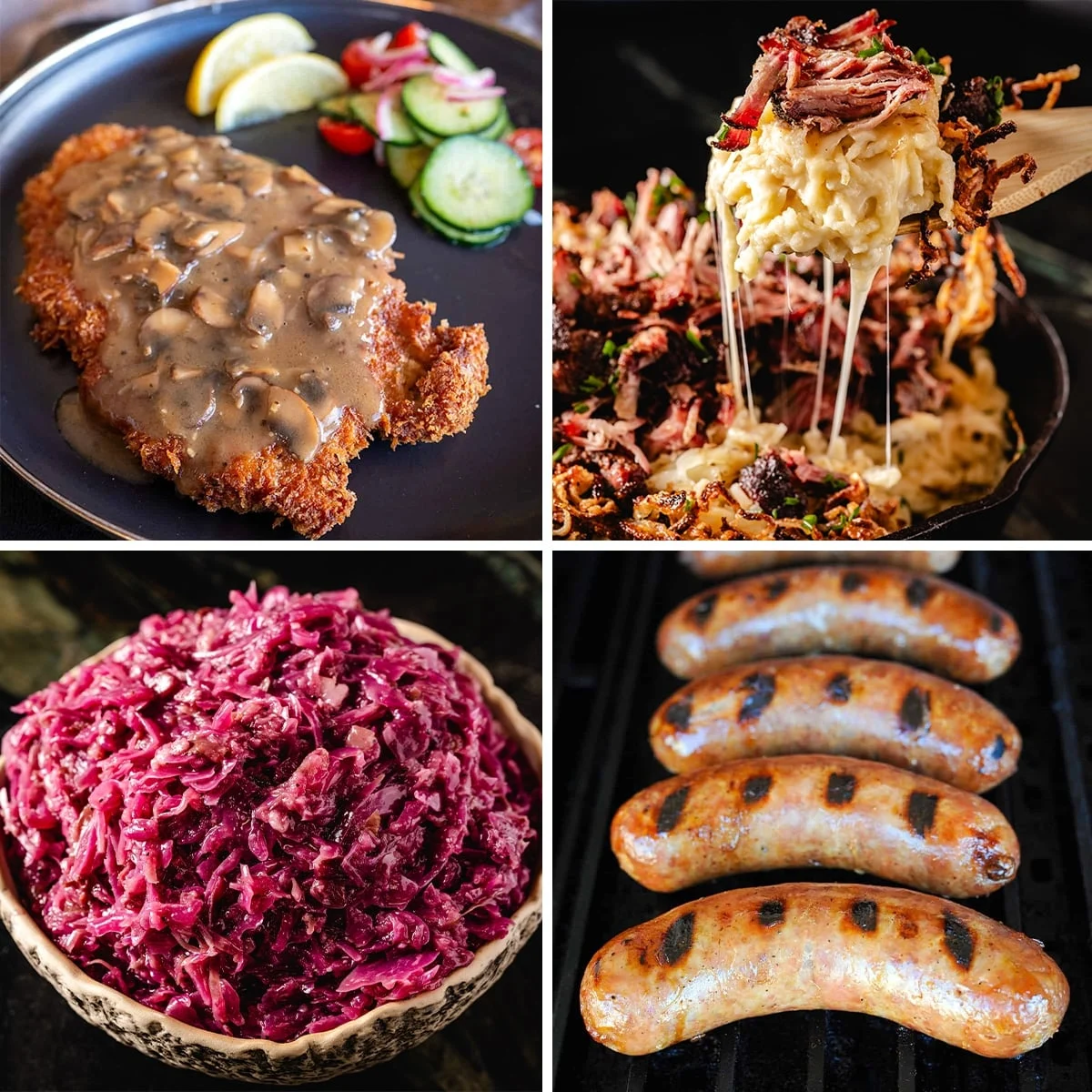
For the second main, the team prepared a Jägerschnitzel using the pork loin. This required a high degree of technical precision, as the lean loin can easily overcook over an open flame. Vanover executed a breaded and pan-fried cutlet, which was then finished with a rich mushroom gravy. In a move that drew praise for its adherence to the nose-to-tail mandate, the team built a pork stock from scratch using the rib bones of the animal. This stock served as the foundational base for the gravy, ensuring that the flavor of the specific pig provided was integrated into the final sauce.

Side Dish Innovation: Rotkohl and Käsespätzle
The "Big Burn" rules required that even the side dishes incorporate elements of the whole animal. Bulloch and Vanover addressed this by preparing Rotkohl, a braised red cabbage dish. To satisfy the protein requirement, they smoked and finely chopped the pork belly, integrating the rendered fat and smoky meat into the cabbage to provide a rich counterpoint to the acidity of the vegetable.
The second side dish, Käsespätzle, represented one of the most technically difficult undertakings of the episode. Spätzle, a type of German egg noodle, is traditionally made by hand-dropping dough into boiling water. Attempting this over an open fire pit introduced variables in temperature and stability that are not present in a controlled kitchen environment. The team topped the cheesy noodles with smoked pig cheeks, a cut often overlooked but prized by pitmasters for its high collagen content and intense flavor.
The Flash Burn: High-Speed Charcuterie
Midway through the "Big Burn," the competition was interrupted by the "Flash Burn," a secondary challenge designed to test speed and fundamental charcuterie skills. The teams were given exactly one hour to produce a fully cased, seasoned, and cooked sausage link using remaining portions of their assigned animal.

Judge Big Moe Cason, a renowned figure in the barbecue world known for his adherence to traditional methods, set rigorous standards for this challenge. He explicitly forbid the submission of sausage patties, requiring instead a "properly cased" product with correct fat-to-lean ratios and internal temperature. First place in this sub-challenge carried a $2,000 cash prize and significant momentum heading into the final judging of the day.
Bulloch and Vanover produced a beer-braised pork bratwurst, garnished with caramelized onions, cabbage, and pickled mustard seeds. The inclusion of pickled mustard seeds was a strategic nod to judge Michael Symon’s well-known affinity for the ingredient. The difficulty of grinding meat, seasoning, casing, and cooking a sausage within 60 minutes cannot be overstated, as any error in the grind or the stuffing process can lead to a "broken" emulsion or a burst casing.
Judging Criteria and Historical Context
The judging for Episode 4 was conducted by a panel consisting of Andrew Zimmern, Big Moe Cason, and Ernest Servantes. The evaluation was not merely based on flavor but on the "integrity of the cook." Servantes, a former champion himself, focused on the technical execution of the fire management, while Zimmern looked for culinary creativity and the successful elevation of "off-cuts."

The head-to-head format introduced a safety mechanism for the winners of each bracket. The winner of a direct matchup was guaranteed a spot in the following episode. However, the elimination process remained tied to a cumulative "Big Burn" score across the season. This meant that a team could technically win their head-to-head but still be at risk if their overall seasonal performance lagged behind the rest of the field.
This episode’s focus on whole-animal cooking reflects a broader trend in the culinary industry toward sustainability and "zero-waste" butchery. By forcing pitmasters to move beyond the "big four" competition meats (brisket, pork butt, pork ribs, and chicken), the show is redefining the boundaries of what constitutes "barbecue." It highlights the intersection of traditional fire-cooking and formal culinary arts.
Broader Impact and Industry Implications
The performance of teams like Bulloch and Vanover also underscores the growing influence of women in the professional barbecue circuit, an arena historically dominated by men. Their strategic use of the German-inspired menu highlighted a sophisticated understanding of culinary history, specifically how Central European smoking and curing techniques laid the groundwork for modern American barbecue in regions like the Texas Hill Country.

As the series progresses, the data from Episode 4 suggests that versatility is the most valuable asset for a modern pitmaster. The ability to transition from a ten-hour slow braise to a sixty-minute sausage grind requires a diverse skill set that extends beyond simply "tending the pit."
For the viewers and the culinary community, Episode 4 of Pitmasters served as a masterclass in adaptation. Whether it was the struggle to boil water for noodles over an open flame or the ingenuity required to turn rib bones into a gourmet gravy, the episode emphasized that at the highest levels of competition, success is determined by the ability to solve problems under thermal and temporal pressure.
New episodes of Pitmasters continue to air on Food Network, with streaming available on HBO Max and Discovery+. As the field narrows, the cumulative scoring system will become increasingly critical, making every "Big Burn" and "Flash Burn" a potential turning point for the remaining contestants. The technical benchmarks set in this episode—particularly in the realm of whole-animal utilization—are expected to influence the judging standards for the remainder of the season.
