

In the landscape of contemporary mixology, the Purl is frequently categorized as a straightforward combination of British ale and a measure of gin. To the modern bartender, it represents a rustic, historical curiosity—a drink served at cellar temperature, traditionally utilizing a British Bitter and an Old Tom style gin. However, a deep dive into the historical record reveals that the Purl’s identity has undergone a radical transformation over the last four centuries. What is now a two-ingredient "boilermaker" variant began its life as a medicinal tonic intended to ward off the bubonic plague, eventually evolving into a complex, spiced, egg-thickened concoction before being stripped down to its current minimalist form.
The Medicinal Origins: Wormwood and the Great Plague
The earliest iterations of the Purl bear almost no resemblance to the gin-based drink known today. In the 17th century, the defining characteristic of a Purl was not the spirit it contained, but rather the infusion of wormwood (Artemisia absinthium). During this era, wormwood was highly regarded for its tonic properties, believed to stimulate the appetite and cleanse the blood.
The historical significance of the Purl as a health supplement is most notably documented in the 1665 publication, Directions for the Prevention and Cure of the Plague Fitted for the Poorer Sort. This manual, released during the height of the Great Plague of London, provided dietary and lifestyle advice for those who could not afford expensive physicians. On its opening page, the text recommends that individuals consume "a draught or two of Purle… especially in the morning." At this stage, the Purl was essentially an herbalized beer or wine. The bitterness of the wormwood was thought to provide a protective barrier against the "miasmas" believed to carry disease.
The drink was so ubiquitous that it was not restricted to ale. Evidence from 1684’s Aphorisms upon the New Way of Improving Cyder suggests that the cider industry also laid claim to the beverage, asserting that a "purl with cider" was just as efficacious as the traditional ale-based version. By 1690, An English Herbal continued to tout the benefits of wormwood-infused Purl, cementing its status as a staple of the English medicinal cabinet.
Social Transition and the Rise of the Purl-Shop
As the threat of the plague receded, the Purl transitioned from a medicinal necessity to a recreational staple. By the early 18th century, "Purl-shops" had become a common fixture in the London urban landscape. However, as the drink became associated with recreational morning consumption, it began to attract social stigma.

In September 1733, The Grub Street Journal published a character attack that linked Purl consumption with other perceived vices of the lower classes, such as heavy smoking and the excessive drinking of gin. This period marked the beginning of the "Gin Craze" in London, and it is likely during this time that spirits first began to be regularly added to the herbal ale. The addition of spirits served two purposes: it increased the shelf life of the mixture and provided a more potent "kick" for laborers who consumed the drink as a "morning constitutional" before starting their shifts at the docks or in the markets.
The 19th Century: The Purl as a Complex Flip
By the Victorian era, the Purl had moved away from its bitter, medicinal roots and toward the sophisticated, multi-ingredient profiles of early cocktail culture. This era is best captured by William Terrington’s 1869 volume, Cooling Cups and Dainty Drinks, which is widely regarded as the first British cocktail book.

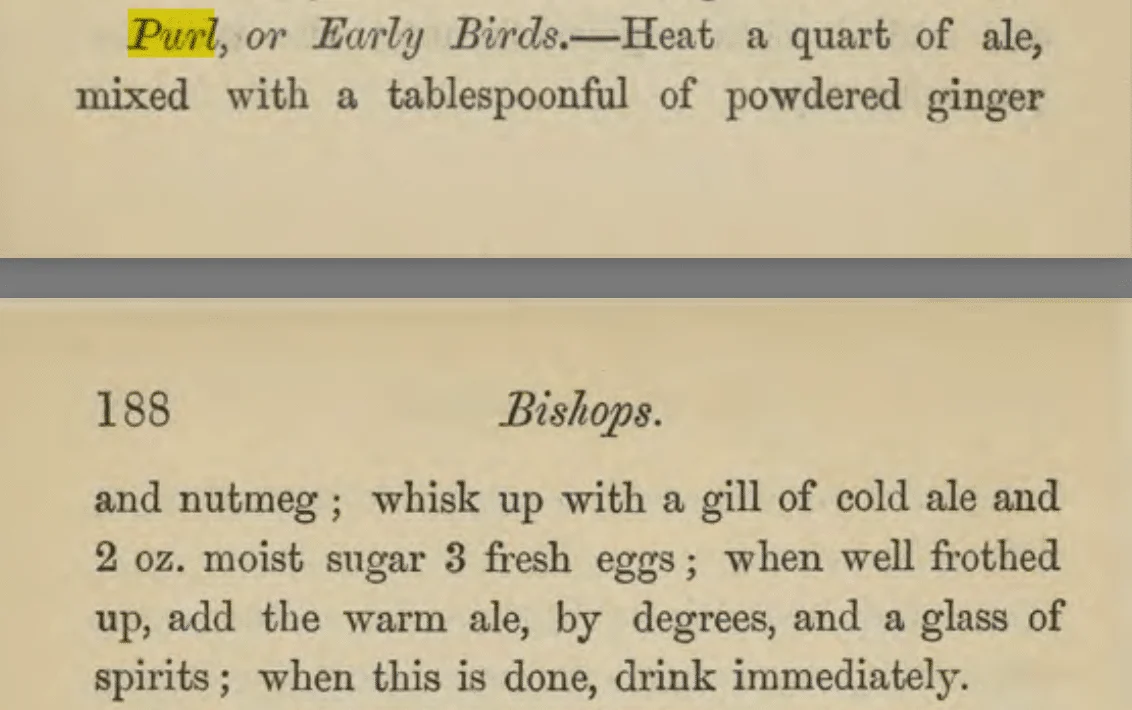
Terrington’s recipes illustrate a significant increase in complexity. No longer just ale and wormwood, the 19th-century Purl often functioned as a "flip"—a category of drinks involving heated ale, sugar, spices, and frequently, eggs. One recipe from Terrington’s manual involves warming the beer and whisking in multiple eggs to create a frothy, custard-like texture. Interestingly, gin was not yet the mandatory spirit. Terrington notes that while spirits were added, the choice of alcohol could range from brandy to whiskey, depending on the preference of the drinker or the availability of stock in the bar.
However, the connection between gin and ale was beginning to solidify. Terrington’s manual also includes a recipe for an "Ale Cup," which specifically calls for gin and ale. This suggests that while the term "Purl" was still somewhat fluid, the specific pairing of gin and malt liquor was becoming a recognized sub-category of the English drink repertoire.

A Chronology of the Purl’s Transformation
The evolution of the Purl can be mapped through several distinct stages of British social history:
- 1660s: The Purl is established as a medicinal tonic consisting of ale or wine infused with wormwood, primarily used as a preventative measure against the plague.
- 1680s–1690s: The definition expands to include cider-based versions; it remains a morning health drink.
- 1730s: The rise of Purl-shops in London. Spirits (likely early forms of gin) begin to be added for potency, and the drink gains a reputation for being a vice of the working class.
- 1860s: The "Golden Age" of the Purl. It becomes a complex, heated "flip" featuring eggs, sugar, and various spices. Gin is common but not yet the exclusive spirit.
- 1920s: The complexity begins to fade. Recipes from this era, such as those found in Summer Drinks and Winter Cordials (1925), show the disappearance of eggs, though the tradition of warming the ale persists.
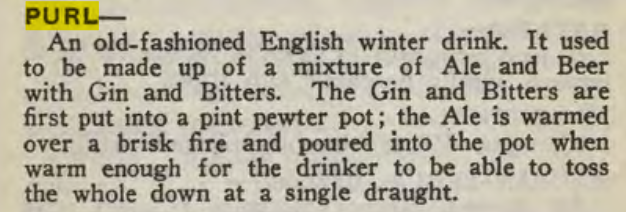
- 1930s–1960s: The recipe is codified into its modern form. The Art of Mixing Drinks (1935) and The Barman’s Bible (1966) define the Purl almost exclusively as a mixture of gin, ale, and sometimes bitters.
The Modern Standardization
In the 20th century, the Purl underwent a process of "mixological Darwinism." The labor-intensive elements of the Victorian recipe—such as the heating of the ale and the whisking of eggs—were largely abandoned in favor of speed and efficiency. The wormwood, once the defining ingredient, disappeared entirely from most recipes, likely due to the shifting palate of the public away from intense medicinal bitters.

By the time the Cocktail and Wine Digest published The Barman’s Bible in 1966, the Purl had reached its final, simplified form: gin and ale. The "Old Tom" style of gin, which was sweeter and more botanically intense than the modern London Dry, remained the preferred choice because it could stand up to the heavy, malty profile of British Bitters. This modern version is essentially a spirit-fortified beer, served cold or at cellar temperature, losing the "hot tonic" identity it held for nearly three hundred years.
Technical Analysis of Ingredients
To understand the Purl, one must understand the specific components that have historically defined it:

- Wormwood (Artemisia absinthium): The original soul of the drink. Its extreme bitterness was believed to aid digestion. Modern equivalents might include a dash of Peychaud’s or Angostura bitters, though these lack the specific thujone-heavy profile of true wormwood.
- British Bitter: Unlike modern carbonated lagers, the ale used in historical Purls was often "flat" by modern standards, served from a cask. Its high malt content provided a sturdy base for the addition of sugar and spirits.
- Old Tom Gin: A bridge between the harsh, malty "Genever" of the Dutch and the crisp "London Dry" of the late 19th century. Its slight sweetness helped balance the bitterness of the wormwood and the tannins in the ale.
- The "Flip" Element: The addition of eggs and heat in the 1800s transformed the Purl into a caloric meal in a glass, reflecting a time when cocktails were often used as meal replacements for the working class.
Broader Cultural and Mixological Implications
The history of the Purl serves as a microcosm for the evolution of Western drinking habits. It highlights a shift from "drinking for health" to "drinking for pleasure" and, eventually, "drinking for convenience." The loss of the wormwood and egg components reflects a broader trend in the 20th century where complex, time-consuming historical recipes were streamlined for the modern commercial bar.
Furthermore, the Purl’s transition from a "poorer sort" remedy to a documented cocktail in high-society manuals like Terrington’s shows how beverages often move across class lines. What began as an inexpensive way for the impoverished to survive the plague eventually became a sophisticated winter warmer for the Victorian middle class, before settling into its current role as a niche interest for cocktail historians.

Today, the Purl remains a testament to the resilience of British bar culture. While its ingredients have changed, its core purpose—a fortifying, spirit-forward beer drink—continues to resonate. For the modern enthusiast, recreating a 19th-century Purl offers a window into a world where the line between medicine and mixology was indistinguishably blurred.
