

In the landscape of contemporary bar culture, the Purl is frequently characterized as a rudimentary combination: a pint of ale fortified with a single shot of gin. According to modern mixological standards, such as those documented in Difford’s Guide, the drink is often contextualized as a relic of 18th and 19th-century British tavern life. Historical reconstructions of this "modern" version typically specify the use of an Old Tom style gin—a sweeter, more botanical precursor to the London Dry style—paired with a traditional British Bitter and served at cellar temperatures to maintain the integrity of the malt profile. However, an exhaustive analysis of historical cocktail manuals, medical texts, and social commentaries reveals that the Purl was once a far more complex and multifaceted beverage. Its transformation from a 17th-century prophylactic against the bubonic plague to a 20th-century morning "pick-me-up" illustrates a broader narrative of shifting societal values, medicinal practices, and the industrialization of spirits.
The earliest iterations of the Purl bear little resemblance to the gin-heavy concoctions found in today’s craft cocktail bars. During the 17th century, the term "Purl" referred primarily to a mixture of ale or wine infused with wormwood (Artemisia absinthium). This bitter herb was prized for its supposed medicinal properties, particularly its ability to stimulate the digestive system and ward off infection. In the mid-1600s, London faced recurrent threats from the plague, leading to a proliferation of medical pamphlets aimed at the general public. One such publication, the 1665 volume "Directions for the Prevention and Cure of the Plague Fitted for the Poorer Sort," explicitly recommended the consumption of Purl. The text advised readers to consume "a draught or two of Purle… especially in the morning" as a dietary safeguard against the pestilence. The targeting of the "poorer sort" suggests that Purl was an accessible, low-cost remedy, utilizing common ale and readily available bittering agents rather than expensive imported spices or distilled liquors.
The 17th Century: Wormwood and the Medicinal Morning Constitutional
The reliance on wormwood in early Purl recipes highlights the intersection of brewing and herbalism in early modern England. Before the widespread adoption of hops as the primary stabilizing and bittering agent in beer, brewers and households utilized a variety of botanicals. Wormwood-infused ale was not merely a recreational choice but a functional one. The 1690 text "An English Herbal" further corroborated the perceived benefits of this mixture, documenting how the bitter qualities of the herb were best extracted and delivered through a malt liquor medium.
By the late 17th century, the beverage had also crossed over into the cider industry. The 1684 work "Aphorisms upon the New Way of Improving Cyder" noted that a "purl wide cider"—essentially cider treated with the same bittering herbs as ale—was considered just as efficacious and palatable as the grain-based version. This indicates that "Purl" functioned more as a category of herbal infusion rather than a rigid recipe tied to a specific base alcohol. The common denominator was the bittering process, intended to cleanse the blood and fortify the constitution.
The 18th Century: Social Stigma and the Rise of Spirits
As the 18th century progressed, the Purl began to transition from a strictly medicinal tonic to a recreational beverage, often consumed to excess. This period coincided with the infamous "Gin Craze" in London, during which the availability of cheap, domestically distilled spirits fundamentally altered the drinking habits of the urban working class. It was during this era that spirits began to be added to the traditional wormwood ale, increasing the drink’s potency and changing its social standing.

Historical accounts from the 1730s reflect a growing disparagement of Purl consumption, linking it to the perceived moral decay of the city. A 1733 character attack published in "The Grub Street Journal" associated Purl-drinking with other "vices" such as heavy smoking and the consumption of raw gin. The "Purl-shops" of London became notorious as venues where the working class would gather in the early hours of the morning to consume these fortified ales before starting their shifts. This "morning constitutional" had evolved from a health-conscious draught into a symptom of habitual inebriation. The introduction of spirits into the Purl marked the beginning of the end for the wormwood-only version, as the high-proof kick of gin or brandy began to replace the medicinal bitterness of the herbs.
The 19th Century: Culinary Complexity and the "Flip" Influence
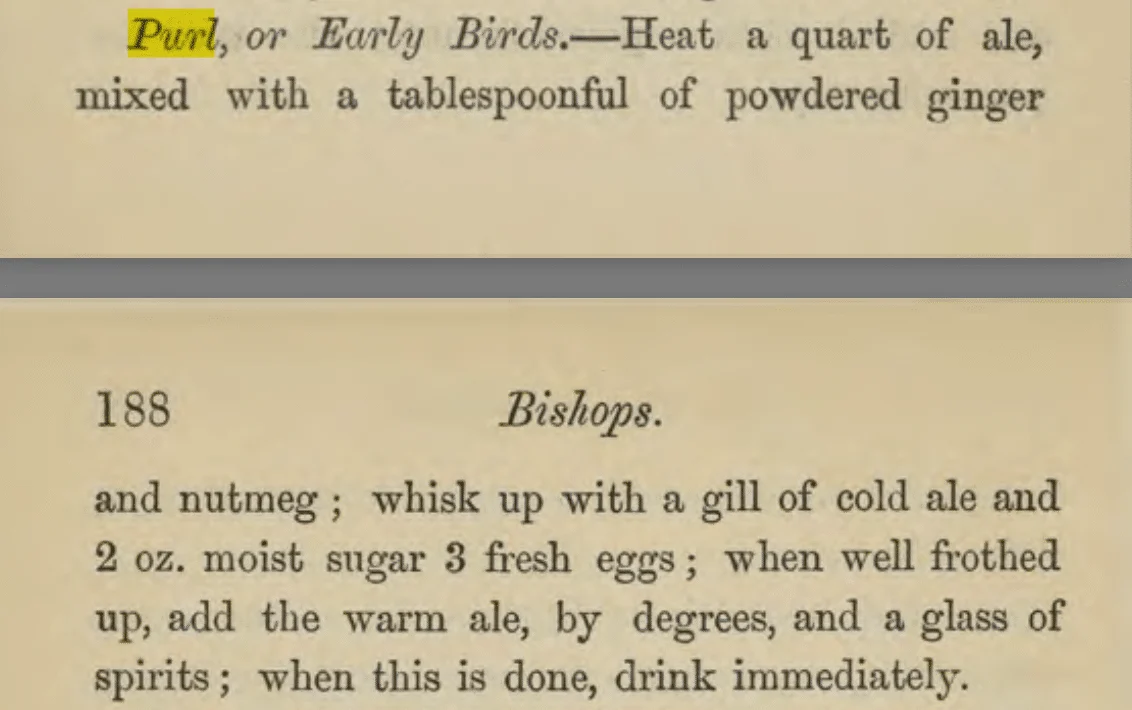
By the Victorian era, the Purl had undergone another radical transformation, becoming a sophisticated and often heated "culinary" drink. In his 1869 volume "Cooling Cups and Dainty Drinks," which is widely regarded as the first British cocktail book, William Terrington provided recipes that depicted the Purl as a type of "flip." These versions were significantly more labor-intensive than the simple ale-and-shot combination known today.

Terrington’s recipes often called for the ale to be warmed and mixed with multiple beaten eggs, sugar, and a variety of spices such as ginger, cloves, and nutmeg. While a glass of spirits was included, it was not strictly limited to gin; brandy and whisky were also common additions depending on the patron’s preference or the barkeep’s inventory. This version of the Purl was thick, frothy, and served warm, intended to provide sustenance and warmth during the damp London winters.
Terrington also documented a related beverage known as the "Ale Cup." While similar in its use of beer and spirits, the Ale Cup was more specifically tied to gin. The coexistence of these recipes in the mid-19th century suggests a period of transition where the Purl was a broad term for fortified, spiced, and often egg-thickened ales, while more specific gin-based beer drinks were beginning to carve out their own identities.

The 20th Century: Simplification and the Canonical Gin Formula
The 20th century witnessed the "standardization" of the Purl, a process that involved stripping away the complex ingredients of the Victorian era. The use of eggs and the labor-intensive heating process began to fade as bar service became more streamlined and the preference for lighter, simpler drinks grew. By the time "Summer Drinks and Winter Cordials" was published in 1925, the Purl was beginning to settle into its modern definition: gin and ale.
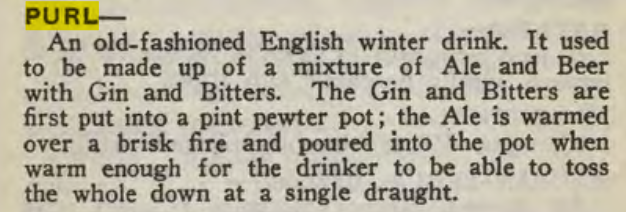
However, even in the early-to-mid 20th century, the drink retained a vestige of its bitter past. The 1935 manual "The Art of Mixing Drinks" and the 1966 "Barman’s Bible" (the Cocktail and Wine Digest) both include recipes for the Purl that, while omitting eggs and wormwood, still insisted on the addition of bitters. This suggests that even as the physical herb disappeared from the bar, the flavor profile—the juxtaposition of sweet malt, botanical gin, and sharp bitterness—remained essential to the drink’s identity.

The 1966 definition in "The Barman’s Bible" solidified the Purl as a mixture of gin, warmed ale, and bitters. This version represented the final step in the drink’s evolution before it reached the "ale + gin shot" simplicity of the 21st century. The warming of the ale remained a common practice well into the mid-century, a nod to the drink’s origins as a cold-weather tonic.
Chronological Evolution Summary
- 1660s–1690s: Purl is a medicinal infusion of ale or wine with wormwood, used as a plague preventative and general health tonic. It is inexpensive and consumed primarily in the morning.
- 1730s: Spirits (primarily gin) are added to the mixture. The drink becomes associated with urban vice and the "Gin Craze." The first "Purl-shops" appear in London.
- 1860s: The Purl reaches its peak complexity as a "flip." Recipes include warmed ale, eggs, sugar, and spices. Gin is one of several spirit options used for fortification.
- 1920s–1930s: The recipe simplifies. Eggs and wormwood are removed, but the drink remains a heated mixture of ale, gin, and aromatic bitters.
- 1960s–Present: The "canonical" Purl is established as gin and ale. In modern practice, the heating element is often discarded, and the drink is served at cellar or room temperature.
Impact and Modern Implications
The history of the Purl serves as a microcosm for the evolution of the global spirits industry. It highlights the transition from "folk medicine" to "industrialized leisure." The removal of wormwood from the Purl mirrors the broader regulatory and social shifts that saw the demonization of absinthe and other bitter herbal spirits in the late 19th and early 20th centuries.

For the modern bartender and historian, the Purl represents a challenge in authenticity. While the "gin and a bitter" version is the most common today, the rediscovery of 17th-century medicinal texts and Victorian flip recipes has sparked a revival of interest in the "authentic" Purl. Craft cocktail programs in London and New York have begun experimenting with wormwood-infused syrups and heated, egg-fortified ales to recreate the sensory experience of the 1860s.
Furthermore, the Purl’s history provides valuable data on the socio-economics of drinking. Its origin as a remedy for the "poorer sort" and its eventual status as a complex cocktail highlights how beverages move across class lines. What was once a survival tool for the destitute during the plague became a sophisticated indulgence for the Victorian middle class, and finally, a streamlined staple of the modern pub. Understanding the Purl is not merely about a recipe; it is about understanding the shifting tides of British social history through the lens of a pint glass.
