

The designation of London Dry Gin remains one of the most misunderstood classifications in the global spirits industry, frequently mistaken by consumers as a Protected Geographical Indication similar to Champagne or Scotch Whisky. In reality, London Dry Gin is a rigorous technical standard and a specific method of production that can be executed anywhere in the world, from the Highlands of Scotland to the valleys of South Africa. While the name pays homage to the historical epicenter of gin’s development, the modern reality of the spirit is defined by chemical purity, botanical integrity, and a rejection of post-distillation additives. This shift from a location-based craft to a global quality benchmark represents a century-long journey of technological innovation and legislative refinement.
The Technical Framework of the London Dry Standard
To understand why a gin produced in the United States or Australia can legally bear the "London Dry" label, one must look to the strict regulatory frameworks established by the European Union and later adopted by various international trade bodies. Under EU Regulation 110/2008—standards which the United Kingdom has maintained post-Brexit—London Gin is defined not by its point of origin, but by its production process.
The regulations mandate that the base spirit must be a high-quality neutral alcohol of agricultural origin, distilled to a minimum strength of 96% alcohol by volume (ABV). This ensures that the base is free from the impurities and "off-flavors" that plagued early spirits. The flavoring must be introduced exclusively through the re-distillation of this neutral spirit in traditional stills in the presence of all the natural plant materials (botanicals) used. Crucially, no artificial flavorings or colorings can be added after distillation. The only permitted addition following the final distillation is water to reach the desired bottling strength, and a minute amount of sweetening, which cannot exceed 0.1 grams of sugar per liter. This lack of sugar is what justifies the term "Dry."
The Industrial Revolution and the Aeneas Coffey Milestone
The transition from the volatile, often toxic gins of the 18th century to the refined London Dry style was made possible by a singular technological breakthrough. In 1830, Aeneas Coffey, an Irish inventor and former Inspector General of Excise, patented the "Coffey Still" or column still. This invention revolutionized the distilling world by allowing for continuous distillation, which produced a much higher concentration of alcohol and a significantly "cleaner" spirit than the traditional pot stills.
Prior to the Coffey Still, distillers relied on pot stills that produced spirits with high levels of congeners and impurities. To mask the harsh, often putrid taste of these early gins, producers frequently added heavy amounts of sugar or, in more desperate cases, dangerous adulterants like turpentine and sulfuric acid. The column still provided a neutral canvas of grain spirit that was palatable without masking agents. This allowed the delicate notes of juniper, coriander, and citrus to stand at the forefront, giving birth to the "Dry" style that eventually became synonymous with London’s leading distilleries.
A Chronology of Gin’s Global Proliferation
The timeline of London Dry Gin is a narrative of improving public health, rising middle-class standards, and the expansion of the British Empire, which carried the spirit to every corner of the globe.
- 18th Century: The "Gin Craze" in London sees unregulated production of "Mother’s Ruin." Spirits are often sweetened to hide poor quality.
- 1801: The publication of Every Man His Own Brewer and Distiller includes recipes for "London Gin," indicating that the city was already recognized as a hub for specific flavor profiles, even before the "Dry" standard existed.
- 1830: Aeneas Coffey patents the column still, enabling the production of neutral grain spirits.
- 1890s: The term "London Dry" begins to appear frequently in international advertisements. A 1897 Australian newspaper highlights the style as a premium import, distinguishing it from local, often inferior products.
- 1903: United States newspapers begin featuring "London Dry" as a specific category of imported luxury goods, cementing its status in the American cocktail culture during the pre-Prohibition era.
- 2008: The European Union formally codifies the definition of London Gin in Regulation (EC) No 110/2008, decoupling the name from geography and linking it strictly to production methods.
Quality Control and the Rejection of Adulterants
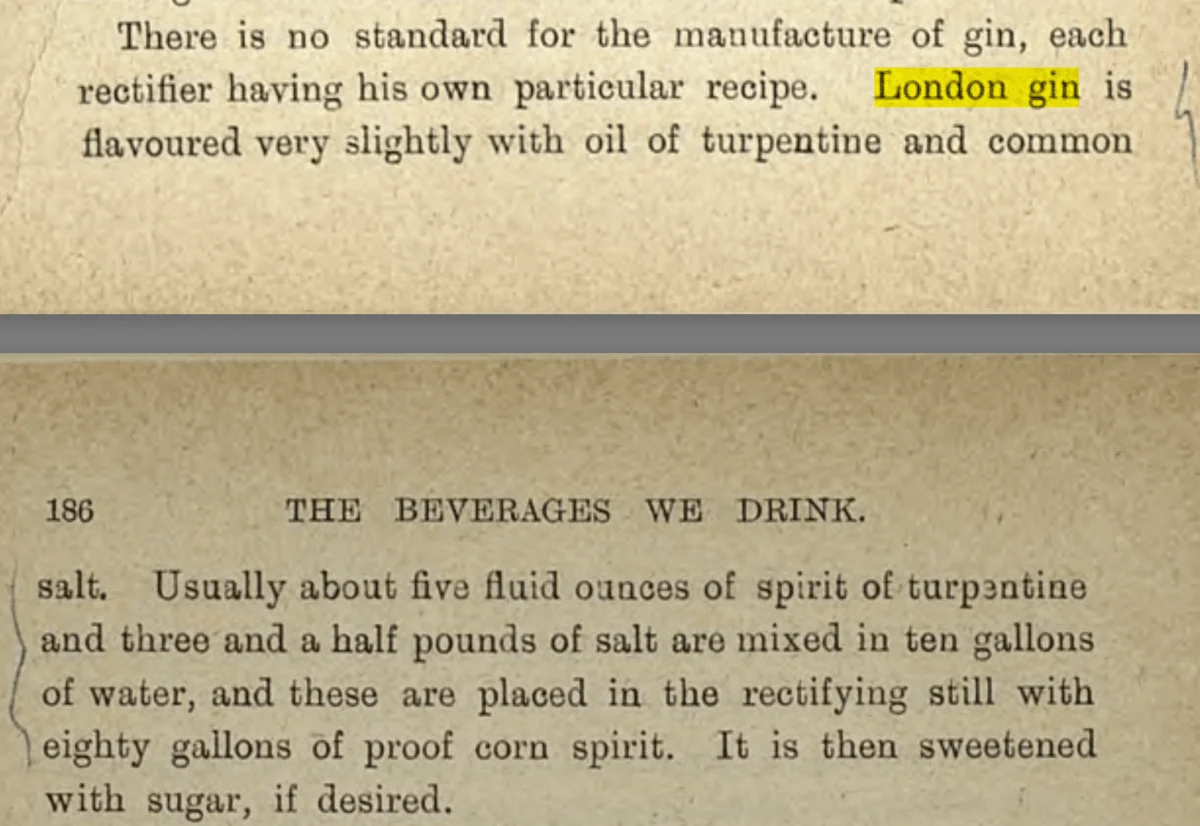
The historical necessity for the London Dry designation was rooted in consumer safety. In the early 19th century, "London Gin" was a term of prestige that many unscrupulous producers attempted to emulate. Historical records indicate that some manuals for home distilling suggested adding turpentine to neutral spirits to mimic the resinous, piney scent of juniper without the expense of using real botanicals.

Turpentine, a fluid obtained by the distillation of resin harvested from living trees, is highly toxic to humans. The "London Dry" movement was, in many ways, an early form of consumer protection. By establishing a standard that required the re-distillation of actual botanicals and forbidding post-distillation "cold compounding" (simply mixing oils and essences into alcohol), the industry created a self-policing mechanism that guaranteed a certain level of purity and craftsmanship.
Global Production and the Displacement of the London Hub
Despite the nomenclature, the modern gin landscape shows a massive geographical shift. Many of the world’s most iconic "London Dry" brands are no longer produced within the city limits of London.
Tanqueray, one of the most recognizable London Dry gins in the world, was originally distilled in Bloomsbury, London. However, following the destruction of its distillery during World War II and subsequent industrial consolidations, production eventually moved to the Cameronbridge Distillery in Scotland. Similarly, No. 3 Gin, though designed by the historic London merchant Berry Bros. & Rudd, is distilled at De Kuyper Royal Distillers in the Netherlands.
The craft spirits movement has further internationalized the style. In the United States, Astraea Meadow Gin utilizes the London Dry process to showcase Pacific Northwest botanicals. In South Africa, Belgravia Gin adheres to the traditional distillation method while serving the African market. In Canada, Long Table Distillery produces London Dry expressions that compete on the world stage, and the Australian Distilling Co. uses the method to create spirits that reflect the unique flora of the Australian continent.

Market Implications and Consumer Perception
The decision to maintain the "London Dry" name as a process rather than a PGI (Protected Geographical Indication) has significant economic implications. For the consumer, the label "London Dry" acts as a hallmark of quality. It reassures the buyer that the product is a "true" gin, created through distillation rather than the cheaper method of "compound gin," where flavorings are simply stirred into spirits.
For distillers, the designation provides a set of "rules of engagement." Adhering to the London Dry standard is often more expensive and technically demanding than other methods. It requires a high-quality still, precise temperature control, and a deep understanding of how various botanicals react under heat. However, the reward is a product that commands a premium price and carries a legacy of Victorian-era sophistication.
Industry analysts suggest that the "London Dry" category remains the backbone of the global gin market, which was valued at approximately $14 billion in 2023 and is projected to grow significantly by 2030. While "New Western" or "Contemporary" gins—which may emphasize non-juniper botanicals or use post-distillation infusions—are growing in popularity, the London Dry style remains the essential component of classic cocktails like the Martini and the Gin and Tonic.
The Future of the Designation
As the spirits industry continues to evolve, there are ongoing debates regarding whether "London Dry" should eventually become a protected geographic term. Some London-based distillers argue that the name should be reserved for those operating within the M25 motorway, similar to how Plymouth Gin was once protected. However, the consensus among global trade bodies is that the term has become too "genericized" as a technical descriptor to be pulled back into a geographic box.

The broader impact of the London Dry standard is the elevation of global distilling. By providing a clear, enforceable definition of what constitutes a high-quality distilled gin, the standard has allowed craft distillers in every country to prove their mettle. Whether a bottle originates from a small-batch distillery in Vancouver or a historic facility in London, the "London Dry" label remains a testament to a 19th-century invention that cleaned up a once-dangerous industry and turned gin into one of the world’s most respected spirits.
