

The Purl stands as one of the most resilient yet misunderstood artifacts of British drinking culture, spanning over four centuries of transformation from a crude medicinal remedy to a sophisticated Victorian tavern staple, and finally to its modern iteration as a minimalist combination of ale and gin. While contemporary bar manuals often reduce the Purl to a simple "fortified beer"—typically a shot of gin dropped into a pint of British Bitter—historical archives reveal a lineage of complexity involving botanical infusions, heated spirits, and culinary techniques that once mirrored the intricate "flips" of the 19th century. To understand the Purl is to trace the history of London itself, moving from the desperate healthcare of the Great Plague to the bustling coaching inns of the Victorian era and the streamlined efficiency of the 20th-century cocktail lounge.
The Medicinal Roots of the 17th Century
The earliest recorded mentions of the Purl do not describe a recreational cocktail but rather a "physic" or medicinal draught. In the mid-1660s, as London grappled with the devastating effects of the Great Plague, the Purl was championed as a preventive measure against infection. The 1665 publication Directions for the Prevention and Cure of the Plague Fitted for the Poorer Sort explicitly recommended that citizens consume "a draught or two of Purle… especially in the morning." This recommendation was grounded in the humoral medicine of the time, which suggested that bitter herbs could "cleanse" the blood and protect the body from miasmic vapors.
At this stage, the drink was fundamentally defined by the presence of wormwood (Artemisia absinthium). Brewers and tavern keepers would infuse ale or wine with the bitter herb, creating a beverage known as "wormwood ale" or "wormwood wine." The term "Purl" likely derived from the French perlé, referring to the beaded appearance of the drink or perhaps its supposed "pearl-like" clarity when properly prepared. Data from 17th-century herbalists, such as those found in the 1690 volume An English Herbal, confirm that wormwood was the defining ingredient, valued for its ability to stimulate the appetite and ward off digestive ailments.
The socio-economic positioning of the Purl during this era was notably humble. Because it was marketed to the "poorer sort," it was an inexpensive alternative to the more costly imported wines. This accessibility ensured its survival in the vernacular culture of London’s East End and dockside taverns, where it transitioned from a plague remedy into a daily "morning constitutional" for laborers and tradesmen.
The Georgian Shift and the Rise of Spirits
As London moved into the 18th century, the Purl began to evolve alongside the burgeoning "Gin Craze." The introduction of cheap, domestically produced spirits altered the composition of many traditional English drinks. While the base remained ale infused with wormwood, tavern keepers began "fortifying" the mixture with whatever spirits were readily available. This period marked the beginning of the Purl’s reputation as a drink of excess and vice.

By 1733, the social perception of the Purl had shifted from a health tonic to a signifier of moral decay. The Grub Street Journal, a prominent satirical newspaper of the time, featured character attacks on individuals who frequented "Purl-shops." These establishments were often grouped with gin palaces, and the consumption of Purl in the morning was frequently cited in court records and social commentaries as evidence of habitual drunkenness.
However, the drink also saw regional variations during this time. The cider industry, seeking to compete with the dominance of ale in London, promoted "Cider Purl." The 1684 text Aphorisms upon the New Way of Improving Cyder argued that wormwood-infused cider was just as effective as its ale-based counterpart. Despite these efforts, the association between Purl and malted grain remained the dominant cultural standard.

The Victorian Era and the "First British Cocktail Book"
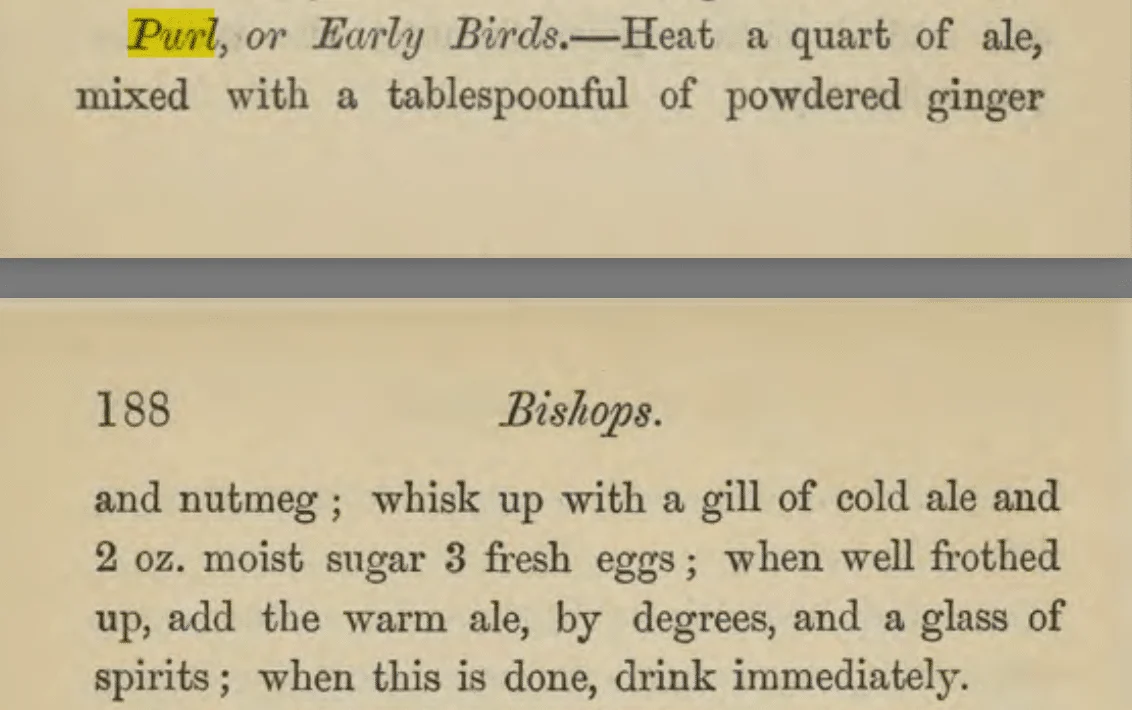
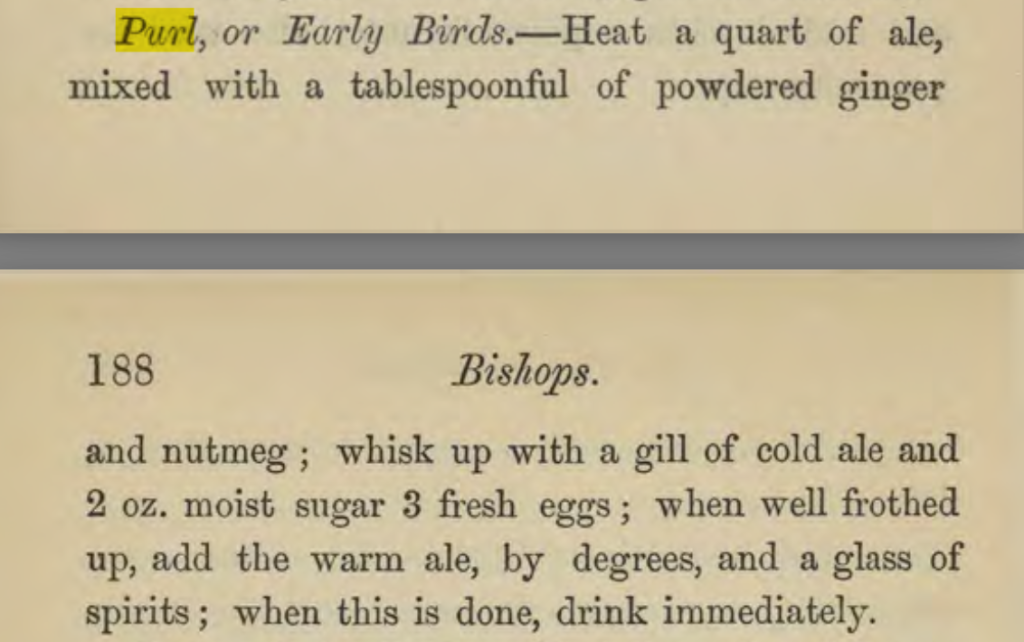
The 19th century represented the peak of the Purl’s complexity. No longer just a bitter beer, the drink was integrated into the "Flip" family of cocktails—beverages that were served hot and often thickened with eggs and sugar. This era of the Purl is best documented in William Terrington’s 1869 volume, Cooling Cups and Dainty Drinks, which many historians categorize as the first true British cocktail manual.
Terrington’s recipes indicate that the Purl had become a sophisticated tavern preparation. The Victorian Purl was typically served warm, involving a process where ale was heated and mixed with a "measure of spirits." Crucially, Terrington did not mandate gin; the spirit could just as easily be brandy or whiskey, depending on the customer’s preference or the tavern’s specialty. The addition of ginger, sugar, and sometimes multiple eggs transformed the drink into a rich, custard-like beverage that bore little resemblance to the medicinal draughts of the 1600s.

Terrington also documented a related drink known as the "Ale Cup." While the Purl remained a broad category for fortified, bittered ale, the Ale Cup was a more specific precursor to the modern Purl, frequently calling for the specific combination of gin and ale. These drinks were staples of the British coaching inn, designed to provide warmth and caloric energy to travelers arriving from the cold English countryside.
The 20th Century: Simplification and Standardization
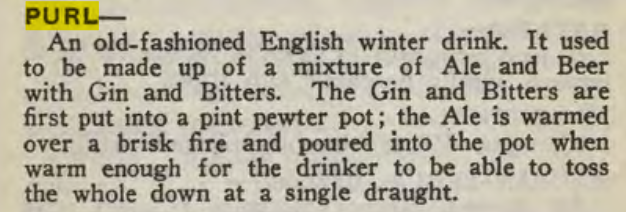
The decline of the complex, egg-laden Purl began in the early 20th century. As the pace of urban life accelerated and the labor-intensive "Flip" style of preparation fell out of fashion, the recipe was stripped down to its essentials. The most significant loss during this period was the removal of wormwood. As the medicinal justifications for bitter herbs faded, the "Purl" name was retained, but the bittering agent was replaced by commercial bitters or simply the natural bitterness of the hops in the ale.

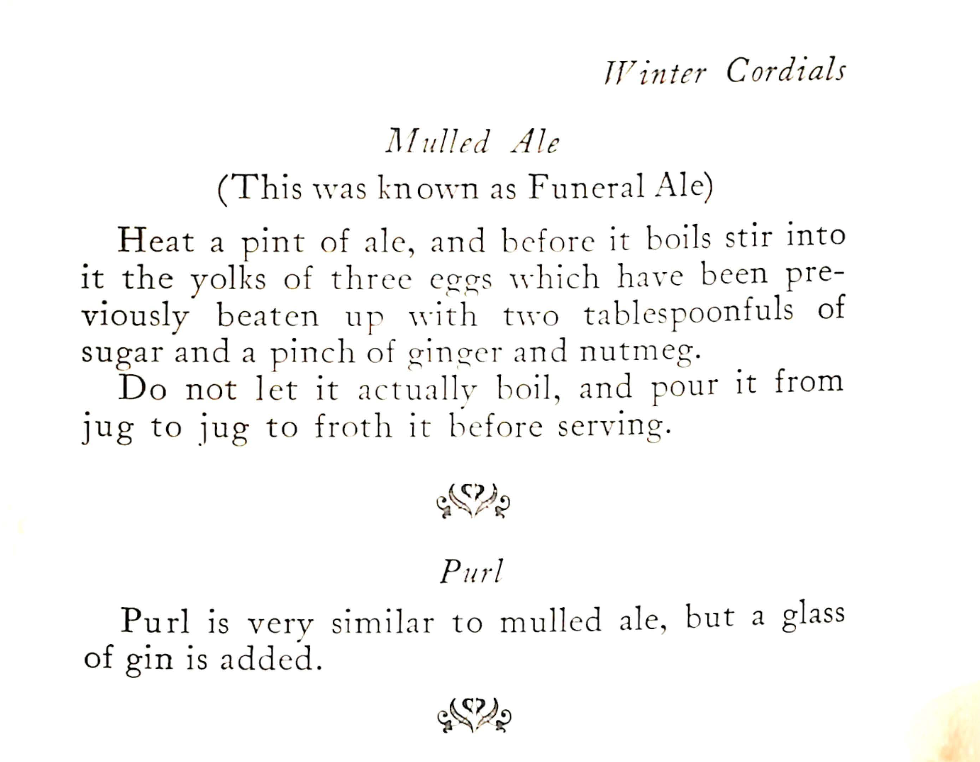
By the 1920s and 30s, the definition of Purl had largely converged on the version recognized today. Mrs. Celeyel’s 1925 book Summer Drinks and Winter Cordials and the 1935 manual The Art of Mixing Drinks both present the Purl as a mixture of gin and ale, often served with a dash of Angostura bitters and a twist of lemon. The requirement to heat the ale remained in some "Winter Purl" recipes, but the use of eggs and complex spices had largely vanished.
The mid-century "Barman’s Bibles," such as the 1966 Cocktail and Wine Digest, further solidified this minimalist approach. In these texts, the Purl is categorized alongside the "Boilermaker" (a shot of whiskey and a beer), though it retained a uniquely British identity through the specification of Old Tom gin—a slightly sweeter, botanically dense style of gin that was prevalent in the 18th and 19th centuries.

Technical Composition and Modern Standards
In contemporary mixology, the Purl is defined by three primary components: the ale, the spirit, and the temperature. Professional standards, such as those maintained by Difford’s Guide, suggest the following technical parameters for a historically informed Purl:
- The Base: A traditional British Bitter or Mild Ale is preferred. These styles offer a malty backbone and a moderate hop profile that complements the botanicals of the gin without overpowering them.
- The Spirit: Old Tom Gin is the canonical choice. Unlike the bone-dry London Dry style, Old Tom provides a bridge between the sweetness of the malt and the bitterness of the hops.
- The Bitters: To honor the drink’s wormwood roots, modern bartenders often add a dash of wormwood-heavy bitters or a small amount of Amaro.
- Temperature: While modern consumers often prefer the drink chilled at cellar temperature (approximately 12-14°C), the "Winter Purl" is still occasionally served warmed, though never boiled, to preserve the delicate aromatics of the gin.
Analysis of Cultural Impact and Legacy
The transformation of the Purl reflects broader shifts in British social history. Its origin as a plague remedy highlights a period when the line between pharmacy and tavern was blurred. The subsequent evolution into a complex Victorian "Flip" speaks to a time when drinking was a slow, communal, and highly ritualized activity. Finally, its 20th-century simplification mirrors the industrialization of the beverage industry, where speed and consistency became the primary metrics of a "good" drink.

The Purl also represents a unique intersection of brewing and distilling. While most cocktails utilize a spirit as the primary volume-contributor, the Purl treats the spirit as a botanical enhancer for the beer. This makes it a precursor to the modern "craft beer cocktail" movement, where bartenders experiment with IPA-based syrups and stout-infused spirits.
From a public health perspective, the Purl’s history is a cautionary tale of how "medicinal" endorsements can lead to widespread social issues. The 17th-century recommendation to drink Purl in the morning likely contributed to the normalization of early-day drinking that plagued London during the Gin Craze. However, in the modern context, the Purl has been reclaimed as a "vintage" classic, valued more for its historical pedigree than its supposed health benefits.
Today, the Purl survives in specialized craft cocktail bars in London, New York, and Melbourne, where bartenders use it as a canvas to explore the history of British bitters. By reintroducing wormwood and experimented with heated ale, these modern practitioners are closing the loop on a 400-year-old story, proving that while the Purl may have simplified over time, its potential for complexity remains as potent as it was in the days of the Great Plague.
