

The semi-final round of Food Network’s high-stakes barbecue competition, Pitmasters, reached a critical juncture in its seventh episode as the field narrowed to the final three teams. Competitors Christie Vanover of Girls Can Grill and Susie Bulloch of Hey Grill Hey faced off against seasoned veterans John and Connie and the duo of Esaul and Grecia. With a direct path to the series finale and an $8,000 prize on the line, the episode featured a grueling "Big Burn" challenge centered on a whole hog, interrupted by high-pressure "Flash Burn" tasks that tested the teams’ versatility and speed under fire.
The Big Burn: A Nine-Hour Whole Hog Trial
The primary objective for the semi-finalists was the "Big Burn," a nine-hour endurance test requiring the preparation of a whole hog accompanied by complementary side dishes. Judge Andrew Zimmern, a noted culinary explorer and critic, characterized the challenge as one of the most demanding trials in the barbecue world, emphasizing the technical difficulty of cooking an entire animal uniformly. Unlike smaller cuts of meat, a whole hog presents a complex thermal challenge; the lean loin can easily overdry while the dense hams and shoulders require significantly more time and heat to reach tenderness.
Judges Andrew Zimmern, Ernest Servantes, Big Moe Cason, and Jess Pryles informed the contestants that the evaluation would be granular. The scoring would focus specifically on five distinct sections of the animal: the belly, ham, loin, ribs, and shoulder. This requirement forced teams to manage multiple temperature zones simultaneously, ensuring that each cut reached its optimal internal temperature without compromising the others.

Technical Innovation: The Asado Cross Method
Vanover and Bulloch opted for a departure from traditional North American pit-smoking methods, choosing instead to utilize an asado cross. This Argentinian technique involves butterflying the animal and securing it between iron racks, which are then positioned upright over an open bed of coals. This method relies entirely on radiant heat and airflow, offering no lid or enclosure to trap moisture or stabilize temperatures.
While the asado cross provides a dramatic presentation and a distinct wood-fired flavor profile, it introduces significant variables. Without the insulation of a cinderblock pit or a traditional smoker, the meat is vulnerable to ambient weather conditions. The judges noted the inherent risk in this choice, as any drop in external temperature or shift in wind direction could stall the cooking process, particularly for the thicker hams and shoulders.
Culinary Strategy and Filipino Influence
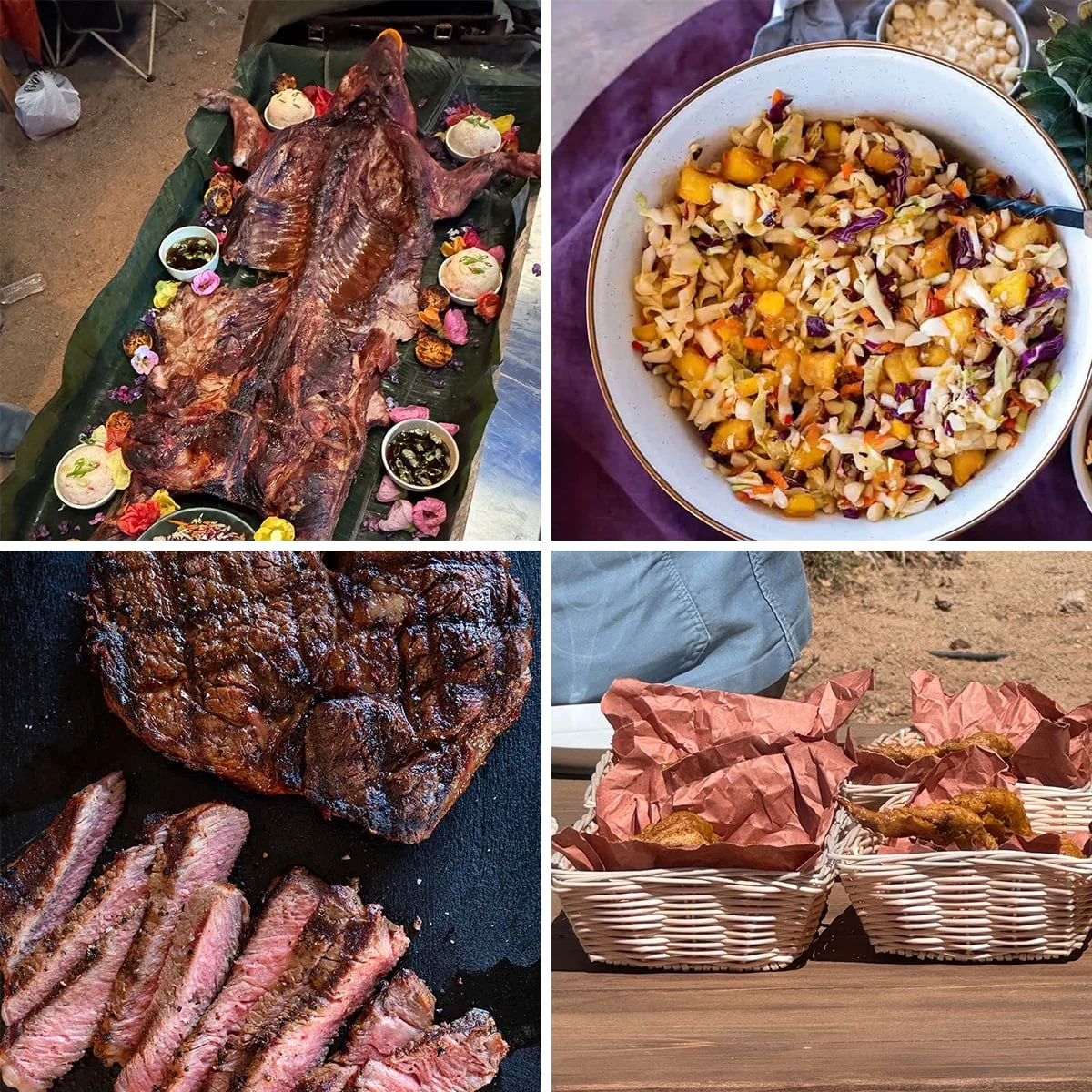
In a bid to distinguish their entry from the traditional barbecue profiles seen in previous episodes, Vanover and Bulloch implemented a Filipino-inspired adobo flavor profile. This culinary direction was a tribute to Vanover’s family heritage and a callback to their successful "first bite" in the season’s premiere.
Adobo, a cornerstone of Filipino cuisine, utilizes a marinade of soy sauce, vinegar, garlic, salt, and sugar. The acidity of the vinegar acts as a tenderizer for the pork fibers, while the soy sauce provides deep umami notes. To round out the meal, the team prepared:

- Traditional Garlic Rice: A fragrant accompaniment learned from specialized whole-hog practitioners.
- Grilled Pineapple Coleslaw: A side designed to provide acidity and crunch to cut through the richness of the pork.
- Soy-Vinegar Dipping Sauce: A sharp, tangy condiment intended to unify the plate.
The strategy was to present a "pig pickin’" style service, a communal tradition where diners pull meat directly from the carcass, combining it with sides to create a cohesive, balanced bite.
The Flash Burn: Lunch Service Under Pressure
Two hours into the nine-hour hog cook, the competition was interrupted by the "Flash Burn" challenge. This segment required teams to pause their long-term strategy to fulfill specific lunch orders from the judges within a 90-minute window. A $2,000 prize was allocated for the winning lunch service.
The judges’ requests were highly specific:
- Ernest Servantes: Requested grilled chicken wings.
- Andrew Zimmern: Requested a meatball sub.
- Big Moe Cason: Requested a BBQ pork burger incorporating onion and garlic.
Through a selection process, John and Connie secured the meatball sub, while Esaul and Grecia took the pork burger. Vanover and Bulloch were tasked with the chicken wings. They chose to apply a chipotle dry rub to full-sized wings, smoking them over live fire before finishing them in a deep fryer using beef tallow. This "smoke-then-fry" technique is a favorite in professional circles for achieving a "shattering" crust while maintaining a smoky interior.

The Double Flash Burn: The Ribeye Challenge
With only 30 minutes remaining in the lunch challenge, judge Jess Pryles—a respected meat scientist and live-fire expert—issued a "Double Flash Burn" challenge. She requested a perfectly cooked ribeye steak, offering an additional $2,000 for the best execution.
Vanover handled the steak, employing the "Just Keep Flipping" (JKF) method often advocated by Pryles. This technique involves frequent turning over high heat to develop a consistent crust without overcooking the interior. The team seasoned the ribeye simply with salt and pepper and tied it with twine to maintain its shape. The steak was pulled at an internal temperature of 125 degrees Fahrenheit and allowed to rest with compound butter.
Judging the Mid-Day Challenges
The lunch service judging yielded mixed results for the Vanover-Bulloch team. Jess Pryles noted that while the ribeye was cooked accurately, the crust was slightly paler than desired. She also expressed a personal preference against resting the meat in butter, suggesting it obscured the natural beef tallow flavor and softened the sear.
Regarding the chicken wings, a disconnect between the judge’s request and the team’s execution emerged. While Ernest Servantes praised the flavor and juiciness of the seasoned wings, he noted that he had requested a "grilled" wing, whereas the team had delivered a "fried" wing. This technicality proved costly. Esaul and Grecia claimed the $2,000 for the lunch challenge, while John and Connie won the $2,000 for the ribeye.

Final Preparations and Environmental Hurdles
As the "Big Burn" entered its final hours, the predicted environmental risks materialized. The ambient temperature began to drop, causing the heat on the exposed asado cross to dissipate. Recognizing that the hams and shoulders were falling behind the required internal temperature, Vanover and Bulloch made a tactical adjustment. They removed the hog from the cross and placed it directly onto cinderblocks closer to the coals, utilizing a heavy "mopping" technique to maintain surface moisture and layer additional flavor.
The final presentation was a visual success, with the whole hog centered on a massive platter surrounded by the Filipino-inspired sides. The team aimed for a balance of savory, sweet, and acidic elements intended to impress the panel of experts.
The Verdict: High Praise and Narrow Margins
The final judging of the whole hog challenge was a testament to the high caliber of the remaining teams. Andrew Zimmern commended Vanover and Bulloch’s tenderloin and the effectiveness of their basting liquid. The most significant praise came from Ernest Servantes, who lauded the texture and appearance of the hog’s skin—one of the most difficult elements to master in whole-animal roasting.
However, the technical challenges of the asado cross were evident in the final product. The judges found the shoulder to be slightly tough and the ham "tight," indicating that those specific sections had not quite reached the ideal breakdown of connective tissue.

In a closely contested decision, John and Connie were declared the winners of the "Big Burn," securing the $8,000 prize and a guaranteed spot in the finale. The remaining spot was a choice between Esaul and Grecia and the team of Vanover and Bulloch.
Conclusion and Broader Impact on the Sport
Ultimately, Christie Vanover and Susie Bulloch were eliminated from the competition, finishing in the top three. Their departure marked the end of a seven-episode run that highlighted the increasing prominence of women in the professional barbecue circuit. Throughout the series, the duo maintained a "backyard approachable" style that resonated with viewers while demonstrating the technical proficiency required for national-level competition.
The elimination of Vanover and Bulloch leaves the remaining teams to compete in the series finale for the title of Pitmaster. The episode underscored the evolution of the sport, where regional and international influences, such as Filipino adobo and Argentinian asado, are increasingly integrated into the traditional American barbecue landscape.
While their journey on Pitmasters concluded, both Vanover and Bulloch continue to influence the industry through their respective platforms, Girls Can Grill and Hey Grill Hey, and their joint appearances on other culinary programs, such as Backyard BBQ Hero. The final episode of Pitmasters is scheduled to air next Monday on Food Network, with streaming available on HBO Max and Discovery+.
