

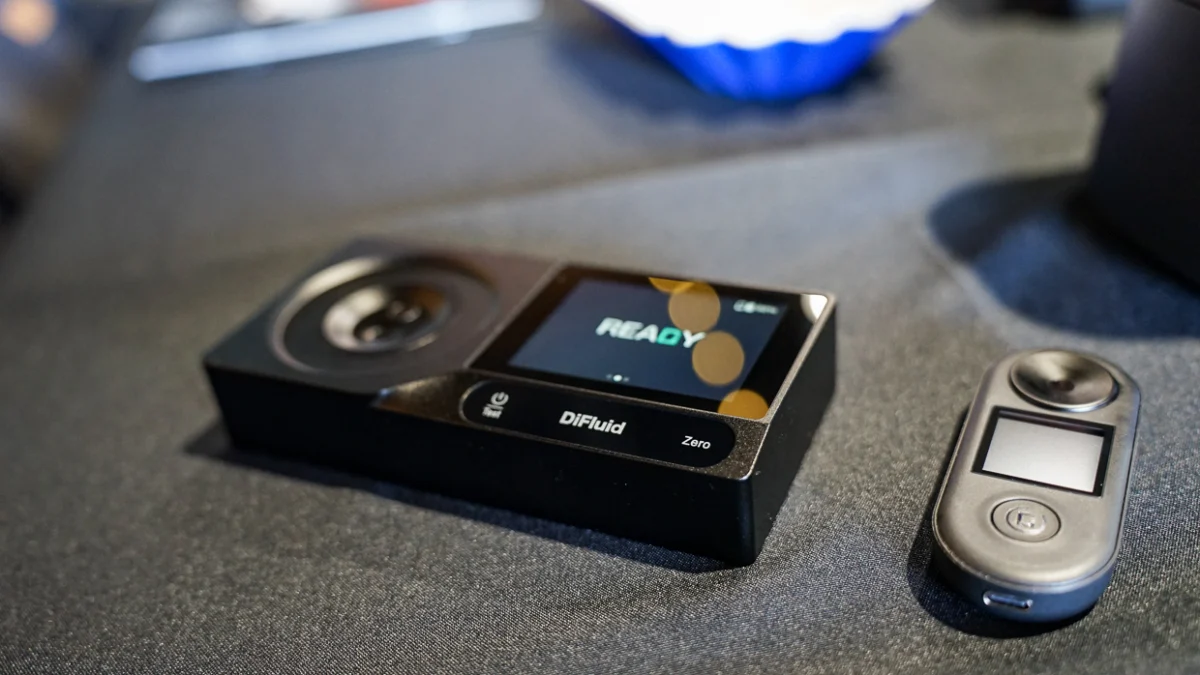
Chinese coffee analysis equipment maker DiFluid has officially launched its latest professional refractometer, the RS Extract, designed to precisely measure total dissolved solids (TDS) in brewed coffee. This innovative device, unveiled in the United States at the 2026 Roast Summit in Portland, Oregon, promises to significantly enhance accuracy and streamline workflows for coffee professionals by offering an unprecedentedly broad temperature range for sample analysis. Priced at $639, the RS Extract is currently available for pre-order, with shipments scheduled to commence on October 25th.
The RS Extract represents a significant advancement over DiFluid’s previous portable TDS meters, such as the R2 Extract. While larger and more robust than its predecessors, its metal construction and advanced internal engineering are specifically engineered for rapid, accurate measurements across a much wider spectrum of sample temperatures. This addresses a critical challenge in coffee TDS analysis: temperature’s influence on perceived density and, consequently, measurement accuracy.
Addressing the Temperature Variable in TDS Analysis
The accuracy of Total Dissolved Solids (TDS) measurement in coffee is inherently linked to the temperature of the sample. As liquids heat up, their molecules expand, leading to a phenomenon where the perceived TDS can appear lower than it actually is. To account for this, traditional refractometers rely on complex algorithms to compensate for temperature variations.
"One of the main contributing factors to how TDS is measured is the temperature," explained Ben Barnard, DiFluid Program Manager, in an interview with Daily Coffee News. "As liquid heats up, the molecules expand, and you get this perception of it being lower TDS, so you have to have an algorithm that compensates for the temperature. This one does that way better than our previous models, to the point where you can test cold brew or hot coffee just by putting it in the dish."
DiFluid’s previous R2 Extract refractometer operated within a more restricted temperature range of 20-40°C (68-104°F). This often necessitated a pre-testing step where hot coffee samples had to be cooled, or cold brew samples warmed, to fall within the device’s operational parameters. This added time and complexity, particularly in fast-paced cafe environments. The new RS Extract, however, dramatically expands this usable range to an impressive 4-65°C (39.2-149°F). This extensive range effectively eliminates the need for temperature pre-conditioning for the vast majority of brewed coffee samples, from chilled cold brew to piping hot espresso.

"Just mix or homogenize the fluid, pour it, fill up the sample tray, hit ‘test’ and that’s the number," Barnard elaborated, highlighting the simplified user experience. This ease of use is expected to be a significant benefit for baristas and technicians alike, allowing for quicker quality control checks without compromising accuracy.
A Deeper Dive into the RS Extract’s Technological Advancements
The RS Extract’s enhanced temperature compensation is powered by a sophisticated system DiFluid has termed "Cooling Curve Compensation." This technology leverages both the ambient temperature and the actual temperature within the sample well to compute a stabilized and highly accurate TDS reading.
Physically, the device features a temperature sensor strategically positioned directly at the sample well, ensuring precise real-time temperature data. The RS Extract’s robust metal construction, coupled with a magnetic metal lid, plays a crucial role in facilitating the sample’s thermal equilibrium. These features also work to minimize external light interference and prevent evaporation, both of which can affect measurement integrity.
Beyond its core TDS measurement capabilities, the RS Extract is designed to integrate seamlessly into the modern coffee brewing process. Its 3.5-inch color touchscreen can display DiFluid’s proprietary Brew Control chart during the brewing process, providing live readouts of weight, flow rate, and time when connected to a compatible DiFluid brewing scale. This integrated approach allows for a holistic view of the brewing parameters, from the initial grounds weight to the final TDS concentration.
Following the brew, the collected data—including the TDS measurement and all relevant brewing parameters—can be consolidated into a single, comprehensive record. This information can then be synced with DiFluid’s CoffeeOS app, creating a digital logbook for each brew. This feature is particularly valuable for cafes and labs aiming to standardize quality, troubleshoot brewing inconsistencies, and maintain detailed records for research and development.
"This sets it up for a cafe or a lab setting where you don’t want to be on your phone during service," Barnard noted. "The [RS Extract] device has everything on screen." This integrated display minimizes the need for baristas to juggle multiple devices or constantly refer to their smartphones during busy service periods, enhancing efficiency and focus.

The 2026 Roast Summit: A Premier Showcase for Innovation
The 2026 Roast Summit, held in Portland, Oregon, in early October, served as the official U.S. debut for the DiFluid RS Extract. This annual event has established itself as a pivotal gathering for coffee professionals, bringing together roasters, baristas, equipment manufacturers, and industry leaders to explore the latest trends, technologies, and best practices in the coffee world. The summit provides a critical platform for companies like DiFluid to introduce new products to a discerning audience, gather immediate feedback, and foster connections within the North American market.
The presence of the RS Extract at the Roast Summit underscored its positioning as a high-end, professional-grade tool. DiFluid’s decision to launch in the U.S. market through such a prominent industry event signals their commitment to expanding their global reach and catering to the demands of the sophisticated American coffee scene. The event’s focus on roasting and brewing quality provided an ideal backdrop for showcasing a device that directly contributes to objective quality control in these areas.
Expanding the Competitive Landscape of Coffee Refractometers
The DiFluid RS Extract enters a market that, while growing, remains relatively specialized. Key competitors include established Japanese instrument maker Atago, which has been a significant player in the refractometer market since its U.S. office was founded in 2002, offering handheld coffee refractometers for TDS and Brix measurements. Another notable competitor is VST Inc., which developed its first coffee-specific refractometer in 2008 and continues to innovate in this space.
DiFluid’s strategy involves offering a tiered product line to cater to different user needs and budgets. The company will continue to sell its more portable and cost-effective R2 Extract, which was launched in November 2022 and has been a popular choice for many coffee professionals seeking basic TDS analysis. The introduction of the RS Extract, with its advanced features and broader capabilities, targets users who require a more sophisticated and integrated solution.
"Since R2 came out, we’ve been collecting feedback and thinking, what is it that people still need, that we’re not providing?" stated James Corwin, DiFluid Product Manager and CoffeeOS Creator. "We tried to solve all of those issues and then came RS." This iterative product development approach, driven by user feedback, is a hallmark of companies seeking to establish a strong foothold in competitive technological markets.
Implications for Quality Control and Accessibility
The RS Extract’s enhanced temperature range and integrated data logging capabilities have significant implications for coffee quality control and the accessibility of precise brewing information. For busy cafes, the ability to perform rapid, accurate TDS checks without the delay of sample temperature adjustment can lead to more consistent beverage quality and reduced waste. It empowers baristas to make real-time adjustments to their brewing parameters, ensuring that each cup meets a defined standard.

Beyond the cafe, the RS Extract’s precision and ease of use make it an invaluable tool for coffee competitions, laboratory research, and field service technicians. Competitors can leverage objective data to refine their brewing techniques, while researchers can gather more reliable and comprehensive data for studies on extraction science. For technicians calibrating espresso machines or automatic brewers, the RS Extract provides a concrete metric for ensuring optimal coffee strength, moving beyond purely subjective taste assessments.
"The super-autos, the espresso machines that you see anywhere from cafes to gas stations or car dealerships, you still want to have high-quality coffee," Barnard observed. "You want to make sure that the coffee is being served well, but the people who are using it don’t necessarily know much about coffee. When you have [TDS] data, it’s now a point that can help you make sure [your equipment] is adjusted accurately, rather than having to train someone for a year on how to taste and notice these nuances." This highlights the device’s potential to democratize high-quality coffee by providing objective tools for consistent preparation, even in environments with less specialized staffing.
DiFluid’s Vision for a Data-Driven Coffee Future
Founded in Shenzhen, China, by Linus Peng in 2021, DiFluid has rapidly emerged as a significant player in the coffee analysis equipment sector. The company’s product portfolio spans a wide range of the coffee journey, from analyzing green coffee beans and roasted whole beans to monitoring coffee during the roasting process and evaluating brewed coffee. This comprehensive approach reflects a broader vision of providing tools that enable a data-driven understanding of coffee from origin to cup.
Looking ahead, DiFluid is actively exploring further innovations. Corwin mentioned that an improved ground-coffee particle analysis tool is among projects currently under development. This indicates a commitment to expanding their analytical capabilities across the entire coffee spectrum.
"How can you improve your coffee? By understanding what it is you’re doing, having concrete data to represent everything across the whole coffee spectrum," Corwin stated. "There’s a lot of different areas in which we can do that. A lot of different products in the works at the same time." This forward-looking perspective suggests that DiFluid aims to be a central hub for coffee data, empowering professionals with the insights needed to elevate the quality and consistency of coffee worldwide. The RS Extract stands as a significant step in this ongoing mission.
