

The contemporary landscape of global bar culture defines the Purl with a striking simplicity: a measure of gin added to a pint of ale. Frequently cited in modern mixology guides as a relic of 18th and 19th-century British drinking habits, the drink is typically associated with the use of Old Tom gin—a sweeter, more botanical precursor to London Dry—and British Bitter, served at the naturally cool temperatures of a pub cellar. However, a deep longitudinal analysis of historical cocktail manuals, medical texts, and social commentaries reveals that the Purl’s lineage is far more complex and multifaceted than the modern "gin-and-beer" shorthand suggests. Originally conceived as a bitter medicinal tonic to combat the bubonic plague, the Purl underwent centuries of transformation, evolving from a health necessity into a decadent, spice-laden "flip" before finally being stripped down to its current two-ingredient form.
The Medicinal Origins of the 17th Century
The earliest recorded iterations of the Purl bear little resemblance to the spirit-forward cocktails of today. In 17th-century London, a "Purl" was primarily a mixture of ale or wine infused with wormwood (Artemisia absinthium). During this era, wormwood was prized for its supposed antiseptic and digestive properties. The historical significance of the drink is anchored in the mid-1600s, a period defined by the Great Plague of London.
In the 1665 publication Directions for the Prevention and Cure of the Plague Fitted for the Poorer Sort, the Purl is explicitly recommended as a dietary staple for those seeking to avoid infection. The text advises the "poorer sort" to consume "a draught or two of Purle… especially in the morning." This suggests that the drink was not only a medicinal prophylactic but also an affordable one, accessible to the laboring classes who could not afford more expensive distilled remedies. The morning consumption of Purl became a cultural mainstay, intended to "fortify the stomach" against the miasmas believed to carry disease.
By the late 17th century, the definition of Purl began to expand. While ale remained the standard base, other fermented beverages were utilized depending on regional availability. The 1684 text Aphorisms upon the New Way of Improving Cyder notes that a "purl made with cider" was considered just as efficacious as the traditional ale-based version. This versatility underscores the Purl’s status as a functional category of beverage—a "bittered malt or fruit liquor"—rather than a rigid recipe. The botanical focus was further reinforced in 1690 by An English Herbal, which documented the specific benefits of wormwood when consumed within a Purl, cementing its reputation as a tonic for the liver and digestive tract.
Transition to Recreational Use and the Rise of Purl-Shops
As the immediate threat of the plague receded in the early 18th century, the Purl transitioned from the apothecary’s shelf to the public house. By the 1730s, London saw the emergence of dedicated "Purl-shops." During this period, the drink began its slow evolution toward a recreational intoxicant. The introduction of distilled spirits into the mixture likely coincided with the "Gin Craze" of the early 1700s, when the unregulated production of spirits led to a surge in consumption across the British capital.

However, this transition was met with significant social pushback. Historical records from The Grub Street Journal in September 1733 depict the consumption of Purl as a mark of low character and vice. The journal describes a culture where smoking, gin drinking, and Purl consumption were inextricably linked, often criticized by the burgeoning temperance advocates of the time. The "morning constitutional" of Purl, once seen as a health requirement, was increasingly viewed as a symptom of chronic alcoholism. Despite this, the drink remained popular among workers in the London markets, such as those at Covent Garden and Billingsgate, who sought the warming, fortifying effects of the bitter ale before starting their labor in the damp, early morning hours.
The Victorian Refinement: The Purl as a Complex "Flip"
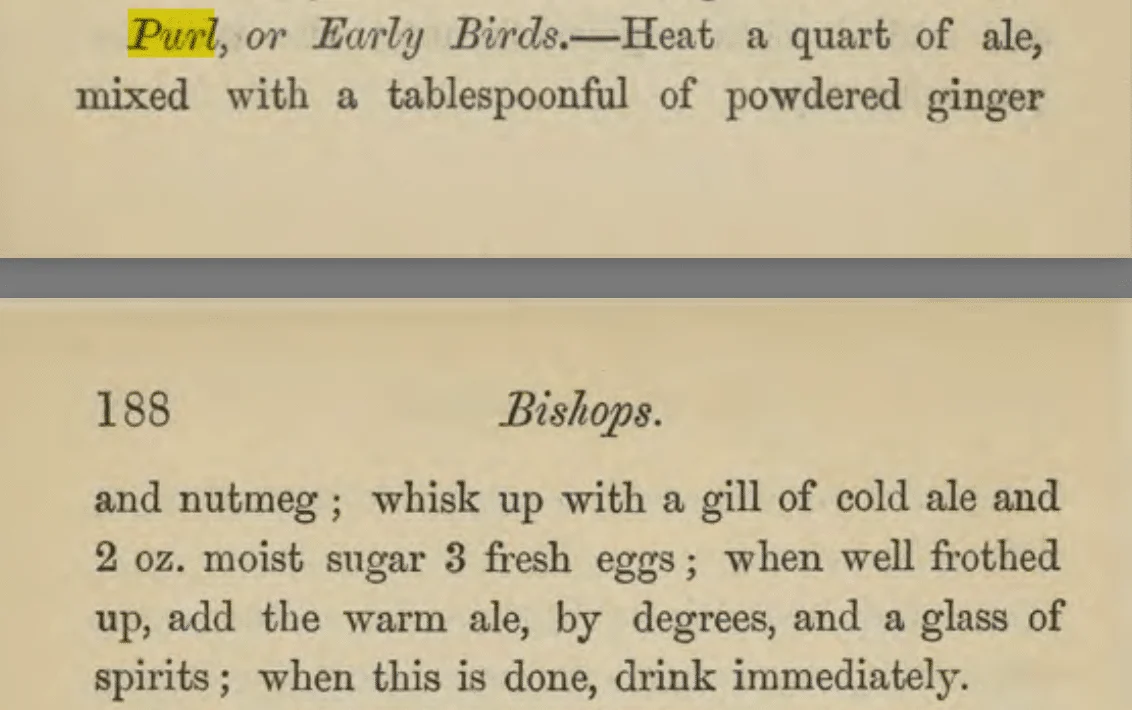
The 19th century represented the peak of the Purl’s culinary complexity. As the science of mixology began to formalize, the Purl was reimagined as a sophisticated, heated beverage akin to a "flip." The 1869 volume Cooling Cups and Dainty Drinks by William Terrington—widely regarded as the first British cocktail book—provides a window into this era.

Terrington’s recipes indicate that the Purl had moved far beyond a simple infusion of wormwood. His version featured warmed beer mixed with multiple eggs, sugar, and various spices such as nutmeg and ginger. Notably, the addition of spirits was common but not exclusively restricted to gin. While gin was a frequent choice, Victorian bartenders often substituted brandy, whisky, or rum depending on the patron’s preference.
Terrington also documented a distinction between the general "Purl" and the "Ale Cup." While the Purl remained a broad category of warmed, enriched ale, the Ale Cup was a more specific precursor to the modern definition, explicitly calling for the combination of gin and ale. This period marks the point where the original medicinal bitterness of wormwood began to be replaced by the botanical bitterness of gin and the aromatic warmth of kitchen spices.

The 20th Century and the Standardization of the Gin-Ale Duo
The 20th century saw a dramatic simplification of the Purl, driven by the changing pace of urban life and the decline of the "flip" style of drinks, which required labor-intensive heating and whisking of eggs. By the 1920s, the medicinal roots of the drink had largely vanished from the public consciousness.
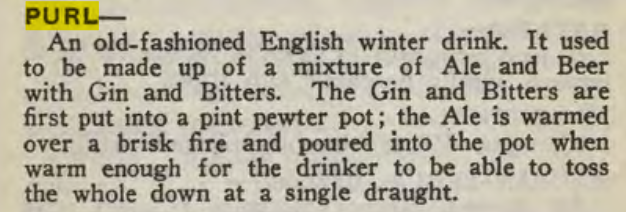
In the 1925 text Summer Drinks and Winter Cordials, the recipe for Purl began to stabilize around the combination of gin, ale, and bitters, though the tradition of warming the ale persisted for several decades. By the mid-20th century, even the warming element began to fade. The 1935 manual The Art of Mixing Drinks and the 1966 edition of The Barman’s Bible (from the Cocktail and Wine Digest) present the Purl as a straightforward mixture. The 1966 recipe defines the Purl simply as "Gin and Ale," occasionally topped with a dash of bitters to provide a ghost of the drink’s original wormwood-driven bitterness.

Botanical and Technical Analysis: Old Tom and British Bitter
The specific ingredients cited in historical reconstructions of the Purl offer insight into the flavor profile that defined British drinking for two centuries. The use of Old Tom gin is critical; unlike the crisp, juniper-forward London Dry gins that dominate the modern market, Old Tom was historically "rectified" with sugar and a heavy dose of botanicals like licorice root. This sweetness was necessary to balance the harshness of early distillation methods and provided a bridge between the heavy, malty notes of 18th-century ales and the sharp bitterness of wormwood.
The ale used in the Purl was typically a "British Bitter" or a "Mild," which in the 1800s would have been significantly more acidic and "funkier" than modern equivalents due to the presence of wild yeasts in wooden fermentation vats. Serving the drink at "cellar temperature" (approximately 12-14°C or 54-57°F) allowed the malt complexity of the beer to remain prominent, a characteristic that is often lost when modern ales are served at near-freezing temperatures.

Socio-Economic Implications and Modern Legacy
The trajectory of the Purl mirrors the broader socio-economic shifts in British history. Its origin as a "poorer sort" remedy during the plague highlights the intersection of public health and alcohol consumption in the pre-industrial era. Its rise to a complex Victorian luxury reflects the growing middle class’s desire for refined, domestic comforts. Finally, its 20th-century simplification reflects the industrialization of the bar trade, where speed and consistency replaced the artisanal preparation of heated, egg-based drinks.
In the modern era, the Purl survives primarily as a curiosity for cocktail historians and a niche offering in craft beer bars that explore "Boilermaker" variations. While the modern version—a shot of gin dropped into a pint—is a functional and potent beverage, it lacks the botanical depth and nutritional density of its ancestors. The loss of wormwood, in particular, signifies a shift in the Western palate away from intense medicinal bitterness toward the cleaner, more predictable profiles of modern spirits.

Chronology of the Purl’s Evolution
- 1665: Mentioned in plague prevention manuals as a morning tonic for the poor (Ale + Wormwood).
- 1684: Documentation of "Cider Purls," showing the recipe’s regional adaptability.
- 1690: Recognition in herbals for its medicinal properties.
- 1733: The rise of Purl-shops and the beginning of social stigma regarding morning drinking.
- 1869: William Terrington documents the Purl as a complex, heated "flip" with eggs and spices.
- 1925: Recipes begin to omit eggs, focusing on the gin-ale-bitters triad.
- 1966: The Purl is canonized in modern bar guides as a simple two-ingredient drink.
The history of the Purl serves as a reminder that the drinks found on modern menus are often the "distilled" versions of much older, more complex traditions. From a desperate measure against the Black Death to a Victorian winter warmer, the Purl remains a foundational, if misunderstood, pillar of Anglo-American drinking history.
