

The beverage known as the Purl stands as a testament to the fluid nature of cocktail history, evolving over four centuries from a medicinal necessity into a staple of the British pub and eventually into a simplified modern classic. While contemporary bar culture often defines the Purl as a straightforward combination of British bitter ale and a shot of gin, historical documentation reveals a significantly more complex lineage. This evolution reflects broader shifts in societal norms, medical understanding, and the industrialization of the spirits industry. Originally a bitter, wormwood-infused ale consumed to ward off the Great Plague of London, the Purl transitioned into a recreational "morning constitutional" before becoming a sophisticated "flip" involving eggs and spices, finally settling into the gin-centric formula recognized by 20th-century mixologists.
The Medicinal Origins and the 17th-Century Plague Context
The earliest recorded iterations of the Purl were fundamentally medicinal rather than recreational. In the mid-17th century, London faced recurrent outbreaks of the bubonic plague, culminating in the Great Plague of 1665. During this period, medical science was rooted in the theory of humors and the belief that bitter herbs could purify the blood and ward off miasmas. Wormwood (Artemisia absinthium), a perennial herb known for its extreme bitterness and antimicrobial properties, became a primary ingredient in preventative tonics.
Historical records, such as the 1665 publication Directions for the Prevention and Cure of the Plague Fitted for the Poorer Sort, recommended a "draught or two of Purle," specifically in the morning. For the "poorer sort," ale or low-quality wine served as the most accessible solvent for extracting the medicinal properties of wormwood. At this stage in history, the Purl did not contain distilled spirits; it was simply an "herbed ale." The bitterness served a dual purpose: it was believed to stimulate the digestive system and act as a tonic against infection.
By 1684, the practice of creating "Purls" had expanded beyond ale. The text Aphorisms upon the New Way of Improving Cyder suggests that the cider industry sought to capitalize on the drink’s popularity, asserting that a "purl with cider" was as effective and palatable as the ale-based version. This indicates that by the late 17th century, "Purl" had become a categorical term for any fermented beverage infused with wormwood. This is further corroborated by the 1690 volume An English Herbal, which details the health benefits of consuming wormwood via a Purl to treat various ailments.
The 18th Century: Morning Constitutionals and Social Stigma
As the threat of the plague receded, the Purl transitioned into a recreational beverage, though it retained its reputation as a morning drink. In the 18th century, "Purl-shops" became common fixtures in London’s urban landscape. These establishments catered to laborers and early risers who consumed the drink as a "morning constitutional" to provide energy for the workday.

However, this period also saw the beginning of the "Gin Craze," and the Purl began to undergo a structural transformation. Spirits, which were becoming cheaper and more widely available, were increasingly added to the traditional wormwood ale. This shift brought about a change in the drink’s social standing. By 1733, the Grub Street Journal published accounts that portrayed Purl consumption as a vice. The drink was often grouped with smoking and excessive gin drinking, forming a triad of behaviors associated with the perceived moral decay of the working class.
During this era, the Purl was no longer just a health tonic; it was a potent intoxicant. The bitterness of the wormwood masked the harshness of the unregulated spirits of the time, making it a precursor to the modern cocktail in its use of modifiers to improve the palatability of base alcohols.

The 19th Century: The Rise of the Purl Flip and Sophistication
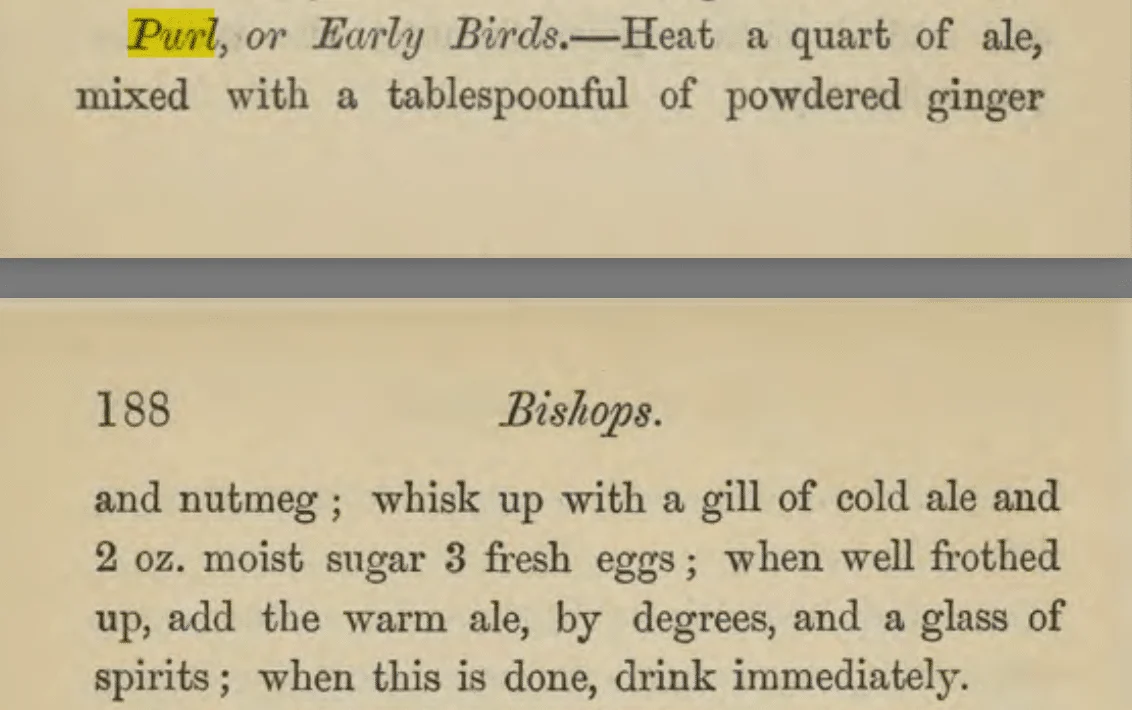
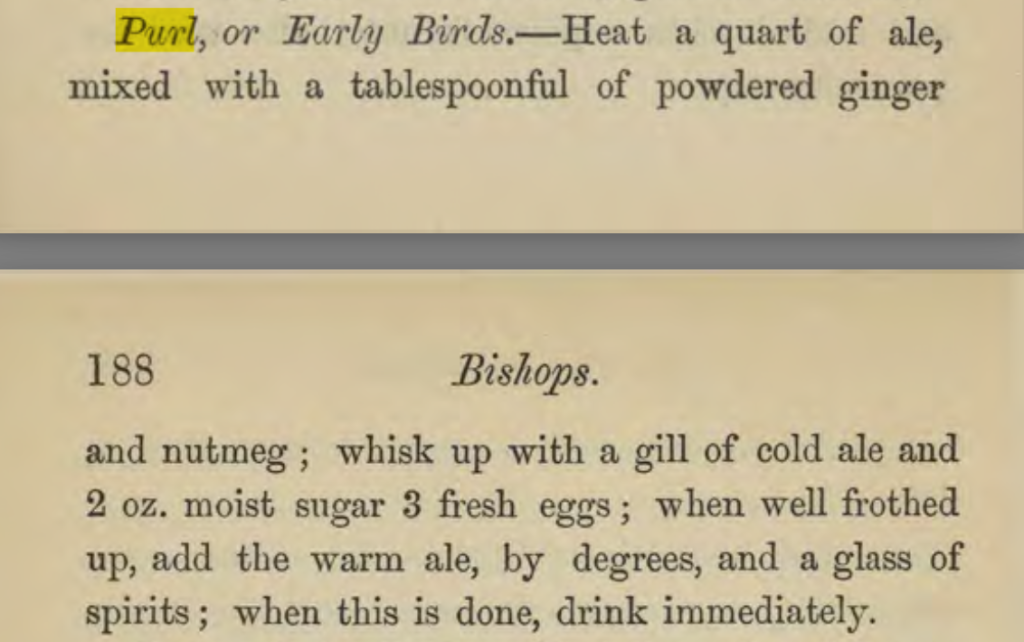
The 19th century represented the peak of the Purl’s complexity. As British bar culture became more refined, the drink evolved into a variety of "flip"—a category of drinks characterized by the addition of eggs and the use of heat. William Terrington’s 1869 manual, Cooling Cups and Dainty Drinks, often cited as the first British cocktail book, provides a window into this era of transition.
Terrington’s recipes demonstrate that the Purl had moved far beyond its two-ingredient origins. His versions often involved warming the beer and whisking in multiple eggs, sugar, and various spices such as ginger or nutmeg. Notably, Terrington did not always specify gin as the requisite spirit. Depending on the region and the patron’s preference, the added spirit could just as easily be brandy or whiskey.

One specific variation noted in 19th-century texts is the "Ale Cup." While the Purl remained the broader term for bittered, spirit-fortified ale, the Ale Cup emerged as a dedicated gin drink. It featured gin, ale, lemon peel, and grated nutmeg. The use of "Old Tom" gin—a slightly sweetened style of gin that predates the modern London Dry—was standard. The sugar in the Old Tom gin helped balance the inherent bitterness of the ale and any residual wormwood flavors, creating a more harmonious profile.
The 20th Century: Simplification and the Canonical Gin Formula
The 20th century saw a dramatic narrowing of the Purl’s definition. Several factors contributed to this simplification. First, the use of wormwood in commercial beverages became more strictly regulated and eventually fell out of fashion, largely replaced by the standardized use of hops in the brewing process to provide bitterness. Second, the elaborate "flip" style—incorporating raw eggs and manual heating—became less practical for high-volume modern bars.

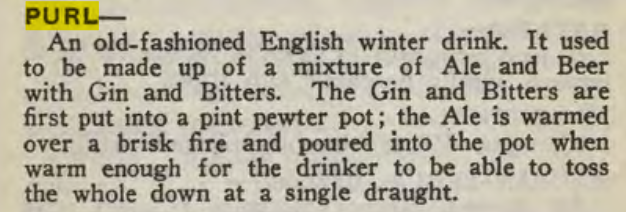
By the 1920s, as seen in Summer Drinks and Winter Cordials (1925), the eggs had largely disappeared from the recipe. The warming of the ale remained a common practice, particularly in winter, but the drink was becoming more streamlined. By the mid-20th century, manuals like The Art of Mixing Drinks (1935) and the 1966 edition of The Barman’s Bible (published by Cocktail and Wine Digest) had codified the modern Purl: a mixture of ale, gin, and occasionally bitters.
In this modern iteration, the "shot of gin" became the canonical spirit. The complex spice blends of the 19th century were replaced by a few dashes of Angostura or orange bitters, which served as a nod to the drink’s original wormwood-driven bitterness. The temperature of the drink also shifted; while traditionally served at cellar temperature or warmed, modern iterations are sometimes served cold, aligning with 20th-century preferences for chilled beverages.

Technical Analysis of Flavor and Ingredients
The historical success of the Purl can be attributed to the chemical and sensory interaction between its components.
- Bitterness Profile: Original Purls relied on absinthin, the bitter compound in wormwood. Unlike the lupulin found in hops, absinthin provides a sharp, lingering bitterness that does not dissipate as easily with heat. When spirits were added, this bitterness helped to "cut through" the ethanol burn.
- The Role of Ale: 18th and 19th-century British ales were typically "Bitters" or "Burton Ales," which possessed a high malt backbone and significant residual sugars. These sugars were essential for balancing the added spirits and herbs.
- Old Tom Gin: The use of Old Tom gin in the 19th century was crucial. Because London Dry gin was not yet the dominant style, the sweeter, more botanical Old Tom acted as both a fortifier and a sweetener, negating the need for the additional sugar syrups found in other cocktails of the era.
- Thermal Impact: Warming the ale—a common practice until the mid-20th century—volatilized the aromatic compounds in the gin (such as juniper and coriander) and the spices, creating a highly aromatic experience that cold drinks lack.
Chronology of the Purl’s Transformation
- 1660s: Emerges as a medicinal tonic (ale + wormwood) used primarily as a plague preventative.
- 1680s-1690s: Expands to include cider bases; recognized as a general "herbal herbal" remedy.
- 1730s: Enters the recreational sphere; "Purl-shops" proliferate in London; spirits begin to be added; social stigma increases.
- 1860s: Documented in the first British cocktail books as a complex "flip" containing ale, spirits (not always gin), eggs, sugar, and spices.
- 1920s: Simplification begins; eggs are removed from the standard recipe; gin becomes the primary spirit.
- 1960s-Present: The definition stabilizes as a simple combination of ale and gin, often served with bitters, losing the requirement for wormwood or heating.
Broader Impact and Implications for Modern Mixology
The history of the Purl illustrates the "evolutionary pruning" that many classic cocktails undergo. As drinks move from medicinal or utilitarian origins into the realm of professional mixology, they often lose their complexity in favor of speed and consistency. The loss of wormwood in the Purl mirrors the broader "sanitization" of the cocktail menu in the early 20th century, where many traditional bittering agents were discarded.

However, the recent resurgence of interest in historical spirits and "botanical" drinking has led some craft cocktail bars to revisit the 17th-century roots of the Purl. By reintroducing wormwood-infused syrups or using modern vermouths (which contain wormwood) alongside ale and gin, bartenders are attempting to bridge the gap between the simple modern "gin-and-ale" and the complex tonic of the past.
The Purl remains a unique cultural artifact of British history. It survived the Great Plague, the Gin Craze, and the industrialization of the Victorian era. Its current form may be a simplified shadow of its 19th-century peak, but its endurance highlights a fundamental human preference for the pairing of grain-based fermented beverages with the sharp, botanical punch of distilled spirits. As modern consumers continue to seek drinks with "heritage," the Purl is well-positioned for a secondary revival that honors its multifaceted history as both a life-saving medicine and a storied pub classic.
