

In the landscape of contemporary mixology, the Purl is frequently characterized as a straightforward combination of British ale fortified with a single measure of gin. This modern iteration, often served at cellar temperature to maintain the integrity of the ale’s profile, is widely believed to be a vestige of 18th and 19th-century British tavern culture. Historical enthusiasts and bartenders typically specify that the gin of that era would have been an Old Tom style—a sweeter, more botanical-heavy precursor to London Dry—while the ale would likely have been a traditional British Bitter. However, a comprehensive analysis of historical cocktail manuals, medical journals, and social commentaries reveals that the Purl’s lineage is far more intricate than its current two-ingredient form suggests. The drink has transitioned through several distinct identities: beginning as a bitter medicinal tonic used to combat the bubonic plague, evolving into a complex, heated "flip" containing eggs and spices, and finally settling into the simplified gin-and-beer pairing recognized today.
The Medicinal Genesis: Wormwood and the Great Plague
The earliest recorded references to the Purl do not involve gin, but rather the infusion of bitter herbs into fermented bases. During the 17th century, particularly in London, a "Purl" was defined as ale or wine infused with wormwood (Artemisia absinthium). At this time, the beverage was viewed primarily through a pharmacological lens. Wormwood has been used since antiquity for its supposed vermifuge (deworming) properties and as a digestive aid, but in the mid-1600s, it took on a more desperate significance.
The 1665 publication Directions for the Prevention and Cure of the Plague Fitted for the Poorer Sort serves as a primary source for this medicinal application. The text, intended to provide affordable health advice to those unable to consult private physicians during the Great Plague of London, explicitly recommends "a draught or two of Purle… especially in the morning." The inclusion of the Purl in a guide for the "poorer sort" indicates that the drink was an accessible, low-cost prophylactic. The bitter qualities of the wormwood were believed to "fortify the stomach" and ward off the "miasma" or foul air thought to carry the disease. During this era, the beverage was often consumed as a "morning constitutional," a practice that would eventually transition from a health necessity to a recreational habit.
The 17th and 18th Century Expansion: Cider and Social Stigma
As the 17th century progressed, the definition of Purl expanded to include other fermented bases beyond ale. The cider industry, seeking to capitalize on the drink’s popularity and perceived health benefits, asserted its own version of the tonic. The 1684 volume Aphorisms upon the New Way of Improving Cyder argued that a "purl made with cider" was equal in merit to the ale-based version. This period highlights the fluid nature of the term "Purl," which essentially described any fermented liquid made bitter with wormwood.
By 1690, An English Herbal further solidified the drink’s reputation as a health tonic, detailing the specific botanical benefits of drinking wormwood-infused Purl. However, as the threat of the plague receded, the consumption of Purl began to shift toward the recreational, leading to its first brushes with social controversy. By the early 18th century, the "morning purl" had become a common sight in London’s burgeoning "Purl-houses."

The transition from medicine to vice is documented in a 1733 edition of The Grub Street Journal. In a scathing character attack published during the height of the London "Gin Craze," the journal linked the consumption of Purl with smoking and excessive gin drinking. This suggests that by the 1730s, the practice of adding distilled spirits to the bitter ale had begun to take root. The Purl-house became a specific type of establishment, often frequented by laborers and the urban poor who sought a potent, inexpensive start to their workday.
The 19th Century: Complexity and the "Flip" Tradition
The 19th century marked the most complex phase of the Purl’s evolution. No longer a simple infusion of wormwood, the drink transformed into a rich, caloric beverage often served hot. This version of the Purl aligned closely with the "Flip" family of drinks—cocktails made by mixing ale with spirits, sugar, and whole eggs, then "frothing" the mixture by pouring it between two vessels or using a red-hot iron loggerhead.

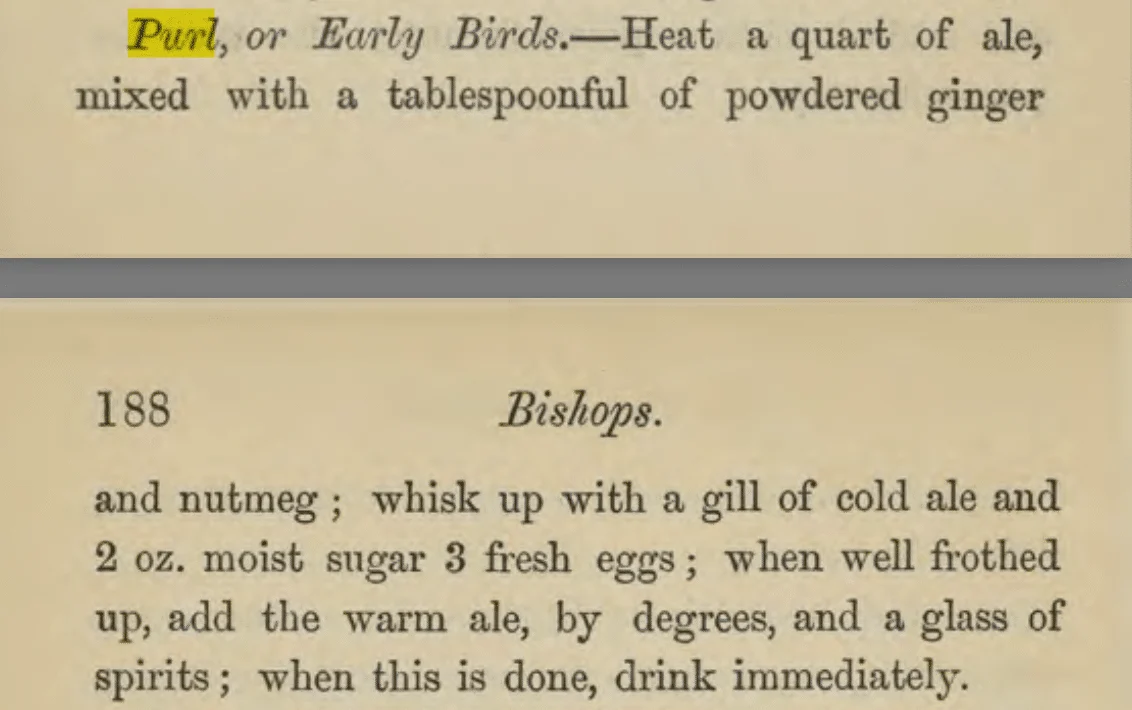
William Terrington’s 1869 work, Cooling Cups and Dainty Drinks, which is frequently cited as the first dedicated British cocktail book, provides a window into this sophisticated era. Terrington’s recipe for the Purl bears little resemblance to the modern version. It called for warmed beer and multiple eggs, and notably, it did not mandate the use of gin. In the mid-Victorian bar, the "spirit" added to a Purl could just as easily have been brandy, rum, or whisky, depending on the patron’s preference and social standing.
Terrington also included a separate recipe for a drink known as the "Ale Cup." While the Ale Cup specifically required gin and ale, it was categorized distinctly from the Purl. This distinction suggests that during the mid-19th century, the term "Purl" still carried the connotation of a complex, egg-thickened beverage, whereas other names were used for simpler gin-and-ale mixtures. The use of heat remained a constant; the Victorian Purl was a winter staple, intended to provide warmth and sustenance as much as intoxication.

The 20th Century: Simplification and the Primacy of Gin
The 20th century witnessed a dramatic streamlining of the Purl. The labor-intensive process of heating ale and tempering eggs fell out of favor in the fast-paced modern bar environment. Simultaneously, the use of wormwood as a direct infusion into ale vanished, likely due to the rise of commercial bitters and changing palates that favored cleaner, less aggressively medicinal flavors.
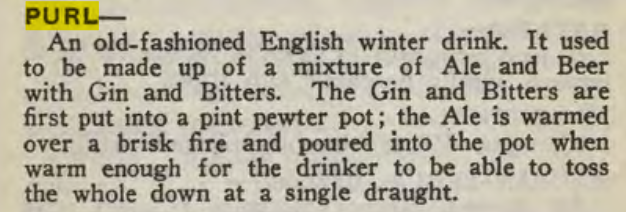
By the 1920s, the Purl began to converge on the definition we recognize today. In the 1925 volume Summer Drinks and Winter Cordials, the recipe had shed its "flip" characteristics. The eggs were gone, though the tradition of warming the ale persisted in some circles. More importantly, gin became the "canonical" spirit for the drink. This shift was likely influenced by the global popularity of gin during the Prohibition era and the Interwar period, which saw the spirit become the backbone of the burgeoning cocktail culture.

Subsequent manuals, such as The Art of Mixing Drinks (1935) and The Barman’s Bible (1966), further codified the modern Purl. These texts describe a drink consisting of ale, a measure of gin, and a dash of bitters. The bitters served as a symbolic nod to the drink’s wormwood-infused origins, providing the necessary aromatic counterpoint to the malt of the ale and the botanicals of the gin.
Technical Analysis: Ingredients and Composition
To understand the Purl’s evolution, one must examine the technical characteristics of its primary components over time.

- The Ale: Historically, the "ale" used was not the highly carbonated, filtered lager of today. It was likely a "British Bitter" or a "Mild," served from a cask. These beers were characterized by a lower carbonation level and a complex malt profile that could stand up to the addition of spirits and heat.
- The Spirit: The transition to gin was significant because of the spirit’s botanical profile. Old Tom gin, with its slight sweetness and heavy juniper and licorice notes, complemented the bitterness of the hops and the (former) wormwood. When gin replaced brandy or rum, the Purl became a lighter, more aromatic beverage.
- The Bittering Agent: The move from raw wormwood to commercial bitters (such as Angostura or orange bitters) changed the drink from a tonic to a cocktail. Wormwood provides a deep, earthy bitterness, whereas modern bitters offer a more nuanced, spicy, and citrus-forward profile.
Broader Implications and Cultural Legacy
The history of the Purl is a microcosm of the broader evolution of British social drinking. It reflects a transition from "necessity drinking"—where alcohol was a vehicle for medicine or a safer alternative to contaminated water—to "pleasure drinking," where the complexity and flavor profile of the beverage became the primary focus.
The Purl also highlights the historical fluidity of beverage categories. The fact that it was once a cider-based drink, then a brandy-based flip, and finally a gin-based ale fortification demonstrates how cocktail names often survive even when their ingredients change entirely. In the modern era, the Purl represents a link to the "Old English" style of drinking, which favored room-temperature or warmed beverages and a marriage of brewery and distillery products.

Today, while the Purl is not a "top-tier" classic like the Martini or the Old Fashioned, it remains a point of interest for historians and craft bartenders seeking to revive lost traditions. Its modern simplicity—a shot of gin in a pint of bitter—belies a four-hundred-year history of plague prevention, social upheaval, and culinary refinement. As the craft cocktail movement continues to look backward for inspiration, the Purl stands as a testament to the enduring human desire to blend the medicinal with the recreational, and the bitter with the bold.
