

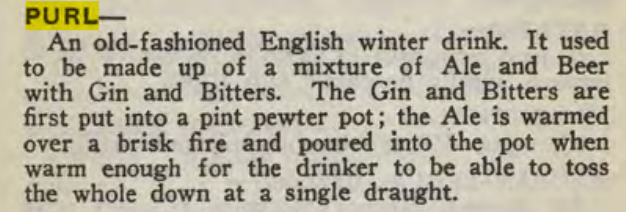
In the contemporary landscape of global bar culture, the Purl is frequently characterized as a straightforward, utilitarian combination: a pint of English ale fortified with a single measure of gin. This modern iteration, often served at cellar temperatures and utilizing a traditional British Bitter or a robust porter, is widely believed to be a relic of 18th and 19th-century tavern life. However, a deeper investigation into the historical record reveals that the Purl’s lineage is significantly more complex, evolving from a bitter plague preventative into a decadent, spiced egg-flip before finally settling into the minimalist gin-and-ale pairing recognized by mixologists today.
To understand the Purl is to understand the social and medical history of London over three centuries. While modern manuals such as Difford’s Guide maintain the drink’s status as a simple "ale-and-gin" mixture, historical cocktail books and medical journals suggest that for most of its existence, the Purl was defined not by the presence of gin, but by the infusion of wormwood.
The 17th Century: A Medicinal Necessity
The earliest documented versions of the Purl date back to the mid-17th century, a period when the line between recreation and medication was frequently blurred. In 1665, London was gripped by the Great Plague, a catastrophic outbreak of bubonic plague that decimated the city’s population. During this era, "Directions for the Prevention and Cure of the Plague Fitted for the Poorer Sort" was published as a public health guide. On its opening page, the manual recommended that citizens consume "a draught or two of Purle… especially in the morning."
At this stage of history, a Purl did not necessarily contain distilled spirits. Instead, it was defined as ale or wine infused with wormwood (Artemisia absinthium). Wormwood was prized in the 1600s for its intense bitterness and its supposed antiseptic properties. For the "poorer sort," who could not afford expensive imported medicines, a bitter ale served as a daily constitutional intended to fortify the stomach and ward off infection.
By the late 1600s, the drink had become so entrenched in English life that other industries sought to capitalize on its popularity. In 1684, the publication "Aphorisms upon the New Way of Improving Cyder" argued that cider-based Purls were just as efficacious as those made with ale. This suggests that "Purl" was less a specific recipe and more a category of bittered, fortified beverages consumed for health and vigor.

The 18th Century: The Morning Constitutional and Social Vice
As the 1700s progressed, the Purl transitioned from a purely medicinal draught into a recreational staple of London’s "Purl-shops." It remained a morning drink, often consumed by laborers, porters, and watermen on the Thames before starting their shifts. However, as the "Gin Craze" began to take hold of the British working class, the recipe began to shift.
By 1733, the Purl had gained a more scandalous reputation. An edition of The Grub Street Journal from September of that year contains a scathing character attack on a Londoner, linking the habitual consumption of "Pots of Purle" with heavy smoking and gin drinking. This period marks the first significant crossover between the bitter wormwood ale and the burgeoning gin industry.

During this era, gin was often of poor quality, heavily flavored with turpentine or sugar to mask impurities. Adding it to a bittered ale served two purposes: it increased the alcoholic potency for a low cost and masked the harshness of the spirit. Despite this, wormwood remained the defining ingredient. Without the bitter herb, the drink was simply "gin and ale," not a true Purl.
The 19th Century: The Rise of the Victorian Flip
The Victorian era saw the Purl reach its peak of complexity. No longer just a bitter ale, it was transformed into a "flip"—a category of drinks served hot, thickened with eggs, and sweetened with sugar and spices.

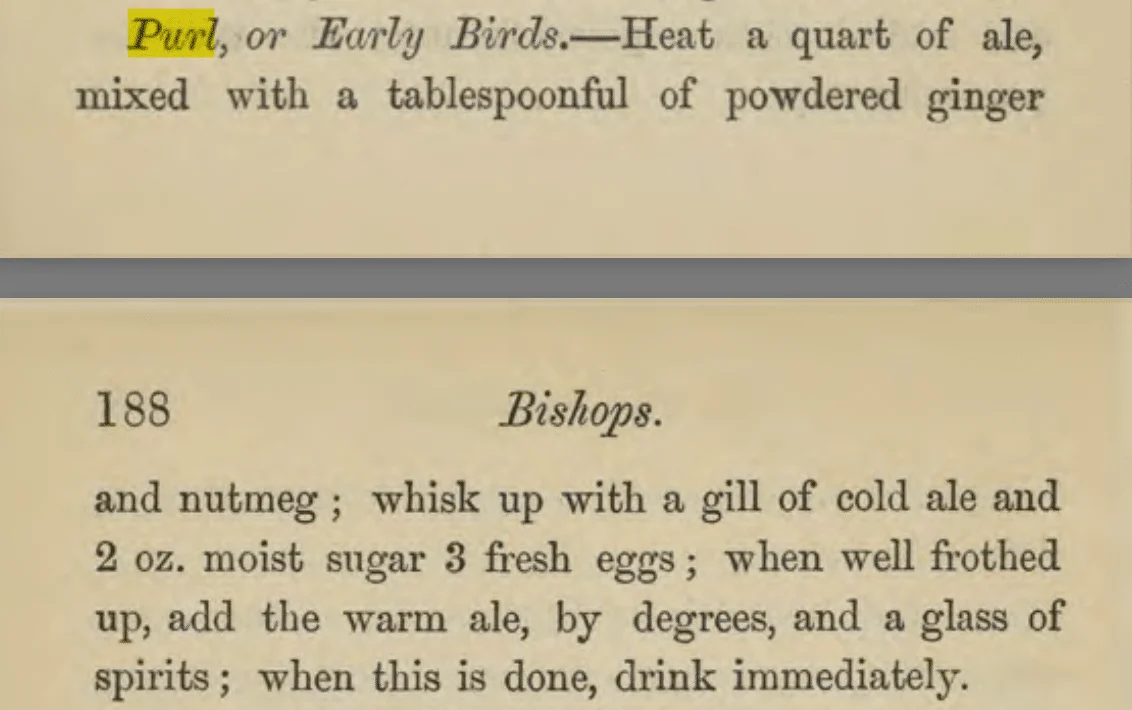
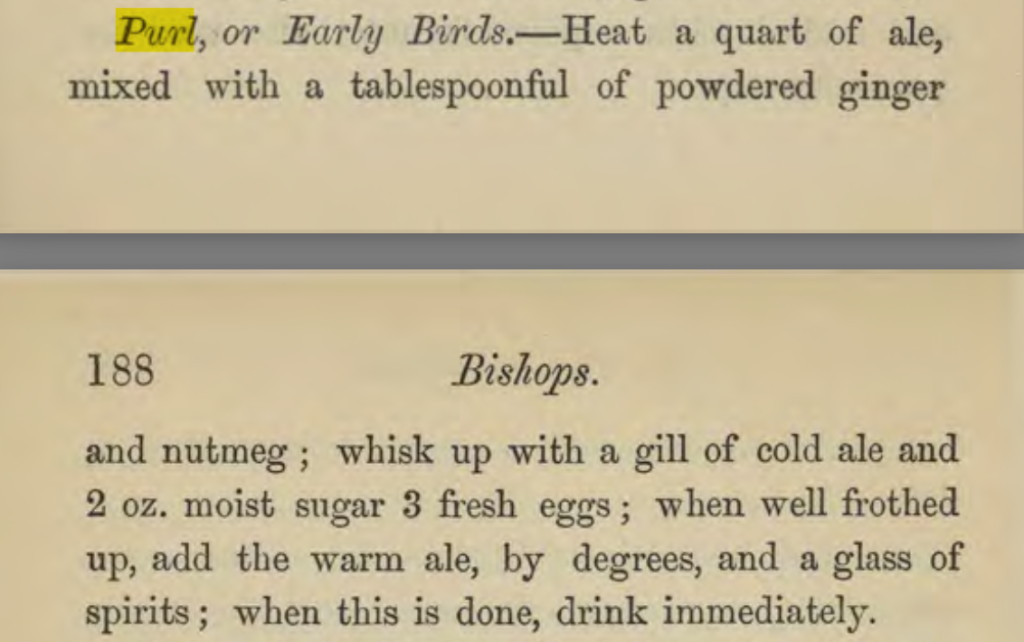
William Terrington’s 1869 volume, Cooling Cups and Dainty Drinks, widely regarded as the first British cocktail book, provides a window into this transformation. Terrington’s recipe for the Purl involves warmed beer and multiple eggs, but notably, it does not mandate the use of gin. In the mid-19th century, the added spirit was just as likely to be brandy, rum, or whiskey, depending on the patron’s preference and the establishment’s stock.
Terrington also included a recipe for a dedicated "Ale Cup," which specifically called for gin and ale. This suggests that while the Purl and the Gin-and-Ale were related, they were still viewed as distinct beverages. The Purl of the 1860s was a substantial, caloric drink—often called an "Early Bird"—intended to provide warmth and sustenance in the damp British climate. It was typically prepared by heating the ale in a "loggerhead" (a red-hot iron poker) and whisking in the eggs and spirits to create a frothy, custard-like consistency.

The 20th Century: Simplification and Standardization
The 20th century brought about the decline of the traditional Purl and the rise of the simplified version we recognize today. Several factors contributed to this evolution:
- The Disappearance of Wormwood: As the medical community moved away from herbalism toward modern pharmacology, the perceived necessity of wormwood diminished. Furthermore, the association of wormwood with absinthe led to a general stigma surrounding the herb in the early 1900s.
- The Decline of Hot Ales: With the advent of better indoor heating and the shift toward chilled beverages, the labor-intensive "flip" style of Purl fell out of fashion.
- The Rise of London Dry Gin: The refinement of the distillation process led to a cleaner, more palatable style of gin. This made the addition of eggs and heavy spices unnecessary.
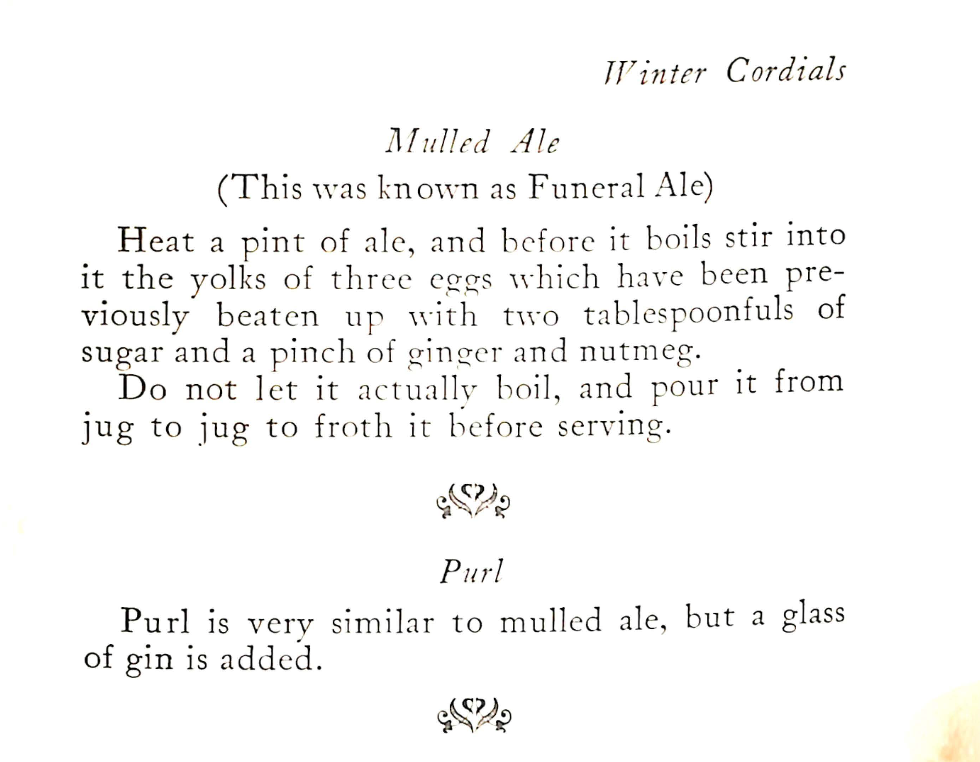
By 1925, Summer Drinks and Winter Cordials showed the Purl losing its "flip" roots. While the ale was still sometimes warmed, the eggs had largely disappeared. By the time The Art of Mixing Drinks was published in 1935, the recipe had converged on the modern definition: gin, ale, and perhaps a dash of bitters to replace the missing wormwood.

The final "canonical" version was solidified in the mid-20th century. The Barman’s Bible (1966) describes the Purl as a simple mixture of gin and ale, usually served cold or at cellar temperature. The transition was complete: the medicinal wormwood brew of the 1600s had been entirely replaced by a two-ingredient spirit-and-mixer combination.
Technical Analysis and Ingredients
The profile of a Purl is heavily dependent on the specific types of ale and gin used. Historically, the ale would have been a "British Bitter" or a "Mild," both of which offer a malty backbone that complements the botanicals in gin.

- The Spirit: In the 19th century, "Old Tom" gin was the standard. This was a slightly sweeter, maltier style of gin that bridged the gap between Dutch Genever and modern London Dry Gin. When making a historical Purl today, using an Old Tom gin provides a more authentic flavor profile than a contemporary, citrus-forward dry gin.
- The Bitterness: The original Purl relied on wormwood for bitterness. Modern versions often use Angostura or orange bitters to replicate this, though the flavor profile is markedly different. Wormwood provides a persistent, earthy bitterness, whereas modern bitters are more aromatic and spicy.
- The Ale: A traditional British Bitter (4.0% to 5.0% ABV) provides the necessary carbonation and hop profile. However, some historical recreations utilize porters or stouts, which echo the heavier "meal-in-a-glass" quality of the Victorian Purl.
Broader Cultural Impact and Modern Mixology
The story of the Purl is a microcosm of the evolution of the cocktail itself. It reflects a journey from "folk medicine" to "working-class staple" to "refined classic." Today, the Purl is experiencing a minor revival among craft cocktail enthusiasts and historical reenactors who seek to move beyond the simple gin-and-ale pairing.
Modern mixologists are increasingly experimenting with "Reverse Purls," using wormwood-heavy vermouths mixed with ale, or creating modern flips that incorporate the eggs and spices of the Terrington era. This resurgence highlights a growing interest in the "bitter" palate, a trend also seen in the global popularity of the Negroni and other amaro-based drinks.
Ultimately, the Purl serves as a reminder that the names of drinks often outlive their original recipes. While a 17th-century Londoner and a 21st-century bartender might both use the word "Purl," they are describing two entirely different experiences: one a bitter shield against the plague, and the other a simple, refreshing fortification of a pint of ale. The drink’s survival over 350 years is a testament to its versatility and its deep roots in the social fabric of British bar culture.
