

In the landscape of contemporary mixology, the Purl is frequently categorized as a straightforward, utilitarian beverage consisting of a measures of gin added to a pint of ale. Historically associated with 18th and 19th-century British pub culture, the drink is often reconstructed by modern bartenders using British Bitter served at cellar temperatures and Old Tom gin, a slightly sweetened style that bridges the gap between the harsh spirits of the past and modern London Dry varieties. However, a deeper examination of historical records, cocktail manuals, and medical treatises reveals that the Purl was once a significantly more complex and culturally significant concoction. Far from being a simple "shot-and-a-beer" precursor, the Purl underwent a multi-century transformation, originating as a bitter herbal medicine used to combat the bubonic plague before evolving into a sophisticated, spice-laden "flip" and eventually settling into its current, simplified form.
The 17th-Century Origins: A Medicinal Foundation
The earliest documented iterations of the Purl bear little resemblance to the gin-based drinks found in modern cocktail bars. During the 17th century, the term "Purl" primarily referred to a mixture of ale or wine infused with wormwood (Artemisia absinthium). Wormwood, known for its intense bitterness and perceived antiseptic properties, was a staple of the early modern pharmacopeia. In 1665, as London grappled with the devastating effects of the Great Plague, the beverage was elevated from a common bitter tonic to a critical health intervention.
The publication "Directions for the Prevention and Cure of the Plague Fitted for the Poorer Sort" (1665) provided dietary and lifestyle advice for those who could not afford private physicians. On its opening pages, the manual recommended that citizens consume "a draught or two of Purle… especially in the morning." At this stage in history, the drink was valued for its purported ability to fortify the body against "miasma" or foul air, which was then believed to be the carrier of disease. Because it was recommended for the "poorer sort," historians infer that the ingredients—standard ale and locally harvested wormwood—were inexpensive and widely accessible, making the Purl a democratic remedy in a time of crisis.
By the late 17th century, the definition of a Purl began to expand. While ale remained the primary base, the cider industry sought to capitalize on the drink’s popularity. In the 1684 text "Aphorisms upon the New Way of Improving Cyder," proponents argued that a "purl with cider" was equal in medicinal and recreational value to the traditional ale-based version. This period marked the transition of the Purl from a strictly clinical application to a common "morning constitutional," a practice supported by "An English Herbal" (1690), which continued to praise the digestive and health benefits of wormwood-infused brews.
The 18th Century: Social Stigma and the Rise of the Purl-Shop
As the 1700s progressed, the Purl began to shift from a health tonic to a recreational intoxicant, coinciding with the rise of London’s "Gin Craze." It was during this era that spirits began to be added to the bitter ale, increasing the drink’s potency and changing its social standing. The "morning draught" of the previous century became a point of contention for moralists and social commentators.

By 1733, the "Grub Street Journal" and other London periodicals began to associate Purl consumption with vice and lower-class dissipation. Character attacks in the press often linked the habit of visiting "Purl-shops" with excessive smoking and the consumption of "Geneva" (gin). The Purl had become part of a morning routine for laborers and the urban poor, serving as both a stimulant and a way to dull the hardships of industrializing London. This period solidified the association between gin and ale, though the herbal bitterness of wormwood remained a defining characteristic that distinguished a Purl from a standard mixture of spirits and beer.
The 19th Century: Culinary Complexity and the Victorian Flip
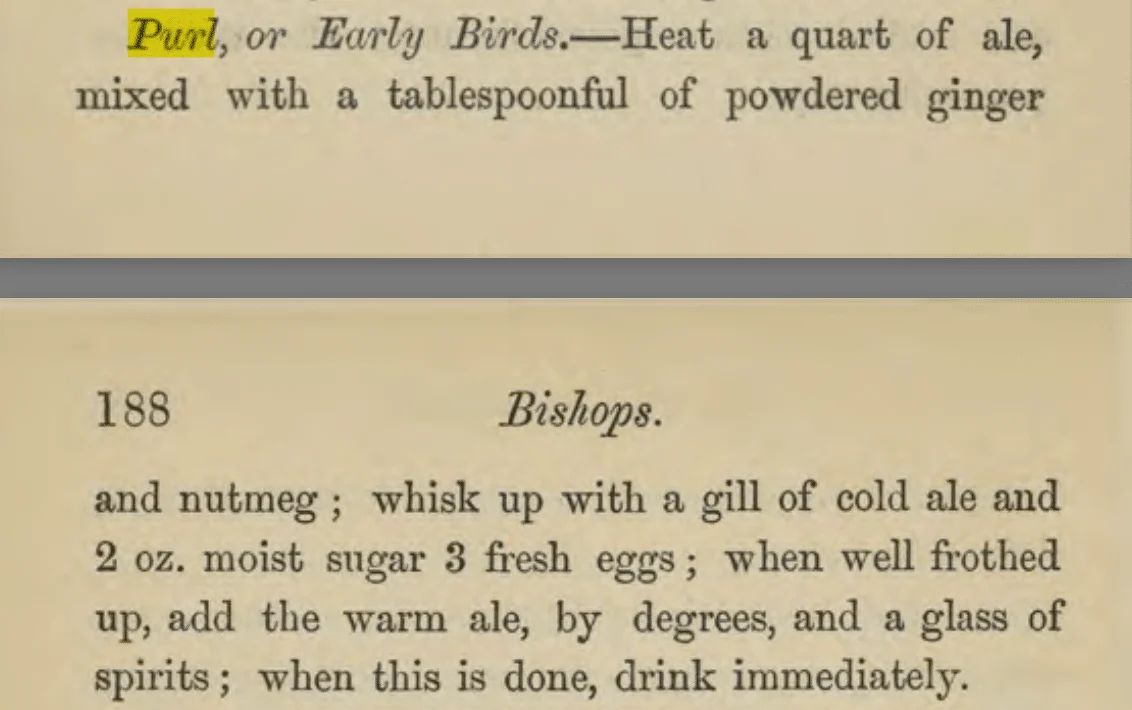
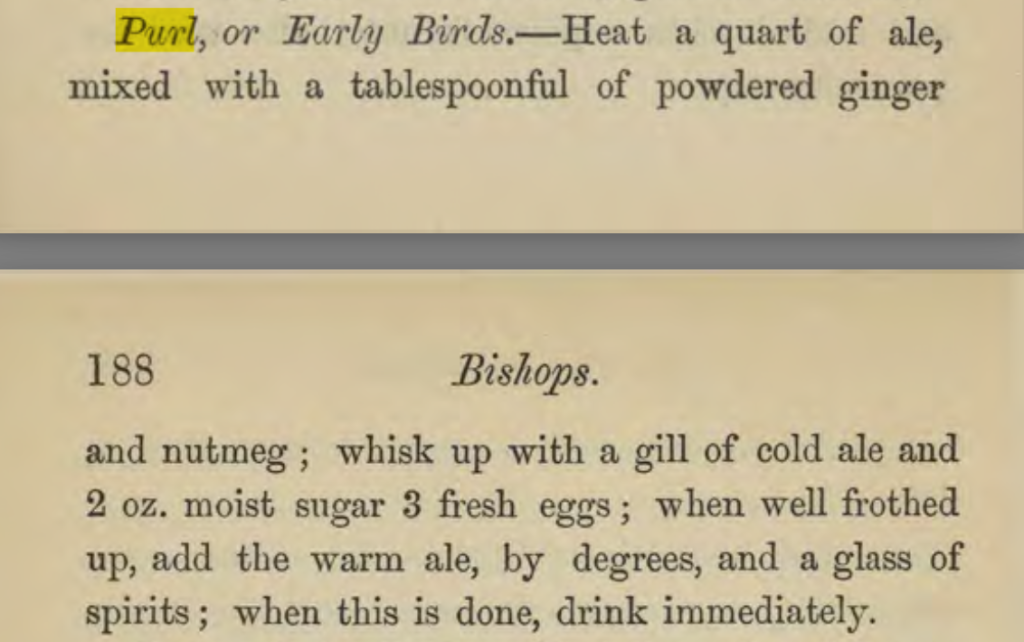
The Victorian era brought a new level of culinary ambition to the Purl, as evidenced by the seminal work of William Terrington. His 1869 volume, "Cooling Cups and Dainty Drinks," is widely regarded by historians as the first proper British cocktail book. Terrington’s recipes reveal that the Purl had evolved into a sophisticated "flip"—a category of drinks characterized by the addition of eggs and heat.

Terrington’s Purl was a far cry from a cold pint of bitter with a gin floater. His instructions called for warming the beer and whisking in multiple eggs and a variety of spices. Interestingly, Terrington did not mandate the use of gin; while a glass of spirits was required, he noted that brandy, whisky, or any available spirit of the era could be utilized. This suggests that "Purl" had become a structural template for a drink rather than a rigid recipe.
In the same manual, Terrington describes a related drink known as the "Ale Cup." Unlike the general Purl, the Ale Cup specifically called for gin and ale, serving as a specialized variation that would eventually influence the modern definition of the Purl. These Victorian versions were often served hot, intended to provide warmth and sustenance during the damp British winters, further distancing the drink from its origins as a room-temperature plague preventative.

The 20th Century: Simplification and the Loss of Wormwood
The 20th century oversaw the most dramatic simplification of the Purl. As the century turned, the labor-intensive "flip" elements—the eggs, the heavy spicing, and the manual frothing—began to disappear from mainstream bar manuals. Simultaneously, the medicinal use of wormwood in common beverages fell out of favor, replaced by the standardized use of commercial cocktail bitters.
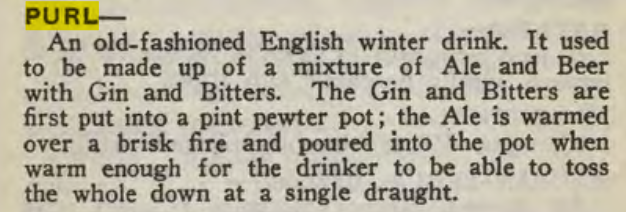
By the publication of "Summer Drinks and Winter Cordials" in 1925, the Purl had begun to stabilize into a two-ingredient combination. While some recipes from this era still suggested warming the ale, the eggs were gone. In "The Art of Mixing Drinks" (1935), the recipe further condensed, and by the time "The Barman’s Bible" (1966) was published, the Purl was defined almost exclusively as a mixture of gin and ale. The "morning constitutional" aspect of the drink had also vanished, repositioning the Purl as a stout evening beverage.

Technical Chronology of the Purl’s Transformation
To understand the Purl’s trajectory, one must look at the specific shifts in its composition over the last 350 years:
- 1660s–1690s: A medicinal infusion of wormwood in ale or wine. Used as a plague remedy and digestive aid. Served at ambient temperatures.
- 1700s–1750s: The introduction of spirits (gin). Consumption moves to "Purl-shops." The drink is associated with early-morning drinking and social unrest.
- 1800s–1880s: The "Golden Age" of the Purl. It becomes a complex, heated beverage containing eggs, ginger, sugar, and nutmeg. Gin is a common but not exclusive spirit.
- 1900s–1950s: The removal of eggs and wormwood. The drink is simplified to gin, ale, and occasionally sugar or bitters.
- 1960s–Present: The canonical modern definition emerges: a shot of gin added to a pint of British Bitter, usually served at cellar temperature.
Expert Analysis: The Role of Old Tom Gin and British Bitter
Modern recreations of the Purl by cocktail historians emphasize the importance of using historically accurate ingredients to achieve the intended flavor profile. The choice of "Old Tom" gin is critical; unlike modern London Dry gin, which is crisp and botanical-forward, Old Tom is slightly sweeter and more viscous. This sweetness was historically necessary to balance the intense bitterness of the wormwood or the tannins in the ale.

The ale itself, typically a British Bitter or a Mild, provides a malty backbone that complements the piney notes of the juniper in the gin. Historically, these ales were "live" products, continuing to ferment slightly in the cask, which added a level of complexity and mouthfeel that modern pasteurized beers lack. When served at cellar temperature (approximately 12-14°C), the flavors of the malt and the gin botanicals meld more effectively than they would in a chilled beverage.
Broader Implications and Cultural Legacy
The history of the Purl is a microcosm of the broader history of British drinking habits. It reflects the shift from communal, medicinal folk remedies to the regulated, commercialized spirits industry. The Purl’s journey from the "poorer sort" in the 1660s to the sophisticated Victorian parlor and back to the utilitarian pub drink of the 20th century highlights how class and economic factors dictate the evolution of taste.

Furthermore, the disappearance of wormwood from the Purl mirrors the wider 19th-century movement toward "pure" food and drink, which saw the removal of many traditional herbal additives. While wormwood survived in the form of Absinthe and Vermouth, its role as a common additive to British beer was largely forgotten, leaving only the "bitter" flavor profile behind in the form of hops.
Today, the Purl remains a niche interest within the craft cocktail movement, often cited as a curiosity of the Dickensian era. However, for those who study the history of spirits, it serves as a reminder that the simplest drinks often have the most convoluted histories. The modern pint of gin-spiked ale is not just a heavy-hitting beverage; it is the final, distilled remnant of a 17th-century battle against the plague and a 19th-century obsession with culinary excess.
