

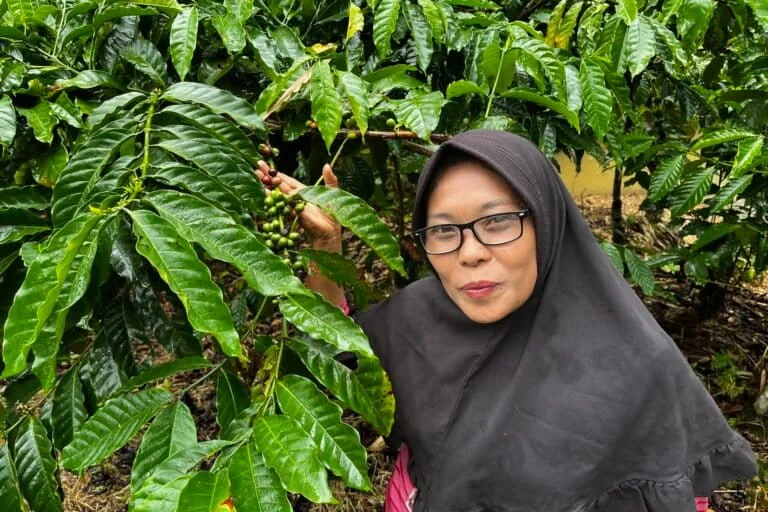
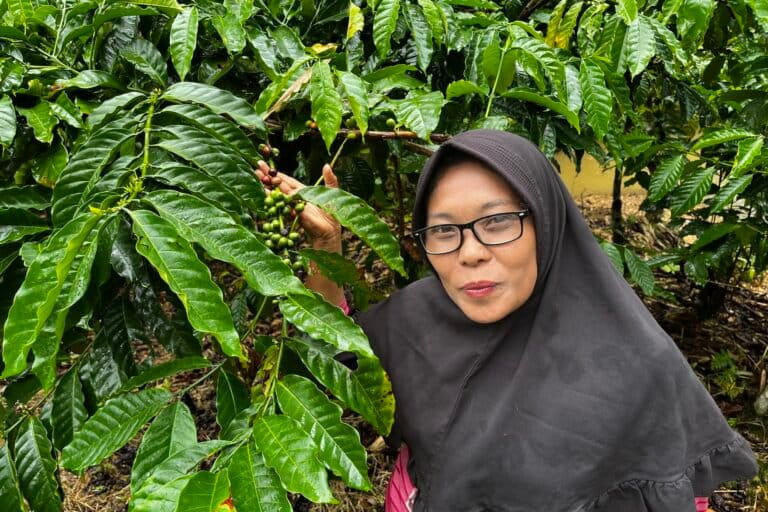
TANGGAMUS, Indonesia – When Sri Atmiatun arrived in the hills of the Batutegi region in southern Sumatra’s Lampung province in 2017, the coffee trees were already there, overgrown and neglected, slowly fading back into scrub. Her uncle had asked her to take over the plot, and Sri agreed, trading years of labor on oil palm plantations in the central Sumatran province of Riau. Nearly a decade later, she still walks the same uphill path each morning, now managing more than 3 hectares (7.4 acres) of land within the 1,400-hectare (3,460-acre) Sumber Makmur social forestry area. This area itself sits on the edge of the more than 80,000-hectare (198,000-acre) Batutegi forest landscape, a complex ecosystem where some zones are strictly protected while others are managed by local communities through intricate agroforestry systems.
Under Indonesia’s ambitious social forestry program, the land officially remains state-owned. However, local communities like Sri’s are granted the legal right to manage these areas for their livelihoods. This stewardship is governed by a framework designed to balance economic needs with the imperative of protecting the forest and its vital ecological functions. “I stayed because this land feeds us,” Sri told Mongabay in early March. “If I leave, who will take care of it?”
Sri’s narrative is not an isolated incident but a reflection of a broader, transformative shift occurring across the Batutegi landscape. Land that was once cleared for coffee cultivation is now undergoing restoration and being managed under the social forestry initiative. This legal recognition has unlocked access to crucial support and training from both governmental bodies and private organizations, fostering a new paradigm for land management. In return, the program aims to curb forest clearing and prevent further encroachment into protected core areas, thereby safeguarding habitats for native wildlife and ensuring the survival of endangered species.
Despite these encouraging developments, conservationists and farmers alike acknowledge that the progress remains fragile. The long-term success of social forestry in Batutegi hinges on the ability of communities to maintain stable and prosperous livelihoods, the strengthening of local institutions, and the collective resolve to resist the persistent pressure to expand cultivation deeper into the forest.
Reshaping the Forest Landscape: A Historical Perspective
The Batutegi region, designated as a protected forest long before Indonesia gained independence in 1945, has a complex history of human interaction with its environment. Despite its protected status, significant waves of encroachment continued until the early 2000s. This period saw a rapid expansion of coffee cultivation, often driven by a combination of lax regulatory enforcement and a scarcity of viable economic alternatives for local populations. Recognizing the challenges and the reality of long-standing cultivation within the forest boundaries, the Indonesian government introduced community forestry permits in Batutegi between 2007 and 2010. The aim was to formalize existing land use and, critically, to mitigate further illegal clearing.
However, the initial implementation of these community forestry permits did not immediately yield robust conservation outcomes. The transition proved complex, and clearing intensified again around 2013 and 2017. This resurgence was partly attributed to the way the social forestry scheme was structured in its early stages. Eligibility for participation in farmer groups, known locally as Gapoktan, was often contingent on possessing land within the designated areas. This created an unintended incentive for communities to reopen long-abandoned plots that had naturally regenerated, thereby legitimizing them as cultivation areas under the program.
The cumulative effect of these historical pressures has reshaped the Batutegi landscape. What was once a continuous primary forest is now significantly altered. Studies indicate that a substantial portion of Batutegi’s approximately 58,000 hectares (143,000 acres) has been converted or is currently under cultivation. Research further shows that most of this area is now utilized by local communities under various management schemes, resulting in a fragmented forest cover interspersed with smallholder farms.
Rommy Qurniati, a forestry lecturer at the University of Lampung, highlights the primary contribution of social forestry in Batutegi and across the wider Lampung province. She explains that the program’s most significant impact has been to provide legal recognition for communities that have historically managed forest land informally. This legal status grants them enhanced security and, crucially, access to government and private sector assistance, partnerships, mentorship, and institutional support that were previously unavailable to groups perceived as operating outside the law.
Despite these advancements, Qurniati notes that the benefits of the social forestry program remain unevenly distributed. Many farmer groups operating under permits continue to grapple with persistent challenges, including limited institutional capacity and suboptimal land management practices.
Fostering Sustainable Livelihoods: The Role of YIARI and Diversified Farming
Since 2017, organizations like the nonprofit conservation group YIARI have been actively collaborating with local communities. Their efforts focus on curbing further expansion into protected forest areas by strengthening agroforestry systems, empowering farmer institutions, and raising conservation awareness. The mentoring programs, which gained momentum from 2020 onwards, increasingly emphasize enhancing productivity on existing farmland rather than resorting to clearing new plots. A key strategy involves promoting multicrop agroforestry systems designed to restore tree cover and reduce the reliance on monocultures, particularly coffee.
Sri Atmiatun is one of hundreds of farmers participating in Indonesia’s community forest scheme in Batutegi. Across the area, the support programs now extend to 16 farmer groups organized under four cooperatives, including Sumber Makmur, where Sri is an active member. The support provided transcends basic farming advice. Farmers engage in field schools, group discussions, and hands-on training sessions. They also receive assistance for livestock rearing and the establishment of nurseries. The overarching objective is to cultivate integrated systems that combine crops, trees, and animals on the same land parcels.
Sri’s farm exemplifies this transformative shift. While coffee remains a dominant crop, it is no longer cultivated in isolation. Candlenut trees now tower above the undergrowth, while nutmeg, avocado, and areca palms are interspersed throughout the landscape. Farmers in the region report that this diversified approach to cultivation helps to mitigate risk and provides multiple sources of income throughout the year, creating a more resilient economic model.
The integration of livestock farming, introduced in 2024 to some farmer groups, has added another layer of diversification. Goat populations have experienced significant growth, with some herds nearly doubling. Farmers are actively selling animals while simultaneously expanding their herds, fostering a virtuous cycle where income and assets grow in tandem. The livestock also contribute to integrated farming practices. For instance, Sri is currently experimenting with goat manure as a fertilizer, with the expectation of reducing input costs while simultaneously improving crop productivity. “I’ve really learned many new farming lessons,” she remarked, underscoring the practical knowledge gained through these initiatives.
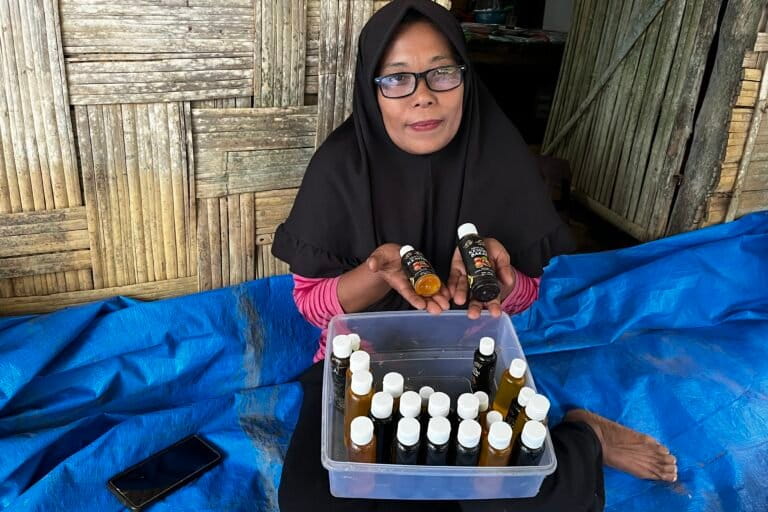
Her daily routine is now structured around these diversified activities. Mornings are dedicated to tending her coffee and candlenut trees, while afternoons are spent cutting grass for her goats. Evenings are reserved for processing crops under the illumination of solar-powered lights. This structured approach provides a stark contrast to the uncertainties of the past. Older farmers recall a time when working the land within a forest area carried inherent risks, including the potential destruction of crops and even the dismantling of homes and farming shelters, often in anticipation of approaching patrols.
The introduction of formal access through the social forestry program in 2017 marked a significant turning point. When Sri’s farmer group first coalesced, many harbored doubts about the long-term viability of the social forestry scheme. Today, her flourishing coffee trees and thriving goat population stand as testaments to its enduring impact.
Dayat, who leads the Sumber Makmur farmer group, articulates a fundamental shift in perspective: “We realized the land belongs to the state. The harvest is ours, but the land is not.” This recognition has fostered a new form of stability, albeit one accompanied by a clear set of rules. Farmers are now expected to actively protect the forest, maintain tree cover, and adhere to sustainable practices. Consequently, land conflicts have seen a notable decline. With legal access and demonstrably clearer benefits, farmers appear more inclined to safeguard the resources upon which their livelihoods depend.
Sri embodies this sense of responsibility. She consciously avoids expanding her plot into protected areas and minimizes her use of agrochemicals. The integration of shade trees has become an intrinsic part of her farming methodology. Her land no longer resembles a conventional coffee plot; instead, it presents as a layered garden, with coffee plants thriving beneath taller canopy trees and other crops filling the available spaces. Certain crops, such as bananas and areca nuts, provide frequent harvests and a steady stream of cash, while others require longer maturation periods but yield higher returns when they do.
Her farm also borders a forest that continues to be a vital corridor for wildlife, including slow lorises, sambar deer, wild boars, and occasionally even Sumatran tigers. While farmers in the past often voiced complaints about foraging wildlife damaging their crops, attitudes are gradually evolving. “We try to make sure they can eat and we can eat,” Dayat stated, emphasizing that farmers are increasingly learning to view the forest as an ecosystem to coexist with, rather than a barrier to be overcome.
A 2021 study on community social forestry, which included Batutegi among its research sites, found that farmers holding community forestry permits reported a reduction in forest fires and air pollution. This was attributed to the establishment of clear land boundaries and collective rules that actively discouraged slash-and-burn clearing practices. Members of these groups also engaged in proactive monitoring and issued warnings against the use of fire for land clearing.
By mid-morning, Sri has typically completed her tasks of clearing weeds and inspecting her crops, a routine that rarely falters. On bright, sunny days, she dedicates time to drying areca nuts behind her home before traders arrive to collect them. However, her earnings are still subject to market fluctuations that are largely beyond her control. Like many farmers in the area, Sri continues to rely on middlemen for the sale of her produce, which limits her influence over pricing. Recently, she began meticulously recording her harvests and sales in a notebook after attending bookkeeping training, a small but significant step toward treating her farm as a formal business enterprise.
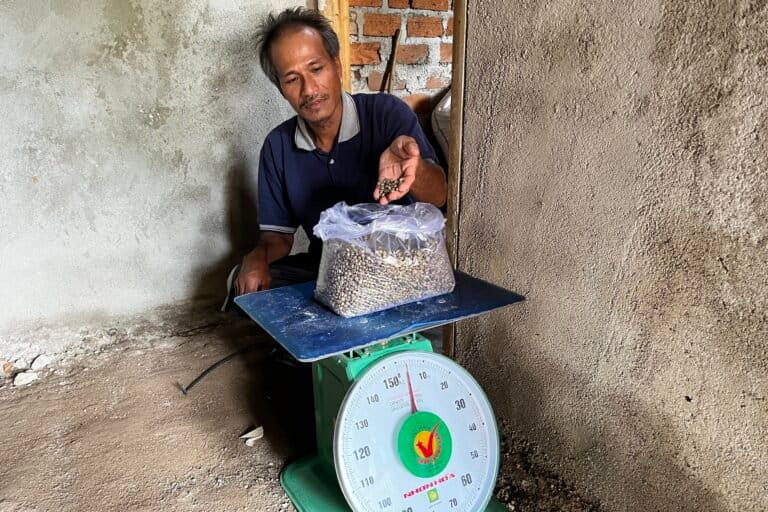
Efforts to enhance market access are underway, including the establishment of farmer business groups, according to Aji Mandala Putra of YIARI, the nonprofit organization that has supported the farmer groups in Batutegi since their formalization. The objective of these business groups is to strengthen bargaining power and reduce dependence on individual traders. However, Putra acknowledges that the results have been mixed, with some groups encountering difficulties in achieving effective functionality. In such instances, farmers often revert to dealing with middlemen. These challenges, he warns, could potentially push farmers back towards historical patterns, where short-term pressures might lead to unsustainable practices, such as clearing additional land. “Rebuilding trust may take more effort, especially if many people would have thought the initiative as unsuccessful,” Putra commented.
Nonetheless, Putra maintains that YIARI’s intervention in Batutegi has been comprehensive, encompassing training, institutional support, and the promotion of improved farming methods. The ultimate goal is to enhance coffee quality and yields without encroaching upon the protected forest’s core areas.
Empowering Women and Building Self-Sufficiency
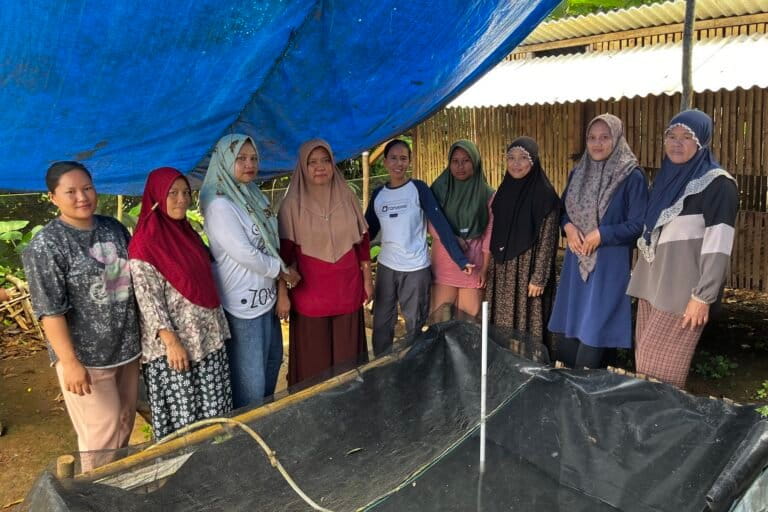
As livelihoods evolve, the dependence on the Batutegi forest remains a constant thread. Sri’s perseverance is mirrored by the efforts of women in a nearby group called Bumi Tani Sejahtera (BTS), established in 2024. Like Sri, many of its 10 members previously worked as unpaid helpers on family farms, a situation that has been transformed through collective organization.
The group’s initial project, raising local chickens, was intended to improve community nutrition but ultimately faced setbacks due to disease outbreaks and escalating feed costs. Instead of abandoning their efforts, the group reinvested its savings into catfish ponds and a small banana chip business. Both ventures are now generating modest but consistent income. For some members, joining the BTS group has meant participating in regular activities outside of farm labor for the first time. They now convene weekly, manage finances collaboratively, and engage directly with buyers.
“Before, women only helped during harvest,” said Nurul, the leader of the BTS group. “Now we have our own activities.”
The experiences of Sri and the BTS group reflect a broader socio-economic transformation. Across these farmer groups in the Batutegi landscape, farming practices are transitioning from subsistence-oriented models to diversified approaches that integrate crops, livestock, and small enterprises to stabilize income. This evolution is shaped by persistent factors such as limited land availability, volatile market conditions, and the gradual but crucial process of building trust in collective action.
The current system, while showing promise, remains inherently fragile. Therefore, sustained cooperation between farmers, government agencies, and conservation groups is deemed essential, according to Dayat. He emphasizes that as the land remains state-owned, the long-term success of social forestry critically depends on farmers demonstrating their capacity for sustainable management.
“The hope is that government and private organizations can help accelerate the process so communities do not have to repeat too many mistakes,” Rommy, the forestry lecturer, told Mongabay. She suggests that Batutegi could benefit from the lessons learned in other regions. She points out that Batutegi differs from more successful social forestry areas in Lampung, such as Pesawaran and Gunung Balak, primarily because some farmers in Batutegi reside at a considerable distance from the land they cultivate. This geographical disparity often leads to reliance on inherited or imitative farming practices, without a deep understanding of soil health, optimal fertilizer use, or sustainable land management principles.
In contrast, successful agroforestry systems elsewhere in Lampung have evolved through prolonged periods of experimentation, more effective facilitation, stronger community ties to the forest, and more adaptable support from local forest management authorities. “The challenge now is finding the right tree combinations that can coexist with coffee while also supporting both economic and conservation goals,” Rommy articulated.
Karmele Llano Sanchez, the founder and chief executive officer of YIARI, expresses hope that the level of external intervention may not need to remain as intensive in the future. The objective is for farmers in Batutegi to achieve true independence and prosperity, with these sustainable practices becoming deeply ingrained habits. Sanchez observes that these groups signify a quiet revolution in the rural economy, where farmers are increasingly becoming entrepreneurs, forests are recognized as shared responsibilities, and women are actively assuming decision-making roles in their own right. “So, this is really an investment in the future,” Sanchez concluded. “The goal is to move forward to a point where, one day, this system can sustain itself without our presence.”
