

In the landscape of contemporary mixology, the Purl is frequently characterized by its utilitarian simplicity: a measure of gin dropped into a pint of ale. Modern cocktail historians and enthusiasts, such as those contributing to Difford’s Guide, typically identify this combination as a relic of 18th and 19th-century British tavern culture. In its most common modern iteration, the drink utilizes an Old Tom style gin—a slightly sweetened precursor to London Dry—and a traditional British Bitter served at cellar temperatures. This pairing, while robust, represents only the final, stripped-back stage of a beverage that has undergone a radical transformation over the last four centuries. Historical records indicate that the Purl was once a significantly more complex, and often medicinal, concoction that bore little resemblance to the two-ingredient "boilermaker" style drink recognized today.
The trajectory of the Purl serves as a microcosm for the broader evolution of British social drinking, tracing a path from a desperate 17th-century plague preventative to a Victorian culinary indulgence, and finally to a simplified staple of the 20th-century bar. By examining the primary source material—ranging from herbal manuals of the 1600s to the cocktail guides of the mid-1900s—a clearer picture emerges of a drink that was as much a product of economic necessity as it was of changing tastes.
The Medicinal Genesis: Wormwood and the Great Plague
The earliest iterations of the Purl were firmly rooted in the apothecary rather than the alehouse. During the 17th century, the term "Purl" referred primarily to a mixture of ale or wine infused with wormwood (Artemisia absinthium). Wormwood, a bitter herb known for its anti-parasitic and digestive properties, was a staple of early modern medicine. The use of wormwood-infused beverages reached a peak during the catastrophic outbreaks of the bubonic plague in London.
A critical primary source from this era is the 1665 publication, Directions for the Prevention and Cure of the Plague Fitted for the Poorer Sort. This manual, intended to provide affordable health advice to the lower classes who could not afford private physicians, explicitly recommended the consumption of "a draught or two of Purle… especially in the morning." This "morning constitutional" was believed to fortify the body against the miasma or "bad air" thought to carry the plague. Because ale was the standard beverage for all classes—safer to drink than the often-contaminated water of London—the addition of wormwood was an accessible way for the "poorer sort" to integrate preventative medicine into their daily routine.
The association of Purl with health continued into the late 17th century. In 1684, the publication Aphorisms upon the New Way of Improving Cyder noted that the cider industry was also adopting the practice, suggesting that "purl-wide cider" was just as efficacious as the ale-based version. By 1690, An English Herbal further solidified the drink’s status, detailing the specific benefits of wormwood when consumed as a Purl. At this stage in history, the drink contained no distilled spirits; it was a bitter, herbalized fermented beverage intended for fortifying the constitution.

The 18th Century: Purl-Shops and the Rise of Spirits
As the threat of the plague receded and the "Gin Craze" of the early 18th century began to take hold of London, the Purl transitioned from a medicinal tonic to a recreational intoxicant. It was during this period that spirits began to be added to the mixture. The bitter profile of the wormwood remained, but the potency of the drink increased significantly.
By the 1730s, "Purl-shops" had become a recognizable fixture of the London landscape. However, the drink began to attract social stigma. In a September 1733 edition of The Grub Street Journal, a character attack on a local individual highlighted the consumption of Purl as a sign of moral and physical decay. The journal linked the drinking of Purl—often still consumed in the morning—with heavy smoking and the excessive consumption of gin. This period marked the beginning of the Purl’s reputation as a "worker’s breakfast," a drink consumed early in the day by laborers, dockworkers, and those struggling with alcohol dependency.

Despite the growing presence of gin in London, the spirit added to a Purl was not yet standardized. Depending on the patron’s preference and the establishment’s inventory, a Purl might be "laced" with gin, brandy, or even a rudimentary form of whisky. The defining characteristic remained the combination of a fermented base (ale) and the bittering agent (wormwood).
The Victorian Era: Culinary Complexity and the "Flip" Style
The 19th century saw the Purl reach its peak of culinary complexity. It moved away from the simple bitter ale of the previous century and entered the realm of the "flip"—a category of drinks that were served hot and often thickened with eggs and sugar.

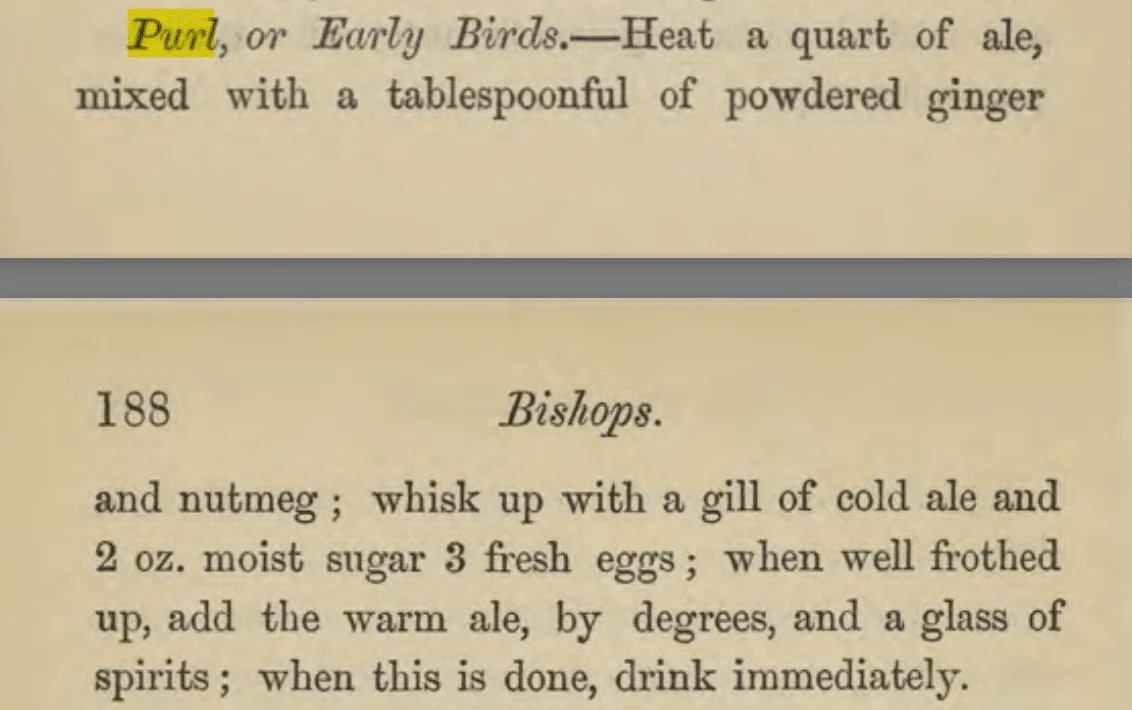
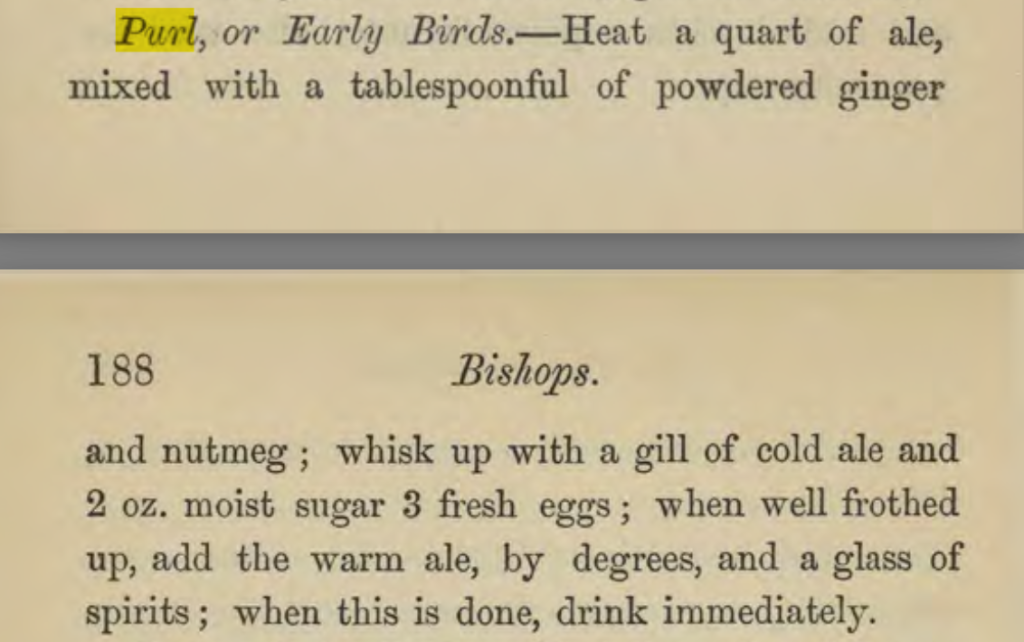
William Terrington’s 1869 volume, Cooling Cups and Dainty Drinks, which is widely regarded as one of the first comprehensive British cocktail books, provides a window into this elaborate era. Terrington’s recipes for Purl often featured warmed beer, multiple eggs, sugar, and spices such as nutmeg or ginger. Notably, gin was still not the mandatory spirit. Terrington’s manual suggests that while a glass of spirits was essential to the recipe, it could just as easily be brandy or any other spirit common to the 19th-century British bar.
During this time, the Purl was a sophisticated, labor-intensive beverage. The process of "mulling" or warming the ale over a fire, whisking in eggs to create a frothy texture, and balancing the spices required a level of skill that elevated the drink from its humble origins. This version of the Purl was a winter staple, designed to provide warmth and caloric density. Terrington also included a recipe for an "Ale Cup," which specifically called for gin and ale. This suggests that while the "Purl" was a broad category of spiced, warmed ale, a specific sub-genre of gin-and-ale drinks was beginning to crystallize.

The 20th Century: Simplification and the Standardization of Gin
The transition into the 20th century marked the "modernization" of the Purl, which effectively meant the removal of its most complex elements. Several factors contributed to this shift:
- The Disappearance of Wormwood: As modern medicine advanced, the perceived need for wormwood as a daily tonic vanished. Furthermore, the association of wormwood with absinthe—which faced bans and heavy regulation in the early 1900s—likely contributed to the herb being dropped from common alehouse recipes.
- The Removal of Eggs: The "flip" style of drink, involving raw eggs and heat, became less popular as tastes shifted toward cleaner, lighter beverages. The labor required to prepare a traditional Victorian Purl was also incompatible with the faster pace of 20th-century service.
- The Standardization of Gin: By the mid-1900s, gin had become the undisputed spirit of choice in the United Kingdom. Its botanical profile, which often included juniper and citrus, provided a more consistent and complimentary flavor to ale than the varying qualities of 19th-century brandy or whisky.
By 1925, publications like Summer Drinks and Winter Cordials began to show the Purl in a transitional state. The eggs were gone, but the practice of warming the ale remained. By 1935, The Art of Mixing Drinks documented a version of the Purl that closely resembles the modern definition, though the addition of bitters was still considered a key component to mimic the original wormwood profile.

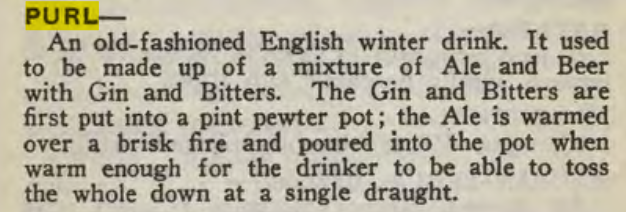
The final stage of this evolution is perhaps best captured in Cocktail and Wine Digest’s The Barman’s Bible (1966). By this point, the Purl had been codified as a simple mixture of gin and ale. The "morning constitutional" of the 1600s and the complex hot egg-flip of the 1800s had been replaced by a quick, potent combination that could be served in any standard pub.
Chronology of the Purl’s Transformation
- 1665: Documented as a medicinal "Purle" (ale/wine + wormwood) used as a plague preventative for the "poorer sort."
- 1684-1690: Emergence of cider-based Purls and inclusion in herbal manuals as a digestive aid.
- 1733: Rise of "Purl-shops" in London; the drink becomes associated with recreational spirit consumption and morning drinking.
- 1869: William Terrington documents the Victorian Purl as a complex, warmed "flip" involving eggs, sugar, and various spirits.
- 1925: The Purl simplifies; eggs are removed, but warming the ale remains common.
- 1935-1966: The drink is standardized in bar manuals as a combination of gin and ale, often with bitters.
- 21st Century: The Purl survives as a niche "historic" cocktail, typically served as a cold shot of gin in a pint of British Bitter.
Broader Impact and Implications
The evolution of the Purl offers a fascinating look at how societal changes dictate the contents of a glass. The shift from wormwood to gin reflects the transition from a society focused on survival and herbal medicine to one focused on industrialization and standardized spirits.

The "modern" Purl, while perhaps less interesting to the palate than the spiced, frothy versions of the Victorian era, remains a testament to the enduring relationship between British brewing and distilling. For the modern drinker, the Purl represents a link to a grittier past. When a bartender today serves a shot of Old Tom in a cellar-temperature bitter, they are—perhaps unknowingly—serving a descendant of a drink that once stood as the primary line of defense against the Black Death.
The simplification of the recipe also highlights a broader trend in the history of cocktails: the "survival of the easiest." Drinks that require fresh eggs, heat, and rare botanicals often fall by the wayside in favor of combinations that can be assembled with the tools already on a standard backbar. However, with the current resurgence of interest in historical mixology, some craft bars are beginning to experiment with "authentic" Purls, reintroducing wormwood bitters and warmed ale to provide a more historically accurate experience. Whether viewed as a medicine, a morning vice, or a classic cocktail, the Purl remains one of the most storied and misunderstood beverages in the British canon.
