

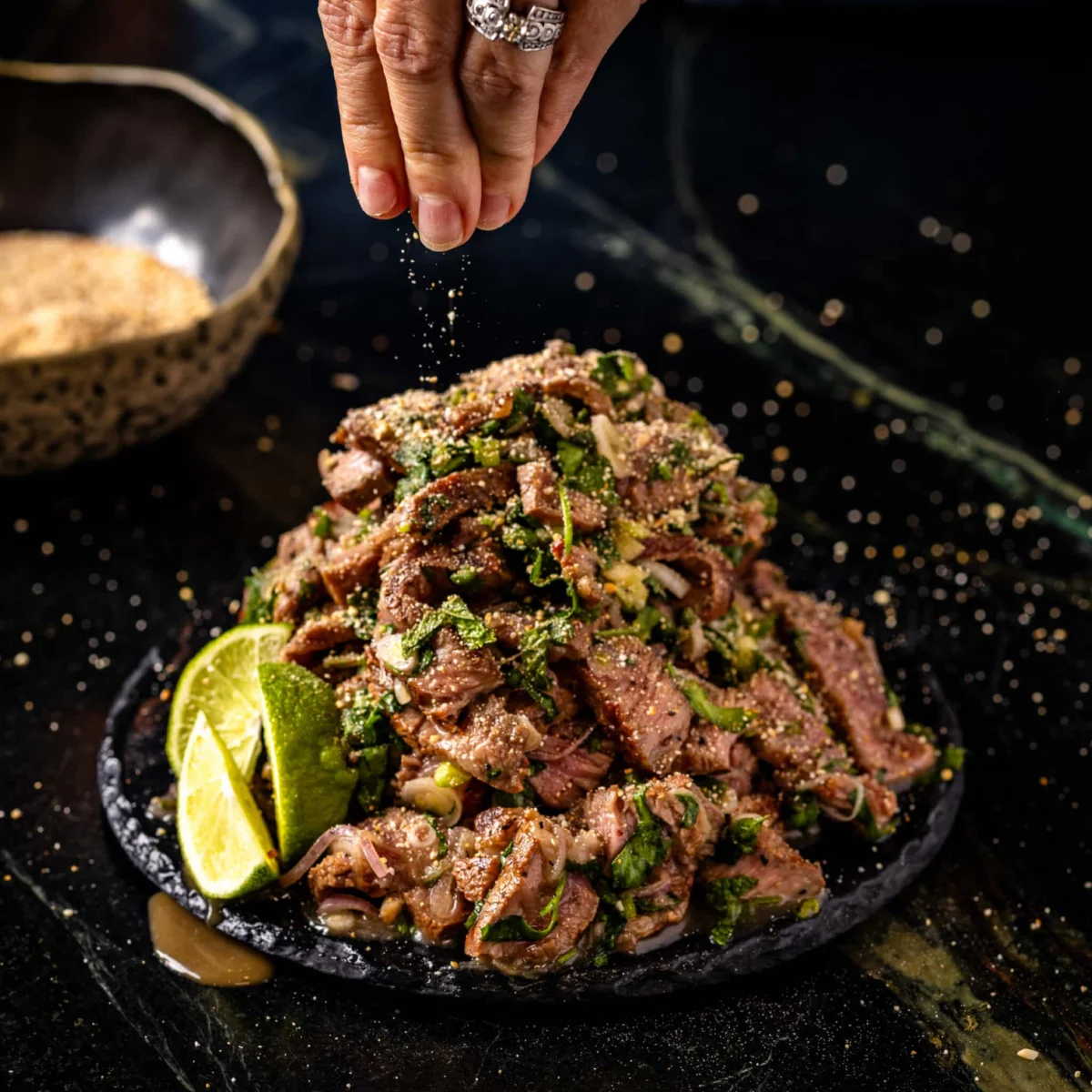
The Thai Beef Waterfall Salad, known traditionally as Nam Tok Neua, represents a sophisticated intersection of Southeast Asian culinary heritage and contemporary Western grilling techniques. This dish, characterized by its smoky profile, rare-seared beef, and vibrant herbaceous dressing, gained significant attention following its feature on the Food Network program Pitmasters. Developed by Susie Bulloch, founder of the barbecue resource Hey Grill Hey, the recipe was conceived during a high-stakes "surf and turf" challenge against prominent pitmaster Christie Vanover of Girls Can Grill. While the "surf" component was represented by a coconut-lime halibut, the "turf" was anchored by this adaptation of a Thai classic, demonstrating the increasing versatility of the modern backyard grill.
Historical Context and Cultural Origins of Nam Tok Neua
The term "Nam Tok" translates literally from Thai as "waterfall" or "falling water." In the context of culinary arts, the name refers to the rhythmic dripping of juices from the meat as it roasts over an open flame, a visual and auditory experience central to the dish’s preparation. Originating from the Isan region of Northeast Thailand and Laos, Nam Tok Neua is a staple of Lao and Isan cuisine, traditionally served alongside sticky rice and fresh vegetables.

The Isan flavor profile is famously defined by a balance of four key elements: salt, sourness, spice, and a distinctive nuttiness provided by toasted rice. Unlike the creamier, coconut-based curries of Central Thailand, Isan dishes tend to be lighter, more pungent, and heavily reliant on fresh aromatics. Bulloch’s adaptation for the American barbecue audience retains these core principles while utilizing equipment and cuts of meat more common in Western domestic environments, thereby bridging the gap between traditional street food and competitive outdoor cooking.
The Pitmasters Competition: A Catalyst for Fusion Barbecue
The appearance of Thai Beef Waterfall Salad on Food Network’s Pitmasters serves as a notable marker in the evolution of barbecue television. Historically, American barbecue competitions focused almost exclusively on the "Big Four": brisket, ribs, pork butt, and chicken. However, the shift toward "backyard hero" challenges has encouraged pitmasters to explore international flavor profiles.
During Season 1, Episode 3 of the series, the challenge necessitated a departure from low-and-slow traditions in favor of high-heat, rapid-execution techniques. Bulloch’s selection of hanger steak was a strategic decision based on the cut’s ability to absorb marinades quickly and its optimal performance under intense direct heat. The confrontation between Bulloch and Vanover highlighted a growing trend in the culinary world: the "globalization of the grill," where traditional American techniques are applied to international recipes to create complex, fusion-style menus.

Technical Analysis of Ingredients: The Butcher’s Cut
The choice of hanger steak is central to the success of the Thai Beef Waterfall Salad. Known as the "butcher’s steak" because butchers would historically keep it for themselves rather than sell it, the hanger steak is a primal cut taken from the upper belly. It "hangs" from the diaphragm of the steer, which accounts for its name.
- Grain and Texture: Hanger steak possesses a coarse, loose grain structure. This makes it exceptionally efficient at holding marinades, as the liquid can penetrate deep into the muscle fibers.
- Flavor Profile: It is often compared to ribeye in terms of beefy intensity but requires careful preparation to avoid toughness.
- Alternative Cuts: For domestic cooks unable to source hanger steak, culinary experts suggest tri-tip, skirt steak, or flank steak as viable substitutes. Each of these cuts offers a similar surface-area-to-volume ratio, which is essential for achieving the charred exterior and rare interior required for Nam Tok.
The marinade utilized in this specific iteration is intentionally minimalist, consisting only of soy sauce and coarse black pepper. The soy sauce provides the necessary salinity and umami depth, while the black pepper adds a foundational heat that complements the more volatile spice of the Thai bird’s eye chilies typically found in the dressing.
The Role of Khao Khua: Toasted Rice Powder
Perhaps the most critical component of a Thai Beef Waterfall Salad is the khao khua, or toasted rice powder. In professional Thai cooking, this ingredient acts as both a flavoring agent and a textural contrast. The process involves dry-toasting raw glutinous rice (sticky rice) or jasmine rice in a skillet until it reaches a deep golden brown.

Once toasted, the rice is ground into a coarse powder. This adds a distinct nutty aroma—reminiscent of popcorn or toasted nuts—and provides a crunch that survives even after being tossed in the liquid dressing. Furthermore, the starch in the rice powder acts as a light thickening agent, helping the lime and fish sauce dressing adhere to the sliced beef.
Culinary Procedure and Temperature Management
The preparation of Thai Beef Waterfall Salad follows a precise five-step chronology: marination, toasting, grilling, dressing, and tossing. Each stage is designed to layer flavors without compromising the integrity of the fresh ingredients.
The Grilling Phase:
To achieve the "waterfall" effect, the grill must be maintained at a high temperature, typically between 400°F and 450°F. The "constant-flip" method is often employed here to ensure an even crust while keeping the center rare. According to technical data from the preparation, a hanger steak usually reaches the desired rare state within 6 to 12 minutes.

Temperature Guidelines:
The internal temperature is the primary indicator of success. While the USDA recommends a minimum internal temperature of 145°F for beef steaks followed by a three-minute rest for safety, traditional Nam Tok is served rare to medium-rare.
- Rare: Pull at 115°F (Final temp ~120-125°F)
- Medium Rare: Pull at 125°F (Final temp ~130-135°F)
- Medium: Pull at 135°F (Final temp ~140-145°F)
The resting period is non-negotiable. During this time, the muscle fibers relax, allowing the juices to redistribute. If the steak is sliced too early, the "waterfall" of juices occurs on the cutting board rather than being retained within the salad.
The Dressing: A Study in Aromatics
The dressing for the Thai Beef Waterfall Salad is a vibrant mixture of fresh herbs and acidic brighteners. The use of cilantro, mint, shallots, and green onions provides a sharp contrast to the heavy, smoky flavor of the grilled beef. In traditional versions, fish sauce (nam pla) is used to provide salt and depth, though some Western adaptations utilize additional soy sauce or lime juice to balance the profile for a broader audience. The result is a "flavor bomb" that emphasizes freshness over the heavy fats often associated with American barbecue.

Nutritional Analysis and Dietary Implications
A quantitative assessment of the recipe reveals that the Thai Beef Waterfall Salad is a nutrient-dense, relatively low-calorie option compared to traditional barbecue fare. Based on a standard serving size for four individuals, the nutritional breakdown is as follows:
- Calories: 143 kcal
- Protein: 6g
- Carbohydrates: 30g
- Fat: 0.4g
- Sodium: 1983mg (primarily from soy sauce)
- Fiber: 3g
- Vitamin A: 585 IU
- Vitamin C: 9 mg
While the protein content varies depending on the specific weight of the steak used, the salad is notable for its low fat content and high vitamin profile, stemming from the generous use of fresh herbs. The high sodium content suggests that those on salt-restricted diets should consider low-sodium soy sauce or reducing the marinade time.
Broader Impact on the Barbecue Community
The popularization of recipes like the Thai Beef Waterfall Salad by figures such as Susie Bulloch has had a measurable impact on the "Backyard BBQ Hero" culture. By moving beyond traditional brisket and ribs, these recipes democratize international cuisine, making exotic flavors accessible to the average griller.

Furthermore, the emphasis on specialty cuts like hanger steak encourages consumers to engage more deeply with local butchers, promoting a "nose-to-tail" appreciation for meat. This shift in consumer behavior supports small-scale agriculture and specialty meat markets.
Conclusion: The Future of Global Grilling
The Thai Beef Waterfall Salad is more than a simple recipe; it is a testament to the fluid nature of culinary traditions. Its journey from the Isan region of Thailand to the television screens of the Food Network illustrates the power of cultural exchange through food. As pitmasters continue to experiment with global ingredients and techniques, the definition of American barbecue continues to expand, proving that the grill is a universal tool for culinary innovation. For the domestic cook, this dish offers a professional-grade experience that combines the technical rigor of competition barbecue with the bright, accessible flavors of Southeast Asian street food.
