

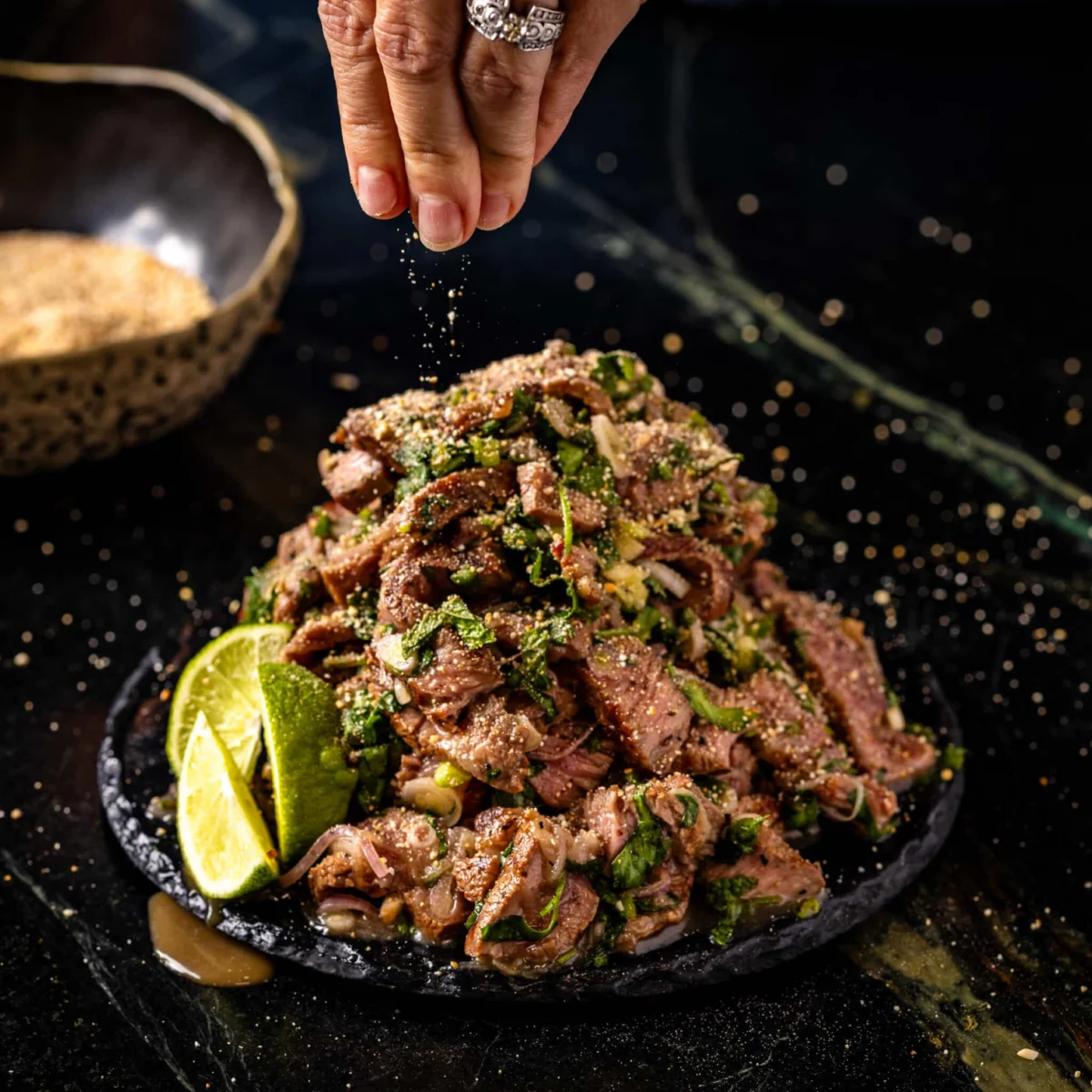
The culinary landscape of American barbecue has undergone a significant transformation over the last decade, shifting from traditional regional staples toward a more globalized, fusion-oriented approach. A primary example of this evolution is the Thai Beef Waterfall Salad, a dish that gained prominence following its appearance on the Food Network’s competitive series, Pitmasters. Known in its native Thailand as Nam Tok Neua, the dish represents a sophisticated balance of smoky protein, vibrant acidity, and aromatic herbs. The version popularized by Susie Bulloch, founder of the barbecue resource Hey Grill Hey, illustrates a strategic intersection between professional competition-grade techniques and accessible backyard grilling methods.
The dish is characterized by its use of rare-grilled hanger steak, which is subsequently tossed in a dressing composed of lime juice, fish sauce or soy sauce, and fresh herbs, then finished with a signature toasted rice powder. This specific iteration of the recipe emerged from a high-stakes "Surf and Turf" challenge on Pitmasters, where Bulloch competed against renowned pitmaster Christie Vanover of Girls Can Grill. While Vanover presented a coconut-lime halibut to represent the "surf," Bulloch’s Thai Beef Waterfall Salad served as the "turf" component, showcasing how high-heat grilling can be adapted to complement the complex flavor profiles of Southeast Asian cuisine.
Historical and Cultural Context of Nam Tok Neua
The term "Nam Tok" translates literally from Thai to English as "waterfall" or "falling water." In a culinary context, this refers to the juices that drip from the beef as it is grilled over an open flame. Traditionally, the dish originates from the Isan region of Northeast Thailand and Laos, where grilled meats are a dietary staple. The "waterfall" effect is considered a hallmark of quality, indicating that the meat remains succulent and is not overcooked.

In traditional Thai preparation, the beef is often served with sticky rice (khao niao) to balance the intensity of the dressing. The introduction of this dish to a Western barbecue audience via televised competition highlights the growing appetite for "bold" flavors that move beyond the sweet and savory profiles of traditional American tomato-based barbecue sauces. By utilizing the grill to achieve a char that mimics the traditional charcoal methods used in Thailand, pitmasters are able to bridge the gap between Eastern flavor palettes and Western cooking equipment.
The Competition Chronology: From Pitmasters to the Public
The development of this specific recipe can be traced through a clear timeline of competitive events and subsequent public release. The "Surf and Turf" challenge on Pitmasters Episode 3 required contestants to innovate within a limited timeframe, forcing a reliance on ingredients that could deliver maximum impact quickly.
- The Challenge Initiation: Contestants were tasked with creating a cohesive meal featuring both seafood and beef. The constraint of the competition necessitated a beef preparation that was fast-cooking yet flavorful enough to stand against a rich coconut-based fish dish.
- Ingredient Selection: Bulloch selected hanger steak, a choice influenced by its availability during the shoot and its reputation among culinary professionals as a "butcher’s cut" for its intense flavor and ability to absorb marinades.
- The Presentation: The salad was presented as a vibrant, fresh counterpoint to the heavier, smoked meats typically found in barbecue competitions. Its success on the program led to a surge in interest from home cooks looking to replicate professional results.
- Public Integration: Following the broadcast, the recipe was refined for the home cook, emphasizing approachable ingredients like soy sauce and black pepper for the marinade while maintaining the essential technical elements like the toasted rice powder.
Technical Analysis of Ingredients and Method
The efficacy of the Thai Beef Waterfall Salad relies on the precise execution of three distinct components: the protein selection, the textural additive, and the aromatic dressing.
The Selection of Hanger Steak
The choice of hanger steak (the diaphragm of the steer) is central to the dish’s success. Historically, this cut was often reserved by butchers for themselves because it was difficult to market but possessed superior flavor. From a scientific perspective, the hanger steak has a loose, coarse grain that allows marinades—such as the soy and black pepper mixture used here—to penetrate deeply into the muscle fibers.

Market data suggests that while hanger steak has seen a 15-20% increase in price at specialty butcher shops over the last five years due to rising popularity, it remains a cost-effective alternative to ribeye or filet mignon for high-heat applications. For consumers unable to locate hanger steak, culinary experts recommend flank or skirt steak as viable substitutes, though these require careful monitoring to avoid the toughness associated with overcooking.
The Role of Toasted Rice Powder (Khao Khua)
Toasted rice powder is the defining textural element of a true Nam Tok. The process involves dry-toasting raw glutinous or jasmine rice in a skillet until it reaches a deep golden brown, then grinding it into a coarse powder. This ingredient provides a nutty aroma and a necessary "crunch" that offsets the softness of the rare beef and the liquid nature of the dressing. In the context of the Pitmasters competition, this element demonstrated a commitment to authentic Thai techniques amidst an American barbecue setting.
Dressing and Herb Integration
The dressing serves as a chemical tenderizer and flavor enhancer. The acidity from the lime juice cuts through the fat of the beef, while the shallots, cilantro, mint, and green onions provide a fresh, herbaceous finish. Unlike traditional salads that rely on leafy greens, the "salad" in this context refers to the mixture of herbs and sliced meat, a common characteristic of the "larb" and "nam tok" families of Southeast Asian dishes.
Grilling Parameters and Safety Standards
Achieving the correct internal temperature is critical for both the flavor profile and food safety. The recipe calls for a high-heat environment, typically between 400°F and 450°F.

Steak Temperature Reference Chart:
- Rare: Pull at 115°F (Final Temp: 120-125°F)
- Medium Rare: Pull at 125°F (Final Temp: 130-135°F)
- Medium: Pull at 135°F (Final Temp: 140-145°F)
- Medium Well: Pull at 145°F (Final Temp: 150-155°F)
- Well Done: Pull at 155°F (Final Temp: 160°F+)
While the United States Department of Agriculture (USDA) recommends a minimum internal temperature of 145°F for beef steaks followed by a three-minute rest, the Thai Beef Waterfall Salad is traditionally served rare to medium-rare. This preference is based on the textural requirements of the dish; rare beef remains tender when sliced thinly against the grain, which is essential when the meat is served as part of a cold or room-temperature salad.
Nutritional Profile and Dietary Impact
For health-conscious consumers, the Thai Beef Waterfall Salad offers a nutrient-dense profile that deviates from the high-sugar, high-calorie nature of traditional BBQ. A standard serving (approximately 4 servings per recipe) contains:
- Calories: 144 kcal
- Protein: 6g (Note: This figure varies significantly based on the portion size of the steak used; 1.5 lbs of steak would provide substantially higher protein per serving)
- Carbohydrates: 30g (Primarily from the rice powder)
- Fat: 0.4g (Saturated Fat: 0.1g)
- Sodium: 1984mg (Largely attributed to the soy sauce marinade)
The high sodium content is a notable factor, typical of many Southeast Asian dressings that utilize fermented sauces. However, the absence of heavy oils and added sugars makes it a lighter alternative for summer dining.

Broader Implications for the BBQ Industry
The popularity of the Thai Beef Waterfall Salad reflects a broader shift in consumer behavior. Data from the Hearth, Patio & Barbecue Association (HPBA) indicates that more than 70% of U.S. households own a grill or smoker, and there is an increasing trend toward "adventure grilling." Recipes that incorporate international flavors allow home cooks to maximize the utility of their outdoor kitchens.
Furthermore, the success of this dish underscores the influence of culinary media. By featuring "approachable" versions of complex international dishes, programs like Pitmasters and platforms like Hey Grill Hey have democratized gourmet cooking. The transition of a competition-winning dish into a backyard staple suggests that the barrier between professional barbecue and home cooking continues to thin.
Conclusion
The Thai Beef Waterfall Salad stands as a testament to the versatility of modern barbecue. By combining the high-heat techniques of the American grill with the ancient flavor profiles of the Isan region, the dish offers a multi-dimensional sensory experience. Its journey from a televised "Surf and Turf" challenge to a widely shared recipe highlights the importance of innovation in the culinary arts. For the "Backyard BBQ Hero," the dish represents more than just a meal; it is an entry point into the global world of live-fire cooking, where smoke, salt, and acid converge to create a "flavor bomb" that is as sophisticated as it is simple to execute.
