

The designation of London Dry Gin represents one of the most enduring paradoxes in the global spirits industry, as the term serves neither as a geographical indicator nor a flavor profile, but rather as a rigorous technical standard for distillation. Contrary to popular consumer perception, London Dry Gin does not require production within the city limits of London, nor even within the United Kingdom. It is a process-driven category that can be legally manufactured anywhere in the world, provided the distiller adheres to strict regulatory frameworks governing the purity of the base spirit, the timing of botanical infusion, and the restriction of post-distillation additives. This distinction marks a departure from other protected spirit categories, such as Scotch Whisky or Cognac, which rely heavily on geographical "terroir" and localized production mandates. Understanding the transition of London Dry Gin from a localized urban product to a global quality benchmark requires an analysis of 19th-century industrial innovation, the evolution of food safety standards, and the modern codification of international trade laws.
Decoding the Technicality: Process Over Place
To understand the modern identity of London Dry Gin, one must first isolate the legal requirements that distinguish it from "Distilled Gin" or "Compound Gin." Under European Union regulations (specifically Regulation (EC) No 110/2008, which remains the blueprint for global standards), London Gin must be produced using a high-quality neutral spirit of agricultural origin, distilled to an initial alcoholic strength of at least 96% ABV. The flavoring must be introduced exclusively through the re-distillation of this neutral spirit in traditional stills in the presence of all natural plant materials used.
Crucially, the "Dry" designation refers to the sugar content. In a London Dry Gin, no more than 0.1 grams of sweetening per liter may be added to the final product. Furthermore, no colorants or additional flavorings can be introduced after the second distillation; the only permitted additive following the still is pure water to reach the desired bottling strength. This creates a "transparent" spirit where the distiller cannot hide imperfections behind sugar or artificial essences, effectively making the London Dry process a "gold standard" for purity in the gin world.
A Historical Chronology of the London Dry Designation
The history of London Dry Gin is inextricably linked to the Industrial Revolution and the rise of chemical engineering in the 19th century. The timeline of its development reflects a shift from a period of unregulated, often dangerous spirits to a sophisticated, globalized market.
Pre-1830: The Era of Masking Impurities
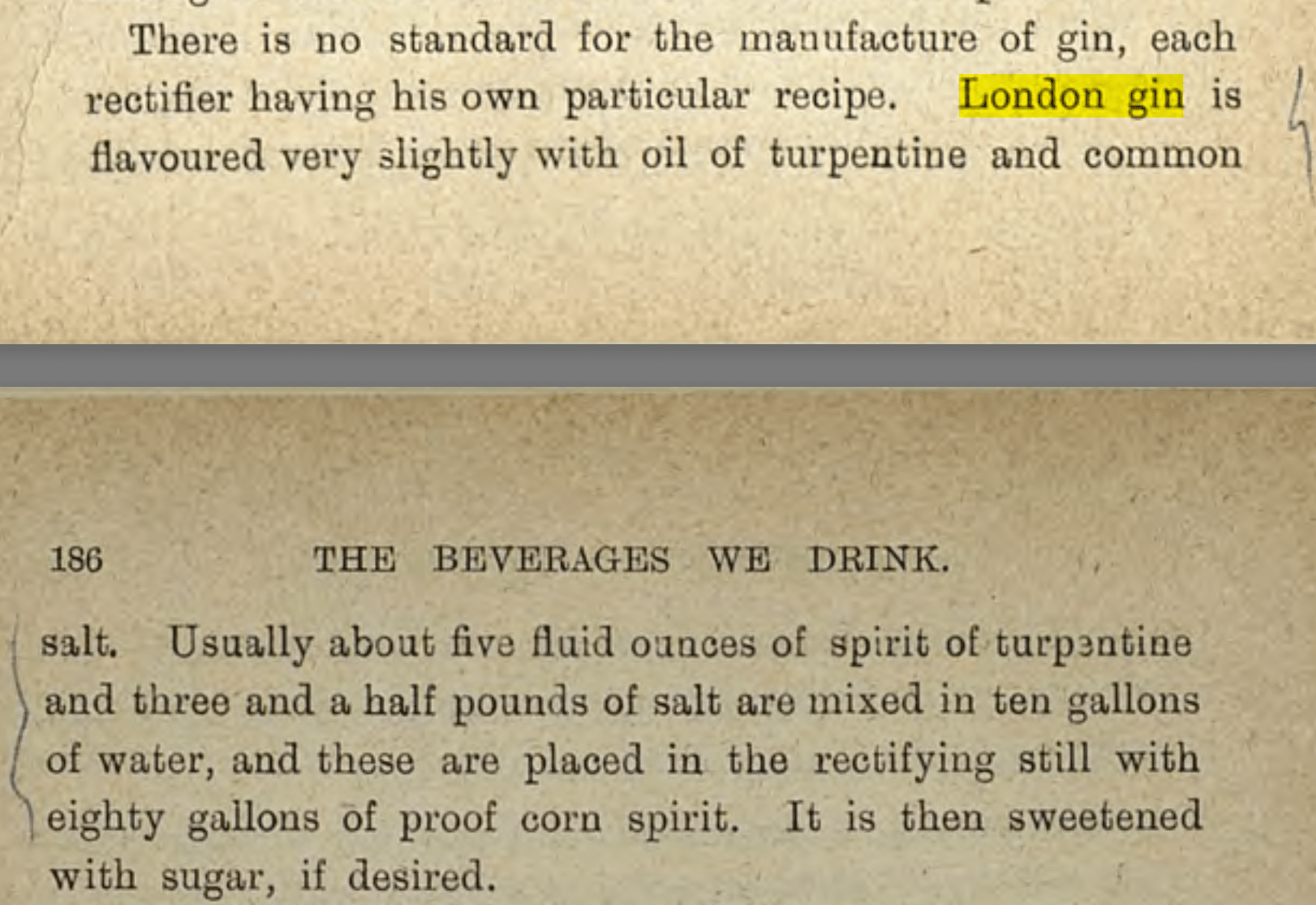
Before the mid-19th century, the majority of gin consumed in England was known as "Old Tom" or simply "Common Gin." Because the pot stills of the era were inefficient at removing fusel oils and impurities, the resulting base spirit was often harsh and unpalatable. To make these spirits drinkable, rectifiers added heavy amounts of sugar and intense flavorings. In more nefarious cases, as noted in historical manuals like Every Man His Own Brewer and Distiller (1801), producers would add toxic substances such as turpentine or sulfuric acid to mimic the "sting" of high-quality juniper or to stretch thin batches of spirit. Turpentine, a resinous solvent, was frequently used to provide a pine-like aroma when real juniper berries were too expensive or unavailable, despite its high toxicity to the human liver and nervous system.
1830: The Aeneas Coffey Revolution
The pivotal moment in the history of the category occurred in 1830 when Aeneas Coffey, an Irish inventor and former excise officer, patented the "Coffey Still" (or column still). Unlike the traditional pot still, the Coffey still allowed for continuous distillation, producing a spirit with a much higher alcohol concentration and significantly fewer impurities. This "neutral spirit" was clean and light, eliminating the need for the heavy sweetening that characterized earlier gins. For the first time, distillers could produce a "dry" gin—one that showcased the delicate aromatics of botanicals without the crutch of added sugar.
Late 19th Century: The Rise of the "London" Brand
As the 19th century progressed, London became the epicenter of high-quality gin production. Large-scale distilleries in the city utilized the new column still technology to create a premium product that was exported across the British Empire. By the 1890s, the term "London Dry" began appearing in international advertisements as a mark of quality. Historical records show the term being used in Australian newspapers as early as 1897 and in United States publications by 1903. At this stage, the name was a marketing tool used by London-based firms to distinguish their clean, modern spirits from the sweetened, often inferior gins produced elsewhere.

Supporting Data: The Globalization of Production
While the name remains rooted in the British capital, the modern production landscape demonstrates the complete decoupling of the "London Dry" label from its namesake city. Data from the Wine and Spirit Trade Association (WSTA) and global market analysts indicate that the "London Dry" style is the most produced gin category worldwide, with major hubs located thousands of miles from the Thames.
A prominent example of this geographical shift is Tanqueray Gin. Although historically associated with London and still bearing the "London Dry Gin" label, the entirety of its production was moved to the Cameronbridge Distillery in Scotland in the late 20th century. Similarly, No. 3 Gin, which was developed by the historic London merchant Berry Bros. & Rudd, is actually distilled in the Netherlands—the traditional birthplace of gin’s ancestor, Genever.
The following table illustrates the global reach of the London Dry designation:
| Brand | Country of Production | Classification |
|---|---|---|
| Astraea Meadow Gin | United States | London Dry |
| No. 3 Gin | Netherlands | London Dry |
| Belgravia Gin | South Africa | London Dry |
| Australian Distilling Co. | Australia | London Dry |
| Long Table Gin | Canada | London Dry |
| Tanqueray | Scotland | London Dry |
This data confirms that the "London Dry" moniker functions as a technical certification of the distillation method (one-shot or multi-shot distillation with no post-still additives) rather than a Protected Geographical Indication (PGI).

Official Responses and Regulatory Frameworks
The preservation of the "London Dry" name as a process-based category rather than a location-based one has been a point of significant discussion within international trade bodies. The Gin Guild, an industry body dedicated to promoting the category, emphasizes that the "London Dry" designation is a "quality hallmark." According to guild statements, the rigor of the London Dry process ensures a level of consistency and craftsmanship that protects the consumer, regardless of where the distillery is located.
In 2008, the European Union formally codified these standards. The regulation was designed to prevent "passing off"—the practice of labeling inferior, cold-compounded spirits (made by simply mixing essence with alcohol) as premium gin. By defining "London Gin" through its production parameters, the EU provided a legal framework that allows distillers globally to use the name, provided they do not add prohibited substances after the final distillation. This regulatory approach has been adopted by many other nations, ensuring that "London Dry" remains a synonymous term for "high-quality distilled spirit" in international trade agreements.
Broader Impact and Industry Implications
The decision to keep London Dry Gin as a process-based category has had a profound impact on the "Gin-aissance"—the global explosion of craft distilling seen over the last two decades. Because the name is not geographically restricted, craft distillers in regions like the Pacific Northwest, South Africa, and Southeast Asia have been able to adopt the prestigious "London Dry" label while incorporating local, indigenous botanicals.
This has led to a fascinating evolution of the spirit. While the traditional London Dry profile is heavy on juniper, coriander, and citrus, modern global interpretations might include:

- Australian London Drys: Utilizing lemon myrtle and Tasmanian pepperberry.
- North American London Drys: Incorporating Douglas fir needles or local wildflower honey (provided the sugar content remains below the 0.1g/L limit).
- African London Drys: Using baobab fruit and rooibos.
The broader implication of this "location-neutral" naming convention is the democratization of spirit quality. It allows small-scale producers to compete on an even playing field with legacy brands by proving their technical proficiency through the London Dry process. However, it also places a burden of education on the industry; as more consumers seek "local" products, the industry must continue to explain why a gin made in Seattle or Sydney can rightfully—and legally—call itself a London Dry.
In conclusion, the "London" in London Dry Gin is a tribute to a historical era of innovation rather than a contemporary requirement for residence. It represents the triumph of the column still and the 19th-century movement toward spirit purity. As the category continues to grow, the designation stands as a testament to the fact that in the world of spirits, the "how" is often more significant than the "where." The future of the category likely lies in this balance: maintaining the strict, traditional production standards that defined the 1830s revolution while embracing the diverse botanical landscapes of the 21st-century global distillery.