

The term London Dry Gin represents one of the most significant misnomers in the global spirits industry, as it denotes a rigorous technical process rather than a requirement for geographic origin. While the name evokes the misty streets of Victorian England, modern international trade laws and distillation standards confirm that London Dry Gin can be produced in any corner of the globe, from the highlands of Scotland to the coastal distilleries of South Australia. This designation serves as a hallmark of quality and a specific methodology of production that emerged from the industrial innovations of the 19th century, effectively transforming gin from a potentially lethal street tonic into a sophisticated, world-class spirit.
To understand the contemporary landscape of the gin industry, one must first dismantle the fiction surrounding its nomenclature. Unlike products with Protected Designation of Origin (PDO) status, such as Champagne, Cognac, or Scotch Whisky, London Dry Gin is defined by the "how" rather than the "where." The legal framework governing its production is primarily centered on the purity of the base spirit, the timing of botanical integration, and the restriction of post-distillation additives. This shift from geographic reliance to process-based certification was a direct response to a century of unregulated and often dangerous production practices that plagued the British Isles.
The Technological Catalyst: Aeneas Coffey and the Birth of Neutral Spirits
The transition to the "Dry" style of gin was made possible by a pivotal moment in engineering history. In 1830, Aeneas Coffey, an Irish inventor and former Inspector General of Excise in Ireland, patented the "Coffey Still" or column still. Before this invention, distillers relied on traditional pot stills, which were inefficient at removing impurities and congeners. The resulting spirits were often harsh, oily, and unpalatable, requiring heavy doses of sugar or strong aromatic masking agents to be consumed.
The Coffey Still allowed for continuous distillation, producing a spirit with a much higher alcohol by volume (ABV) and a clean, neutral flavor profile. This "neutral grain spirit" provided a blank canvas for distillers. For the first time, gin producers did not need to hide the flaws of their base spirit with sweeteners; they could instead showcase the delicate nuances of juniper, coriander, and citrus. This innovation gave birth to the "Dry" style, distinguishing it from the sweetened "Old Tom" gins that had dominated the market during the early 18th and 19th centuries.
A Chronology of the London Dry Designation
The emergence of "London Dry" as a specific marketing and quality term followed a distinct historical timeline:
- 1801–1803: Early references to "London Gin" began appearing in instructional manuals such as "Every Man His Own Brewer and Distiller." During this era, the term was used loosely to describe spirits flavored to mimic the style popular in the capital.
- 1830: The patenting of the Coffey Still provides the technical capability to produce high-purity neutral spirits.
- Late 19th Century: As British trade expanded globally, established London distilleries began using "London Dry" on export labels to signal a premium, unsweetened product.
- 1897–1903: Newspaper archives from Australia and the United States show a surge in advertisements for London Dry Gin, cementing its status as an international commodity.
- 2008: The European Union formally codified the definition of London Gin under Regulation (EC) No 110/2008, establishing the modern legal standard that persists today.
The Era of Adulteration and the Necessity of Standards
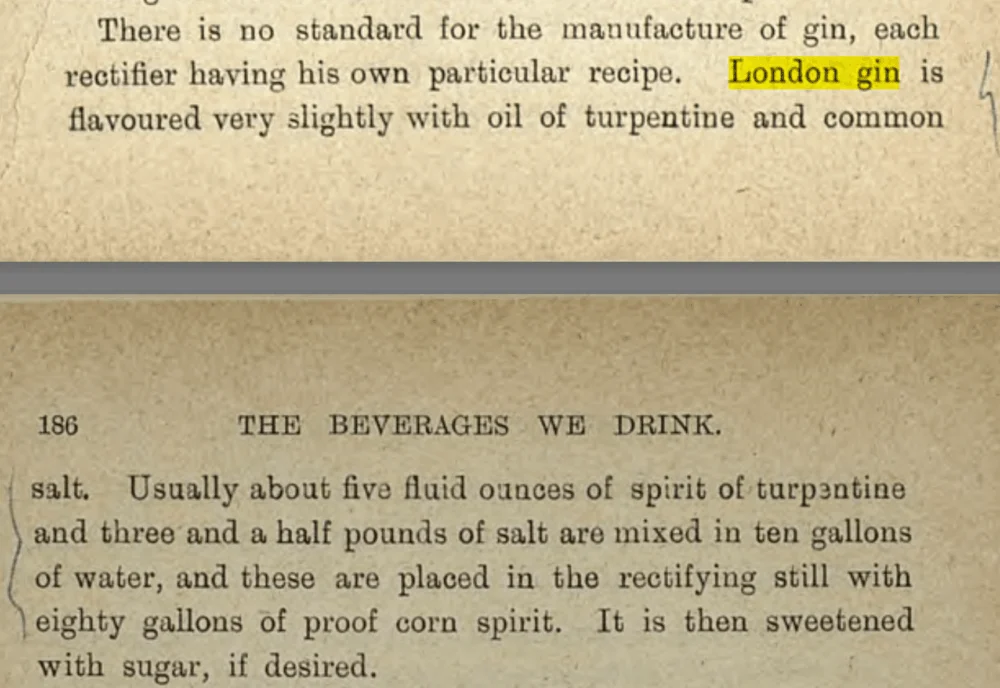
The drive toward the London Dry standard was fueled by a desperate need for consumer safety. In the late 18th and early 19th centuries, the gin industry was largely unregulated. Unscrupulous producers often added toxic substances to their spirits to simulate the "burn" of high-proof alcohol or to mask the taste of poorly distilled grain. Historical records, including the 1803 edition of The Morning Chronicle, highlight recipes for "London Gin" that included hazardous additives such as turpentine, sulphuric acid, and alum.
Turpentine was frequently used to provide a resinous, juniper-like aroma at a fraction of the cost of actual botanicals. These practices led to widespread public health crises and contributed to the social upheaval known as the "Gin Craze." The eventual adoption of the London Dry process was as much a public health initiative as it was a culinary evolution. By mandating that the flavor must be introduced through the distillation of natural botanicals with a high-quality base spirit, the industry effectively banned the post-distillation "cold compounding" of chemical flavorings that had characterized the era of "bathtub gin."

Technical Requirements and Legal Frameworks
Today, for a spirit to be labeled as London Dry Gin, it must adhere to strict regulatory requirements enforced by bodies such as the UK Food Standards Agency and the European Commission. The primary criteria include:
- Base Spirit Quality: The ethyl alcohol used must be of agricultural origin and distilled to a minimum strength of 96% ABV, ensuring nearly total neutrality.
- Botanical Integration: All flavorings must be introduced during the distillation process using traditional stills. The spirit must be distilled in the presence of natural plant materials (botanicals).
- Post-Distillation Restrictions: No flavorings (natural or artificial) can be added after the distillation process. Only water and a minute amount of sweetener are permitted.
- Sugar Content: To maintain the "Dry" designation, the final product must contain no more than 0.1 grams of sugar per liter.
- Minimum Bottling Strength: The final spirit must be bottled at no less than 37.5% ABV (though many premium brands bottle at 40% to 47% ABV to better carry the botanical oils).
These regulations ensure that the flavor profile is derived entirely from the physical interaction of the spirit vapor and the botanicals during the heat of distillation, rather than through the addition of extracts or essences.
The Global Landscape: Production Outside the Capital
Because London Dry is a process-based designation, some of the world’s most famous "London" gins are produced hundreds or even thousands of miles away from the River Thames.
One of the most notable examples is Tanqueray Gin. While Charles Tanqueray founded the distillery in Bloomsbury, London, in 1830, the production eventually moved. Today, Tanqueray is produced at the massive Cameronbridge Distillery in Fife, Scotland. Despite its Scottish home, it remains a quintessential London Dry Gin because it adheres strictly to the regulated distillation method.

Other prominent examples of global London Dry production include:
- No. 3 Gin: Though owned by the historic London merchant Berry Bros. & Rudd, this award-winning gin is distilled at De Kuyper Royal Distillers in the Netherlands.
- Astraea Meadow Gin: A high-end craft spirit produced in the United States that utilizes the London Dry method to showcase Pacific Northwest botanicals.
- Belgravia Gin: A major market player in South Africa, demonstrating the international reach of the production standard.
- Australian Distilling Co. Gin: Produced in Australia, this gin utilizes local flora while maintaining the structural integrity of the London Dry process.
Industry Analysis: The Prestige of the Label
The persistence of the word "London" in the title is a testament to the city’s historical role as the epicenter of the gin trade. During the British Empire’s peak, London-based distilleries like Beefeater, Booth’s, and Gordon’s set the global benchmark for what gin should be. By naming the process after the city, the industry effectively "branded" a set of quality controls.
For modern craft distillers, choosing to label a product as London Dry Gin is often a strategic decision to signal transparency and traditionalism. In an era where "New Western" or "Contemporary" gins frequently use post-distillation infusions and heavy sweeteners to appeal to a broader palate, the London Dry label assures the connoisseur that the spirit was made "the hard way."
Broader Implications and Future Outlook
The global success of London Dry Gin has paved the way for a broader discussion on spirit transparency. As the "gin renaissance" continues, with thousands of new distilleries opening worldwide, the London Dry standard remains the foundational pillar of the category. It provides a baseline of quality that protects consumers from the types of adulteration seen in the 19th century while allowing for creative botanical expression.

However, some industry experts suggest that the lack of geographic protection for "London" could eventually lead to consumer confusion as more regions develop their own protected styles, such as Plymouth Gin (which formerly held protected status) or various regional gins in Spain and Germany. For now, the London Dry designation stands as a unique example of a geographic term that has successfully evolved into a global technical standard, ensuring that no matter where a bottle is produced, the "London" on the label guarantees a specific, time-honored approach to the art of distillation.