

The contemporary landscape of mixology often categorizes the Purl as a straightforward combination of ale and a shot of gin, a staple of British bar culture traditionally served at cellar temperatures. While modern enthusiasts typically identify the drink by this two-ingredient profile—often utilizing a British Bitter and an Old Tom style gin—historical records reveal a lineage far more intricate than the current iteration suggests. Far from being a mere "fortified beer," the Purl originated as a botanical medicinal preparation intended to combat the bubonic plague, eventually evolving through phases as a morning constitutional, a complex spiced flip, and finally, the simplified gin-based beverage recognized today.
The transformation of the Purl reflects broader shifts in British social history, moving from the desperate medical necessities of the 17th century to the recreational excesses of the Victorian era. By examining primary sources ranging from 17th-century plague manuals to mid-20th-century bar guides, a clear trajectory emerges: the Purl is not a static recipe, but a liquid chronicle of London’s changing relationship with spirits, botanicals, and public health.
The 17th Century: Wormwood and the Plague
The earliest documented versions of the Purl bear little resemblance to the gin-centric drinks found in modern cocktail manuals. In the mid-1600s, the drink was primarily defined by the infusion of wormwood (Artemisia absinthium) into ale or wine. This bitter botanical was highly regarded for its perceived antiseptic and digestive properties.
In the 1665 publication Directions for the Prevention and Cure of the Plague Fitted for the Poorer Sort, the Purl is explicitly recommended as a prophylactic measure. The text advises the "poorer sort" of Londoners to consume "a draught or two of Purle… especially in the morning" to shield the body from the pestilence. The recommendation to the "poorer sort" indicates that the Purl was an accessible, low-cost preparation, likely utilizing common ale as a base for the bitter herb. At this stage, the "Purl" referred specifically to the infusion process—bittering the brew with wormwood—rather than the addition of distilled spirits.
This medicinal use was echoed in botanical literature of the time. The 1690 volume An English Herbal details the benefits of wormwood when consumed in a Purl, emphasizing its role in fortifying the stomach and cleansing the blood. During this era, the Purl was a functional beverage, consumed out of a sense of duty toward one’s health rather than for leisure.
Diversification and the Rise of Cider Purls
As the 17th century progressed, the concept of the Purl began to expand beyond ale. The burgeoning cider industry in England sought to capitalize on the popularity of bittered beverages. In 1684, the text Aphorisms upon the New Way of Improving Cyder argued that cider-based Purls were equal, if not superior, to those made with beer.
This diversification suggests that the term "Purl" was becoming a category of drink defined by its herbal additives rather than its base liquid. Whether the foundation was ale, wine, or cider, the common denominator remained the infusion of wormwood. This period marked the transition of the Purl from a strictly medicinal concoction to a more generalized health tonic that could be enjoyed with various fermented bases.
The 18th Century: Recreational Consumption and Social Stigma
By the early 1700s, the Purl began its migration from the apothecary to the public house. While it retained its reputation as a "morning constitutional," its consumption became increasingly recreational. This shift coincided with the "Gin Craze" in London, a period of rampant spirit consumption that led to significant social upheaval.

Historical accounts from this era, such as those found in The Grub Street Journal of September 1733, illustrate a growing social stigma surrounding the Purl. The journal describes "Purl-shops" as places of vice where smoking, gin drinking, and Purl consumption occurred simultaneously. The Purl was no longer just a plague remedy; it was now a vehicle for intoxication, frequently mentioned in disparaging character attacks against the urban poor and those deemed habitually idle.
It was during this century that distilled spirits—most notably gin—began to be integrated into the Purl. The bitter wormwood ale provided a robust base that could mask the harshness of lower-quality spirits, creating a potent mixture that contributed to the drink’s reputation as a "hard" morning beverage.
The 19th Century: The Era of the Spiced Flip
The Victorian era saw the Purl reach its peak of complexity. No longer a simple herbal infusion or a crude mixture of gin and beer, the Purl evolved into a "flip"—a category of drink characterized by the addition of eggs, sugar, and spices, often served hot.

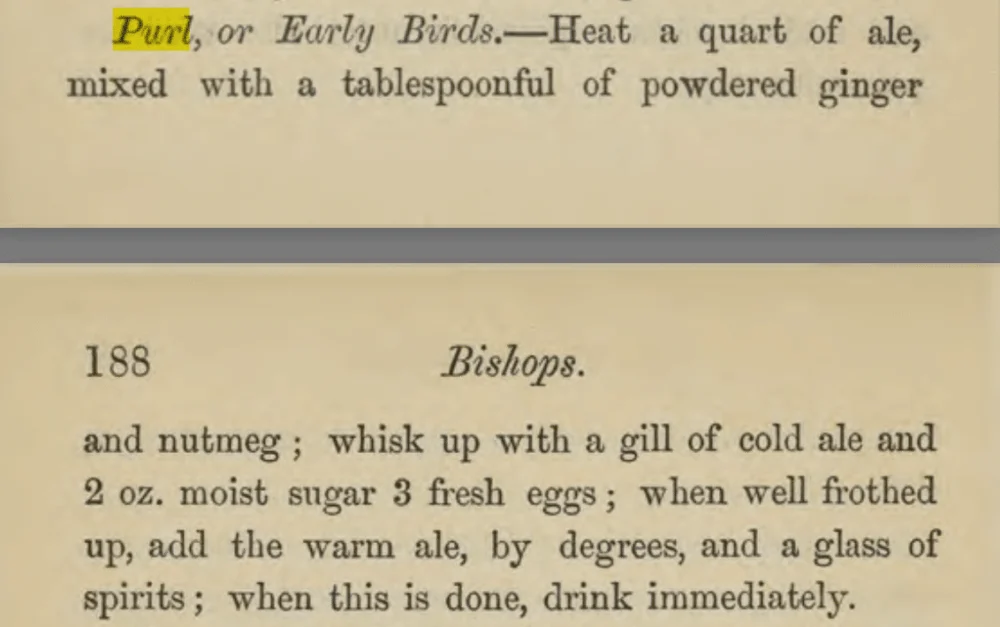
William Terrington’s 1869 volume, Cooling Cups and Dainty Drinks, which is frequently cited as the first British cocktail book, provides a window into this elaborate preparation. Terrington’s recipes for the Purl involve warming the beer and whisking in multiple eggs and spices such as ginger and nutmeg. Crucially, Terrington’s Purl did not automatically require gin; while spirits were added, the choice could range from brandy to whiskey, depending on the drinker’s preference or the barkeep’s inventory.
Terrington also documented a related drink known as the "Ale Cup." Unlike the Purl of that period, which remained somewhat fluid in its spirit base, the Ale Cup was a dedicated gin and ale mixture. This distinction is vital for understanding the eventual consolidation of the Purl’s identity; over time, the specific gin-based Ale Cup and the broader category of the Purl began to merge in the public consciousness.
The 20th Century: Simplification and the Modern Standard
As the 20th century dawned, the Purl underwent a process of radical simplification. The labor-intensive "flip" elements—the eggs, the constant whisking, and the heavy spice profiles—began to disappear from standard bar manuals. The use of wormwood, once the defining characteristic of the drink, also fell into obsolescence, replaced by the more standardized commercial bitters that were becoming staples of the modern bar.

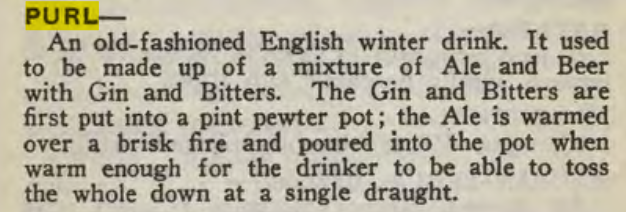
By the mid-1920s, publications like Summer Drinks and Winter Cordials (1925) began to present the Purl in a form that modern drinkers would recognize: a combination of ale, gin, and bitters. While the practice of warming the ale persisted for several decades, the ingredient list had been streamlined.
In 1935, The Art of Mixing Drinks further solidified this transition, presenting the Purl as a straightforward mixture where gin was the canonical spirit. By the time The Barman’s Bible (1966) was published, the Purl had been codified as a simple, cold-weather beverage consisting of ale fortified with gin. The complex history of the drink as a medicinal tonic and a spiced egg flip had been largely erased, leaving behind the "shot in a beer" format that survives today.
Chronology of the Purl’s Development
- 1665: Mentioned in Directions for the Prevention and Cure of the Plague as a morning remedy for the poor.
- 1684: Expansion of the category to include cider-based Purls in Aphorisms upon the New Way of Improving Cyder.
- 1690: Documented in An English Herbal as a digestive and blood-cleansing tonic.
- 1733: Described in The Grub Street Journal as a recreational drink associated with "Purl-shops" and social vice.
- 1869: William Terrington’s Cooling Cups and Dainty Drinks documents the Purl as a complex, heated egg flip with variable spirits.
- 1925: Summer Drinks and Winter Cordials shows the removal of eggs but the retention of warming techniques and bitters.
- 1935: The Art of Mixing Drinks establishes gin as the primary spirit for the Purl.
- 1966: The Barman’s Bible codifies the modern, simplified recipe of ale plus gin.
Technical Composition and Ingredients
To understand the Purl’s evolution, one must look at the specific ingredients that defined its various stages:

- The Base (Ale/Cider): Historically, "British Bitter" or "Mild" ales were used. These were top-fermented beers with a significant malt profile that could stand up to the bitterness of wormwood or the heat of a loggerhead (a red-hot poker used to heat the drink).
- The Bittering Agent (Wormwood): Artemisia absinthium provided a sharp, medicinal bitterness. In modern versions, this is often substituted with Angostura or orange bitters, though some craft bartenders are returning to wormwood-infused syrups to honor the drink’s roots.
- The Spirit (Gin): The transition to Old Tom gin in the 19th century was significant. Old Tom is sweeter than London Dry gin, making it an ideal bridge between the bitter ale and the spices used in the flip versions.
- The Emulsifiers (Eggs/Sugar): During the Victorian era, eggs were used to create a creamy, frothy texture, turning the Purl into a substantial, meal-like beverage.
Analysis of Implications and Social Impact
The history of the Purl offers a fascinating glimpse into the evolution of urban life in London. The drink’s journey from a plague-time necessity to a "morning constitutional" for laborers suggests a society where alcohol was deeply integrated into daily functionality. The Purl-man, a street vendor who sold the warmed mixture to dockworkers and early-morning laborers, was a fixture of the London landscape well into the 19th century.
The eventual simplification of the Purl in the 20th century reflects the broader "Americanization" of cocktail culture, where speed and consistency began to take precedence over the ritualistic and time-consuming preparations of the Victorian era. The loss of the egg and the warming process transformed the Purl from a communal, prepared bowl drink into a quick, individual fortification.
Today, the Purl is seeing a minor resurgence among cocktail historians and craft beer enthusiasts. This revival often seeks to re-incorporate the lost elements—wormwood and heat—reminding modern drinkers that the Purl was once more than just a fortified ale; it was a bitter, complex shield against the hardships of London life. As contemporary bars continue to explore historical recipes, the Purl stands as a testament to the fluid nature of "tradition" in the world of spirits.
